
A farmer pretended to be poor to find a wife… but only the most despised woman truly loved him
In the quiet farming town of Willow Creek, where gossip traveled faster than the wind across wheat fields, everyone knew Samuel Carter.
Or at least, they thought they did.
To most, Samuel was just another struggling farmer—thin, quiet, always dressed in worn denim and patched boots. His small, aging farmhouse leaned slightly to one side, its paint long surrendered to time. His fields looked modest, even neglected, compared to the sprawling lands owned by wealthier men nearby.
Women weren’t exactly lining up for him.
But what no one in Willow Creek knew was that Samuel Carter wasn’t poor—not even close.
His father, a shrewd businessman, had left him vast acres of fertile land hidden under different ownership names, savings in banks across the state, and investments that quietly grew year after year. Samuel could have lived in luxury, worn tailored suits, and married into wealth.
But he had seen what money did to people.
He had watched his father’s so-called friends circle like vultures, had seen women smile too sweetly at him once they learned his last name carried weight. He had witnessed love twisted into transaction, affection measured in dollars.
So Samuel made a decision.
He would find a woman who loved him—not his money.
And to do that, he became someone else.
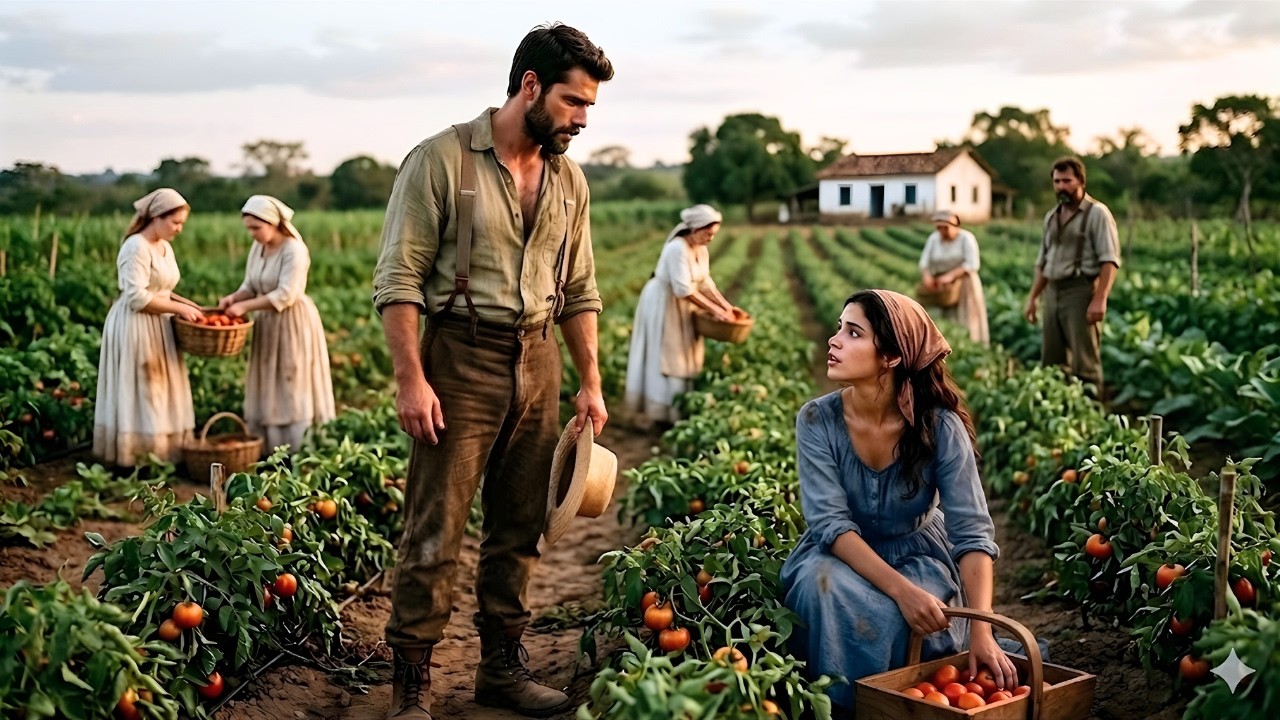
At twenty-nine, Samuel announced to the town that he was looking for a wife.
He did it plainly—no grand gestures, no advertisements beyond a simple notice at the general store:
“Farmer seeking honest woman for marriage. Modest life. Hard work. Serious intentions only.”
It didn’t take long for the first wave to arrive.
They came in dresses too clean for farm work, smiles too polished to be sincere.
Some tried to hide their disappointment when they saw his house.
Others didn’t bother.
“I thought you said you had land,” one woman said bluntly, looking around at the small fields.
“I do,” Samuel replied calmly.
“This? This is barely anything.”
She left before sunset.
Another stayed longer—two days—but complained about everything: the food, the chores, the lack of comfort.
“You expect a wife to live like this?” she scoffed.
Samuel simply nodded.
She was gone the next morning.
Weeks turned into months.
Dozens of women came and went. Some kind, some cold, most uninterested the moment they realized Samuel’s life offered no luxury, no ease, no promise of status.
Word spread quickly.
“Samuel Carter’s desperate,” people whispered.
“Or foolish.”
“Who’d marry a man like that?”
Eventually, the visits stopped altogether.
No one wanted a poor farmer with nothing to offer.
No one… except her.
Her name was Clara Whitmore.
And in Willow Creek, she was known for all the wrong reasons.
“Too big.”
“Too plain.”
“Too quiet.”
Men avoided her. Women pitied her—or worse, mocked her behind soft smiles.
At thirty-two, Clara had long stopped expecting kindness, let alone love.
She worked at the town bakery, kneading dough before dawn, her hands strong and capable. She spoke little, laughed rarely, and kept her eyes lowered when people passed.
She had learned, over time, that the world had already decided her worth.
It wasn’t much.
One rainy afternoon, Clara stood in front of the notice at the general store.
She had seen it before, weeks ago. Ignored it. Then thought about it. Then tried to forget it.
But something about it lingered.
Honest woman.
Not beautiful. Not charming.
Honest.
Her fingers tightened around the folded cloth in her hand.
“This is foolish,” she whispered to herself.
And yet… she walked.
Samuel was repairing a fence when he saw her approach.
At first, he assumed she was lost.
Clara’s dress was simple, slightly damp from the rain, her hair pulled back loosely. She hesitated a few steps away, as if reconsidering every breath.
“Can I help you?” Samuel asked, setting his tools aside.
Clara swallowed.
“I… I saw your notice.”
Samuel’s brow lifted slightly.
It had been weeks.
“I came about… the marriage.”
He studied her quietly.
She didn’t meet his eyes.
“You understand what I’m offering?” he asked.
“Yes.”
“It’s not easy. There’s work. Long days. Little comfort.”
“I know.”
“And no guarantee of… anything beyond that.”
Clara nodded.
“I’m not here for guarantees.”
That caught his attention.
“Then why are you here?”
For a moment, she said nothing.
Then, softly:
“Because I don’t think anyone else will ask me.”
The honesty struck him harder than any rehearsed charm ever could.
Clara stayed.
Not because Samuel asked her to.
But because she didn’t leave.
The first morning, she woke before him and started working in the kitchen—clumsy at first, unfamiliar with his sparse supplies, but determined.
She didn’t complain about the cold floors, the simple meals, or the endless chores.
She worked.
And worked.
And worked.
Samuel watched quietly.
He had seen effort before—but never like this.
Clara didn’t perform for approval. She didn’t try to impress him. She simply did what needed to be done, as if her place there depended on it.
Maybe it did.
Days turned into weeks.
Something changed.
The house, once dull and quiet, began to feel… alive.
Clara hummed softly while she worked—never loudly, never for attention. She fixed things Samuel hadn’t noticed were broken. She planted small flowers near the porch, though she never mentioned them.
She laughed once, unexpectedly, when Samuel nearly dropped a bucket of water.
The sound startled both of them.
It was soft. Real.
Samuel found himself thinking about it long after.
One evening, as the sun dipped low over the fields, Samuel sat beside Clara on the porch.
“You haven’t asked me anything,” he said.
Clara looked at him, puzzled.
“About what?”
“About my past. My plans. Why I’m doing this.”
She shrugged slightly.
“You’d tell me if you wanted to.”
“And if I don’t?”
“Then it’s yours to keep.”
Samuel studied her carefully.
“Most people want more.”
Clara gave a small, almost sad smile.
“I’ve learned not to.”
The truth pressed against his chest.
He had expected greed, impatience, disappointment.
But Clara… wanted nothing.
Not his money.
Not his secrets.
Just… a place.
A chance.
And somehow, that made him uneasy.
Because for the first time, Samuel realized something dangerous:
He wanted her to want him.
Weeks later, the town began to notice.
“Clara Whitmore moved in with Samuel Carter,” people whispered.
“Desperate, both of them.”
“Guess they deserve each other.”
Clara heard the comments.
She always did.
But she said nothing.
Samuel, however, felt something unfamiliar rise in his chest.
Anger.
One afternoon, they went into town together.
At the bakery, Clara’s former coworkers exchanged glances.
“Well,” one woman said with a smirk, “looks like you found someone.”
Clara stiffened.
Samuel stepped forward.
“Yes,” he said calmly. “I did.”
The room fell quiet.
“And I’d say I’m the lucky one.”
Clara looked at him, stunned.
No one had ever said something like that—especially not about her.
That night, Samuel couldn’t sleep.
The truth weighed heavily on him.
Every day he waited felt like a betrayal.
She had given him honesty.
He had given her a lie.
The next morning, he made a decision.
“Clara,” he said, standing in the doorway, “I need to show you something.”
She followed him without question.
They walked past the small fields… then further… beyond what she had ever seen him tend.
And then—
She stopped.
Stretching before them were vast acres of rich farmland, golden under the morning sun. Barns stood tall in the distance, well-kept and sturdy. Workers moved about, tending to crops and livestock.
Clara stared, confused.
“Whose land is this?” she asked.
Samuel took a breath.
“It’s mine.”
Silence.
“I never lost it,” he continued. “I never struggled the way I said I did. I… hid it.”
Clara’s face didn’t change.
“I wanted to know if someone could love me without it,” he said. “Without… all of this.”
Still, she said nothing.
“I lied to you,” he finished quietly. “And I understand if you want to leave.”
The wind moved gently through the fields.
Finally, Clara spoke.
“Do you still want me here?”
Samuel blinked.
“What?”
“Now that you know I’m not leaving for your money,” she said, her voice steady. “Do you still want me?”
“That’s not—of course I do.”
“Then nothing’s changed.”
He stared at her.
“You’re not angry?”
Clara considered the question.
“I’ve been lied to before,” she said softly. “Usually, it’s to make me feel like less.”
She met his eyes.
“You lied because you were afraid no one would love you.”
A pause.
“I understand that.”
Samuel felt something in his chest break open.
They were married a week later.
Not in a grand ceremony.
Just a small gathering, under the same sky that had watched them grow closer.
The town was shocked.
Then envious.
Then quiet.
Because the truth became impossible to ignore.
Samuel Carter, the man who had everything, chose the woman no one wanted.
And in return, she gave him the one thing money never could buy.
Real love.
Years later, their home stood strong—not just in wealth, but in warmth.
Laughter filled the halls.
Flowers bloomed where Clara had first planted them.
And Samuel, once so afraid of being loved for the wrong reasons, finally understood something simple:
The right person doesn’t see your worth in what you own.
They see it in who you are—when you have nothing left to offer but your truth.
And sometimes…
That person is the one the world overlooked.
Marriage didn’t change Clara overnight.
If anything, it revealed just how deeply the past had settled inside her.
Even after Samuel told her the truth—after he showed her the land, the workers, the quiet fortune hidden behind years of careful disguise—Clara still woke before dawn, still wore the same simple dresses, still moved through the house as though she were borrowing someone else’s life.
Samuel noticed.
At first, he thought it was humility.
Then he realized—it was fear.
One morning, he found her in the kitchen, scrubbing an already spotless table.
“You don’t have to do everything yourself,” he said gently.
Clara didn’t look up.
“I know.”
“Then why do you?”
She hesitated, her hands slowing.
“Because if I stop… I might not belong here anymore.”
The words landed harder than Samuel expected.
“Clara,” he said, stepping closer, “this is your home.”
She gave a faint smile, but it didn’t reach her eyes.
“It feels like yours.”
Samuel began making changes—not to impress her, but to include her.
He introduced her to the workers, not as someone who needed to earn her place, but as his wife.
At first, Clara struggled.
She stumbled over words, avoided eye contact, and flinched at even the smallest attention.
But slowly, something shifted.
One of the older workers, Mrs. Hargrove, took a liking to her.
“You’ve got good hands,” the woman said one afternoon, watching Clara tend to a batch of seedlings. “Steady. Careful.”
Clara blinked in surprise.
“Thank you.”
It was such a small exchange.
But it stayed with her.
Still, not everyone was kind.
When word spread beyond Willow Creek that Samuel Carter was far wealthier than anyone had known, curiosity turned into judgment.
And Clara became the target.
“She tricked him.”
“She must’ve known.”
“Men like that don’t marry women like her without a reason.”
The whispers found their way back, as they always did.
Clara heard them at the market.
At the church.
Even in passing glances that lingered too long.
One evening, she sat quietly on the porch, her hands folded tightly in her lap.
Samuel joined her.
“You’re quieter than usual,” he said.
She didn’t respond right away.
“Do you ever regret it?” she asked finally.
“Regret what?”
“Choosing me.”
The question hit him like a sudden storm.
“Never.”
“But you could have had someone…” she struggled for the word, “…better.”
Samuel turned toward her fully.
“Better than what?”
Clara looked down.
“Better than me.”
There it was again—that quiet, unshakable belief.
Samuel exhaled slowly.
“Clara,” he said, “do you know why I pretended to be poor?”
She nodded slightly.
“To find someone who loved you for who you are.”
“Yes. And do you know what I found instead?”
She glanced at him, uncertain.
“I found someone who doesn’t believe she deserves to be loved at all.”
Her breath caught.
“That’s not—”
“It is,” he said gently, not accusing, just certain. “And no amount of land, or money, or time is going to change that unless you let it.”
Clara’s eyes filled, but she blinked the tears away.
“I don’t know how,” she whispered.
Samuel reached for her hand.
“Then we’ll figure it out together.”
The turning point came sooner than either of them expected.
Late one afternoon, a young woman arrived at their property.
She looked nervous—thin, pale, her clothes worn from travel.
Samuel recognized the look immediately.
Hope mixed with desperation.
“I saw the notice,” she said, clutching a crumpled piece of paper.
Samuel exchanged a glance with Clara.
“I’m sorry,” he said kindly. “That was… some time ago.”
The woman’s face fell.
“Oh.”
Silence stretched awkwardly.
Then Clara stepped forward.
“Are you looking for work?” she asked.
The woman blinked.
“I… yes. I can cook. Clean. Anything.”
Clara nodded.
“We could use help.”
Samuel watched quietly.
Her name was Lila.
She stayed.
And in Lila, Clara saw something painfully familiar.
The hesitation.
The quiet apologies.
The way she made herself smaller, as if trying not to take up space.
One evening, Clara found her crying softly behind the barn.
“What happened?” Clara asked.
Lila wiped her face quickly.
“Nothing.”
Clara sat beside her.
“You can tell me.”
Lila hesitated.
“People always leave,” she said finally. “Or they don’t want me to stay.”
Clara felt something tighten in her chest.
“I thought if I worked hard enough… maybe someone would choose me.”
The words echoed too closely.
Clara looked at her—really looked.
And for the first time, she saw herself… as she used to be.
That night, Clara couldn’t sleep.
She thought about everything Samuel had said.
About the way she still felt like she didn’t belong.
About how easily she believed the worst things people said about her.
And then she thought about Lila.
How she had spoken those same fears out loud.
How Clara had immediately wanted to tell her she was wrong.
That she was worth something.
That she deserved to be chosen.
The realization came quietly.
But it was undeniable.
If she could believe that about Lila…
Why couldn’t she believe it about herself?
The next morning, Clara did something she had never done before.
She stood in front of the mirror.
Really stood.
No rushing.
No looking away.
She studied her reflection—the softness of her features, the strength in her shoulders, the quiet steadiness in her eyes.
For years, she had only seen what others told her was there.
Now, she tried to see something else.
Not perfection.
Not beauty, as the town defined it.
But… truth.
“I’m still here,” she whispered.
“And that has to mean something.”
Change didn’t happen all at once.
But it started.
Clara began to speak more—first with Lila, then with the workers, then even in town.
She stopped apologizing for things that didn’t need apologies.
She laughed more freely.
She stood a little taller.
And slowly, the way people saw her began to shift.
Not because she had changed into someone else.
But because she had finally stopped trying to disappear.
One afternoon, as Clara walked through the market, she heard a familiar voice.
“Well, look at you.”
It was one of the women who had mocked her before.
Clara turned.
“Yes?”
The woman hesitated, clearly thrown off by her calm.
“You’ve… changed.”
Clara smiled slightly.
“No,” she said. “I’ve just stopped agreeing with you.”
That evening, Samuel found her in the garden, surrounded by blooming flowers.
“You seem different,” he said.
Clara looked up at him, sunlight catching in her hair.
“I think I am.”
He studied her for a moment.
“What happened?”
She considered the question.
“I realized something,” she said. “I’ve spent my whole life waiting for someone to decide I was worth loving.”
She stood, brushing dirt from her hands.
“But you already did.”
Samuel smiled softly.
“That was the easy part.”
Clara stepped closer.
“Loving you was the easy part for me too.”
She took his hand.
“The hard part… was learning to love myself enough to believe you.”
Years passed.
Their farm thrived—not just in crops and wealth, but in people.
They took in workers who needed a second chance.
Offered shelter to those with nowhere else to go.
Not out of charity alone—but because they understood what it meant to feel unwanted.
Lila stayed, growing stronger, more confident.
Eventually, she found her own path—one built not on desperation, but on choice.
And Clara…
Clara became someone the town no longer whispered about.
Not because she fit their standards.
But because she had outgrown them.
One quiet evening, Samuel and Clara sat on the porch, watching the sun dip below the fields.
“Do you ever think about how it started?” Samuel asked.
Clara smiled.
“All the time.”
“A poor farmer,” he said.
“And a woman no one wanted,” she added.
He squeezed her hand.
“Funny how wrong they were.”
Clara leaned her head against his shoulder.
“They weren’t wrong about what they saw,” she said softly.
“They were wrong about what it meant.”
Samuel looked at her, curious.
Clara’s smile deepened.
“Being overlooked doesn’t make you worthless,” she said.
“Sometimes… it just means the right person hasn’t seen you yet.”
And as the last light faded over Willow Creek, they sat in the quiet certainty of something rare and unshakable—
A love that had nothing to do with what the world valued.
And everything to do with what it almost missed.