
They Forced the “Old Maid” on the Lonely Mountain Man — But She Had Always Been His SECRET Desire…
The wind rolled down from the mountain in a low, restless sigh, stirring dust along the packed earth of the village square. It carried the scent of pine, woodsmoke, and the faint bite of winter not yet gone. The townsfolk had gathered in a tight circle, boots scraping, shoulders hunched in rough coats. No one spoke above a murmur—except the old man in black.
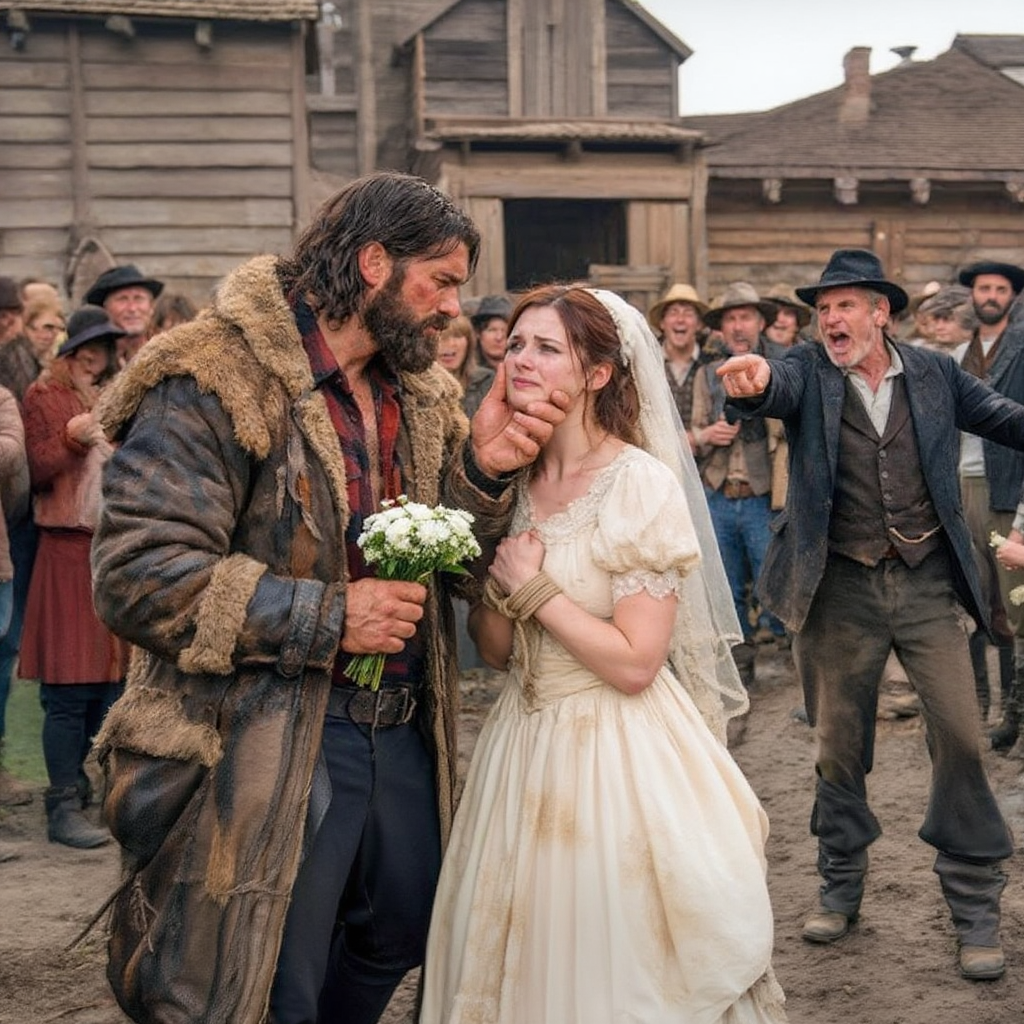
“You’ll take her,” he barked, jabbing a crooked finger toward the woman. “You live alone, you need a wife, and she’s long past being chosen. This settles both problems.”
The crowd shifted uneasily.
At the center of it all stood Elias Mercer.
Tall, broad-shouldered, and wrapped in a heavy fur-lined coat, he looked like a piece of the mountain itself—silent, weathered, immovable. His dark hair fell to his collar, and a thick beard framed a mouth that rarely smiled. Snowmelt still dampened the hem of his coat from his descent that morning. In one hand, he held a small bouquet of white flowers—early mountain blooms, delicate and out of place against his rough fingers.
With the other, he lifted the woman’s chin.
She flinched.
Clara Whitmore stood stiffly beside him, her wrists bound with rope in front of her. The off-white lace of her wedding dress looked borrowed, slightly too large at the shoulders. Her reddish-brown hair had been hastily pinned, loose strands clinging to her pale cheeks. Her eyes were wide, shimmering with fear and humiliation.
The older man—Sheriff Dalton—leaned forward again, voice sharp as a whip. “You’ve lived up there ten years, Mercer. Never once asked for help. Never once come down for anything but supplies. Well, now the town’s asking something of you.”
Elias didn’t answer. He studied Clara’s face instead, his thumb brushing lightly beneath her jaw. She stiffened, but didn’t pull away—she couldn’t.
Someone in the crowd muttered, “Old maid’s lucky anyone’ll take her.”
Another voice added, “Better than starving alone.”
Clara closed her eyes for a moment.
She had heard those words before. For years.
Old maid. Too quiet. Too plain. Too old.
At twenty-eight, she was already considered a burden. Her father dead, her brother gone west, and no man willing to claim her, the town had decided for her. The lonely mountain man needed a wife. She needed a place to go.
That was how it was done.
Elias tilted her chin slightly higher. His dark eyes searched hers—not cold, not cruel, but unreadable. The white flowers trembled faintly in his other hand.
Sheriff Dalton snapped, “Well? Speak up, Mercer. You’ll take her or not?”
A long silence followed.
The wind shifted again. A board creaked somewhere. A horse snorted.
Finally, Elias spoke, his voice low and rough from disuse.
“I’ll take her.”
The crowd exhaled as one.
Clara’s breath caught.
Sheriff Dalton grinned, satisfied. “Good. Then it’s settled. You’re wed today. No sense delaying.”
Clara turned her head slightly, but Elias’s hand gently steadied her. His grip wasn’t tight—just firm enough to keep her facing him.
“You’re afraid,” he murmured, so quietly only she heard.
Her lips trembled. “Wouldn’t you be?”
His thumb brushed her cheekbone. “No.”
She frowned faintly.
Because she noticed something strange then.
He wasn’t looking at her like a man forced into marriage.
He was looking at her like he had already chosen.
—
Years earlier, Clara had first seen him in winter.
She had been twenty-one, carrying a basket of laundry behind her father’s store, when the door opened and a blast of cold air swept in. The man who entered seemed carved from snow and shadow. His coat was dusted white, his beard rimmed with frost, and he walked with the quiet heaviness of someone used to steep slopes and long silence.
He set coins on the counter. “Flour. Salt. Coffee.”
That was all.
He didn’t look at anyone. Didn’t speak again. Didn’t linger.
But as he turned to leave, he paused.
Just for a second.
His eyes flicked toward Clara.
She froze, basket in her hands.
Then he was gone.
She didn’t know why that moment stayed with her. Perhaps because no one ever looked at her twice. Perhaps because his gaze had been steady—not dismissive, not polite—just… noticing.
He came twice a year after that.
Always in winter. Always quiet.
Each time, she found herself watching from the doorway, pretending to sweep or sort crates. Each time, he left without a word. But once, she found something strange: a sprig of white flowers placed beside the store door.
Mountain blooms.
No one claimed them.
She took them home.
The next winter, it happened again.
And again.
She never knew why.
—
Now, standing in the square, Clara stared at the bouquet in his hand.
The same flowers.
Her heart stumbled.
“You…” she whispered, barely audible.
Elias leaned closer. “Yes.”
Her eyes widened.
He knew.
All those years.
Before she could speak, Sheriff Dalton clapped his hands. “Untie her. They’ll walk to the chapel.”
A woman stepped forward and cut the rope binding Clara’s wrists. The marks remained, red and raw. Elias immediately shifted, gently taking her hands in his large ones, rubbing warmth into her fingers.
The crowd murmured again—some surprised, some amused.
“Look at that,” someone whispered. “He’s gentle.”
Clara tried to pull back slightly, but his grip softened, not tightening. “You don’t have to be afraid of me,” he said quietly.
“You don’t know me,” she replied.
His mouth curved faintly. “I know enough.”
The chapel stood at the edge of the square—a small wooden building with warped boards and a crooked steeple. The walk there felt longer than it was. Every step echoed in Clara’s chest.
Inside, the preacher waited, already informed. No music. No guests beyond those who had followed. No ceremony beyond necessity.
Clara stood beside Elias, hands trembling.
“Do you take—” the preacher began.
Elias answered before Clara could breathe. “I do.”
The preacher turned to her.
Clara swallowed. The room blurred. Her whole life seemed to hang in that moment—fear, shame, loneliness.
Then she remembered the flowers.
Every winter.
Every year.
Someone had chosen her, silently, long before the town forced it.
“I… do,” she whispered.
The preacher nodded. “Then you are husband and wife.”
It was done.
Too quickly.
Too quietly.
Too real.
—
They left the village before sunset.
Elias had brought a sturdy horse and a small wagon. He helped Clara up carefully, as if she might break. The townsfolk watched, some relieved, some curious.
Sheriff Dalton tipped his hat. “Good luck to you both.”
Elias didn’t reply.
The mountain path began just beyond the last cabin. Snow lingered in shaded patches. Pines closed around them, muting the world.
For a long while, they rode in silence.
Finally, Clara spoke. “Why?”
Elias glanced at her. “Why what?”
“Why did you leave those flowers?”
He didn’t answer immediately. The wagon wheels creaked over stone.
“I saw you,” he said at last. “Years ago. Behind the store.”
She waited.
“You looked… lonely. Like you were always watching others leave.”
Her throat tightened.
“I wanted to say something,” he continued. “But I don’t speak well. Never did.”
“So you left flowers?”
He nodded once. “Figured you’d know someone saw you.”
Tears blurred her vision.
“You never spoke to me,” she said.
“I thought you deserved a better man than one who lives in the mountains.”
She laughed weakly. “No one else thought so.”
He looked at her then—fully. “I did.”
They rode on.
The sun dipped low, painting the snow gold. The air grew colder.
“Were you… angry?” she asked. “When they forced this?”
Elias shook his head. “No.”
“Why?”
His voice softened. “Because I’ve wanted you for years.”
Clara stared at him.
The wagon rolled to a stop near a clearing. A cabin stood there—solid, built of thick logs, smoke curling from the chimney. Snowmelt dripped from the roof. The place looked warm, lived-in, safe.
Elias climbed down and helped her gently. She hesitated at the door.
“This is your home now,” he said.
She stepped inside.
The cabin surprised her. Clean. Orderly. A quilt folded neatly. Shelves stocked. A small table set with two cups.
Two.
Her chest tightened again.
“You expected someone,” she said quietly.
He looked embarrassed. “I hoped.”
Clara turned toward him slowly.
“You weren’t forced,” she realized.
“No.”
“You chose.”
“Yes.”
Silence filled the room.
Then she did something neither of them expected.
She stepped forward and took the flowers from his hand.
“They were always my favorite,” she whispered.
He watched her, unsure.
She placed them in a small jar by the window.
Then she turned back, meeting his eyes—not afraid now, just uncertain.
“We should… start somewhere,” she said.
He nodded.
“Dinner?” he offered.
She smiled faintly. “Dinner.”
Outside, the wind quieted. Snow began to fall again—soft, gentle, covering the tracks from the village below.
The mountain man had not been forced.
And the “old maid” had never truly been unwanted.
They had simply been waiting—for the world to step aside long enough for them to finally see what had always been there.