
They Laughed at the Boy at the Auction… Then Something Changed Everything
The laughter started before the boy even reached the table.
It rolled through the barn in low waves—quiet snickers at first, then louder chuckles, and finally open amusement that echoed off the corrugated metal roof. The sound bounced between the wooden rafters and settled like dust over the gravel floor.
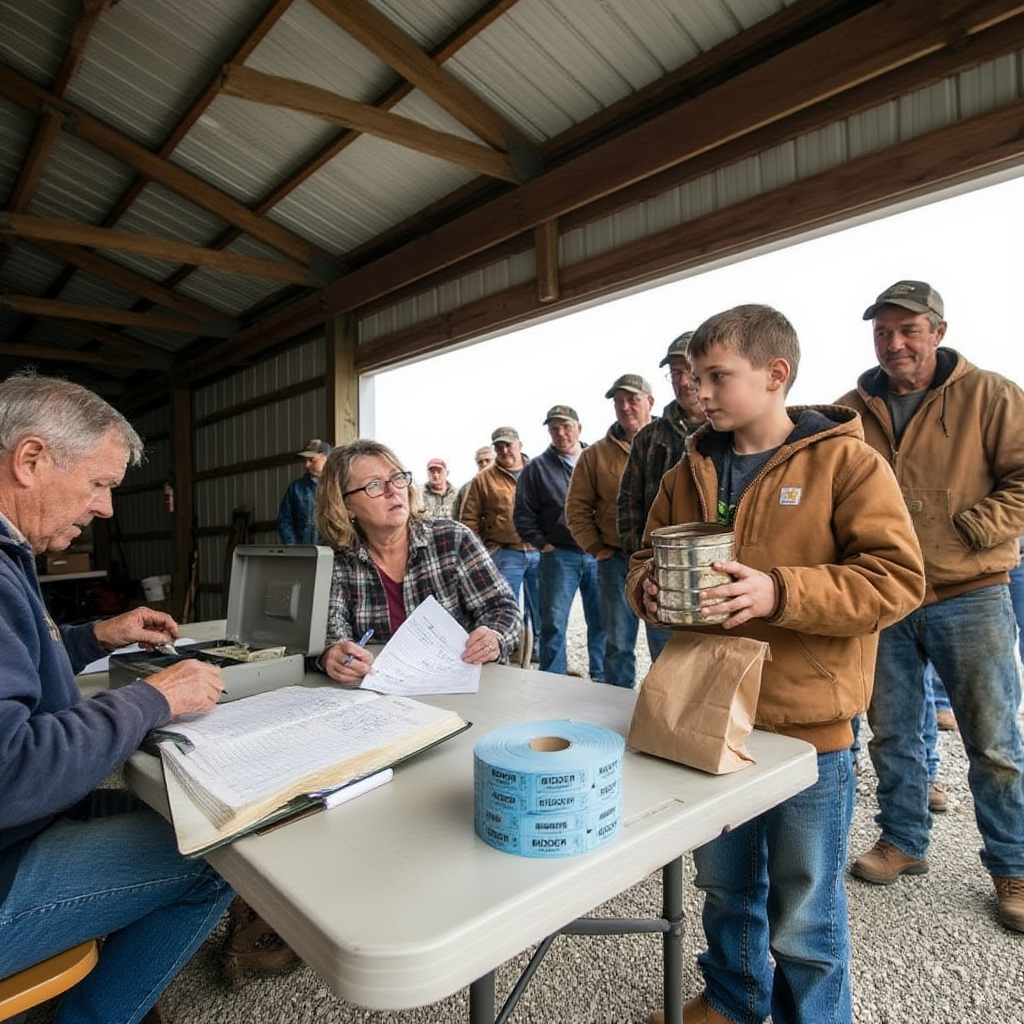
The auction had already been going for an hour. Folding chairs filled the center aisle, and families stood shoulder to shoulder along the sides. The smell of hay, machine oil, and coffee hung in the air. A hand-painted banner reading COUNTY FALL BENEFIT AUCTION drooped slightly from one beam.
At the white folding table near the front, Harold Benton wrote carefully in his ledger, his thick glasses sliding down his nose. He’d run this benefit auction for nearly twenty years. Beside him, Linda Foster shuffled stacks of bidder forms and handed out blue tickets labeled “BIDDER.” A brown paper bag held cash from early sales—pies, tool sets, quilts, and an old tractor seat someone swore came from 1948.
“Next item?” Linda asked.
Harold didn’t look up. “Whatever’s waiting.”
There was a pause.
Linda glanced toward the side entrance, and that’s when she saw him.
The boy stood just inside the wide barn doors, small and still, wearing a brown jacket that looked two sizes too big. He held something in both hands—metal, dull, and oddly shaped. For a moment, he didn’t move, as if deciding whether to turn back.
“Is that…?” Linda murmured.
Harold followed her gaze. “Looks like someone’s kid.”
The boy walked forward slowly, boots crunching gravel. People shifted to make space, and whispers followed him. He couldn’t have been older than ten. His hair needed cutting, and one sleeve of his jacket was frayed. He clutched the metal object like it might disappear if he loosened his grip.
When he reached the table, he stopped.
Harold waited.
“Yes?” he asked gently.
The boy lifted the object. It was an old metal sifter—handmade, uneven mesh nailed into a circular frame. The handle had been replaced with a bent piece of wood, smoothed by use.
“I… I brought something,” the boy said.
Linda blinked. “For the auction?”
He nodded.
Behind them, someone chuckled.
Another voice whispered, “What is that, a kitchen strainer?”
More laughter followed.
The boy’s ears turned red, but he didn’t step back.
Harold leaned forward, studying the sifter. “You make this?”
“Yes, sir.”
“For what?”
The boy swallowed. “Panning. For gold… or gravel sorting. It works.”
That brought louder laughter.
“Gold?” someone called from the crowd.
“Kid thinks he’s gonna strike it rich!”
A few people clapped sarcastically.
Linda frowned, but she didn’t interrupt.
Harold tapped his pen against the ledger. “What’s your name, son?”
“Ethan.”
“Last name?”
“Walker.”
Harold paused. The name stirred something faintly familiar.
“You want us to auction this?” Harold asked.
Ethan nodded again. “For the benefit.”
The barn quieted slightly. Even the laughter softened. The benefit was for the Miller family, whose farmhouse burned down two weeks earlier. Everyone in the county had brought something to help.
Harold looked at Linda. She gave a small shrug.
“Well,” Harold said, clearing his throat, “we don’t turn away donations.”
He wrote slowly: Handmade metal sifter — Donated by Ethan Walker.
Linda handed the boy a small paper number. “You’re officially in.”
Ethan held the slip carefully, as if it were valuable.
“Thank you,” he said.
He stepped aside, but the whispers followed him.
“Who’s Walker?”
“Don’t know.”
“Looks like junk.”
“Probably scrap metal.”
The auctioneer, Tom Redding, climbed onto the wooden pallet that served as a stage. He adjusted his cap and flipped through the list Harold handed him.
“All right, folks,” Tom called, voice booming. “We got ourselves a handmade metal sifter, donated by… Ethan Walker.”
A few people laughed again.
Tom held up the sifter. “Who’ll give me five dollars?”
Silence.
“Two dollars?”
Still silence.
Ethan stood near the side, staring at the gravel.
Tom smiled politely. “One dollar?”
A man near the back raised his hand lazily. “I’ll give a buck for scrap.”
Tom pointed. “One dollar—do I hear two?”
Another voice called, “I’ll give two just to help the kid.”
“Two dollars—do I hear three?”
The bidding slowed. Not real bidding—more like pity.
Ethan gripped the edge of his jacket.
Tom lifted the sifter higher. “Three dollars? Anyone?”
The barn seemed ready to move on.
Then a voice spoke from the far side.
“Ten.”
Heads turned.
It was Caleb Morgan, who owned the old quarry outside town. He stood with arms crossed, expression unreadable.
Tom blinked. “Ten dollars?”
Caleb nodded once.
A murmur rippled through the crowd.
“Do I hear fifteen?” Tom called, suddenly energized.
A woman raised her hand. “Fifteen.”
Tom grinned. “Fifteen—do I hear twenty?”
Caleb lifted his chin. “Twenty.”
Now people leaned forward.
“Twenty-five?” Tom called.
A man near the aisle shrugged. “Twenty-five.”
The laughter was gone now. Something else filled the space—curiosity.
Ethan looked up.
Tom’s voice grew louder. “Thirty?”
Caleb again. “Thirty.”
The woman countered. “Thirty-five.”
Tom’s cadence quickened. “Forty?”
Caleb didn’t hesitate. “Forty.”
Someone whistled softly.
Ethan’s mouth parted slightly.
“Forty-five?” Tom asked.
The woman hesitated… then shook her head.
Tom scanned the crowd. “Forty dollars—going once… going twice…”
He raised his hand.
“Sold!”
The barn broke into scattered applause.
Ethan stood frozen.
Tom handed the sifter to Caleb, who walked forward and placed forty dollars into the brown paper bag. Then he turned—not toward the exit, but toward Ethan.
“Kid,” he said quietly, holding out the sifter.
Ethan blinked. “Sir?”
“You keep it.”
“I… but you bought it.”
Caleb nodded. “Yeah. And I’m giving it back.”
The boy hesitated before taking it. “Why?”
Caleb studied him. “Because you made it right.”
Ethan looked down at the sifter.
Caleb leaned closer. “Where’d you learn to build that?”
“My dad,” Ethan said softly.
Caleb’s expression shifted. “Walker… Your dad was Daniel Walker?”
Ethan nodded.
The barn fell quiet again.
Several people exchanged glances.
Daniel Walker had been known across the county—a quiet man who spent weekends searching the riverbanks, sifting gravel for tiny flecks of gold. Most people thought it was a hobby. But he’d built tools—clever ones—metal pans, sifters, small sluices.
He’d died the previous winter.
“I remember him,” Caleb said. “He knew what he was doing.”
Ethan swallowed. “He showed me how.”
Caleb examined the mesh. “This isn’t random. You used different gauge wire… and angled the frame.”
Ethan nodded. “So small pieces don’t slip.”
Someone in the crowd stepped closer. “Let me see that.”
Another followed.
Within seconds, a small circle formed around Ethan.
Harold adjusted his glasses, watching.
Linda leaned closer to him. “You think…?”
Harold nodded slowly. “Maybe.”
A man picked up the sifter. “This is solid work.”
Another said, “I’d use this.”
Someone else asked, “You make more, kid?”
Ethan blinked. “I… I could.”
Caleb turned to Tom. “You got more items?”
Tom looked at Harold.
Harold flipped his ledger closed. “Hold on.”
He stepped forward. “Folks… we might have another auction.”
The crowd quieted.
Harold looked at Ethan. “Son… would you be willing to take orders? For more like this?”
Ethan stared at him. “Orders?”
“Yes. People bid now, you build later.”
The boy hesitated. “I… I don’t know.”
Caleb spoke gently. “You can do it. I’ll help you get materials.”
The crowd murmured agreement.
Tom grinned. “All right then. Who wants one of Ethan Walker’s sifters?”
Hands went up.
“Starting at twenty!” Tom called.
“Twenty-five!”
“Thirty!”
“Thirty-five!”
The bidding rose quickly—real bidding this time.
Harold opened a new page in his ledger, writing names.
Linda handed out numbered slips.
Ethan stood in the center, stunned.
Within ten minutes, twelve sifters were ordered.
When the last bid closed, the barn erupted in applause—this time louder, warmer.
Ethan looked around, overwhelmed.
Caleb crouched beside him. “You just started something, kid.”
“I… I didn’t mean to.”
“Doesn’t matter.”
Ethan held the sifter tighter.
Harold stepped forward and placed a hand on his shoulder. “Your father would be proud.”
The boy’s eyes filled, but he didn’t cry.
Outside, the sky remained gray, light filtering evenly across the fields. Inside the barn, people lingered longer than usual, talking, shaking Ethan’s hand, asking questions.
The laughter from earlier had disappeared completely.
In its place was something else—respect.
And as the auction continued, Harold added a new line at the bottom of his ledger:
Special Entry: Ethan Walker — Handmade Tools.
By the end of the day, it wasn’t just the Miller family who had something to rebuild.
So did the boy everyone had laughed at.
And that changed everything.