
She Found a Deed Folded in Her Father’s Bible — It Led to a Farm No One Knew Existed
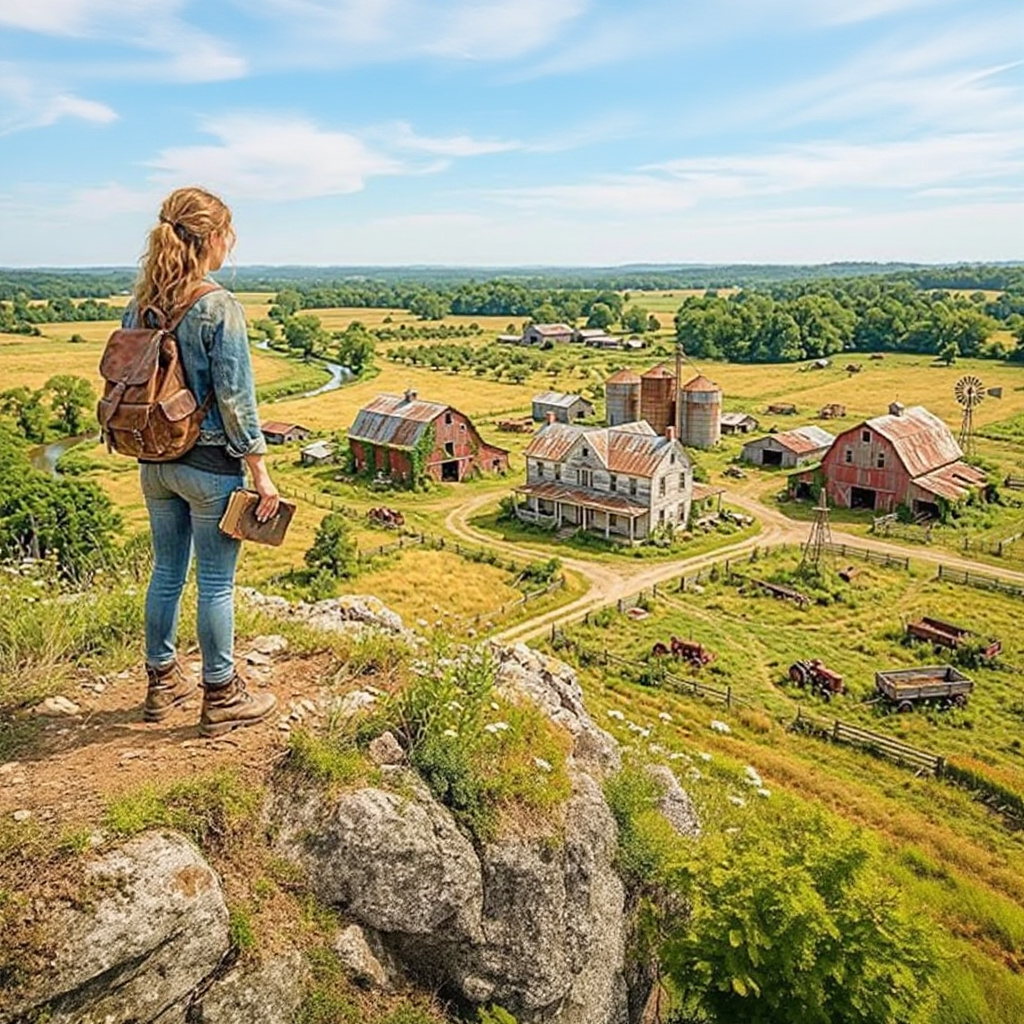
The wind lifted strands of Hannah Carter’s long blonde hair as she stepped onto the rocky outcrop. Gravel shifted beneath her boots, and she steadied herself, the brown leather backpack tugging lightly at her shoulders. In her right hand, she held the thick, worn Bible—her father’s Bible—the leather cover cracked, the pages yellowed and soft from decades of use.
She hadn’t expected the view.
Below her stretched a vast valley, golden fields rolling like quiet waves under the bright blue sky. Red barns dotted the land, their rusted roofs catching sunlight. A large white farmhouse stood near the center, flanked by metal silos. Dirt roads curled through fenced pastures, and a thin stream wound lazily across the landscape, reflecting light like a ribbon of glass. Old tractors and wagons sat scattered near the barns, as if abandoned mid-task.
No one had told her this place existed.
No one had even hinted.
And yet the deed in her father’s Bible had led her straight here.
Hannah swallowed, her throat tight. “Dad… what were you keeping from me?”
She opened the Bible carefully, fingers brushing the page where she had found it three days earlier.
Folded between Psalms and Proverbs had been a single piece of parchment. The ink had faded but remained legible: a land deed dated forty-two years earlier. The name listed as owner—Thomas Carter.
Her father.
The coordinates were written in careful handwriting, along with a short note:
“If you ever find this, go see it for yourself. Some things are better discovered than explained.”
That was all.
Her father had died two weeks earlier. A quiet heart attack in the small Kansas town where she’d grown up. No secrets, no drama, just a modest house, a pickup truck, and a lifetime of routine. He had never mentioned owning land, never talked about farming, never hinted at anything beyond his hardware store and Sunday church.
Yet the deed was real.
And now she stood above what looked like a fully developed farm—one no one had claimed.
Hannah tucked the Bible under her arm and began descending the slope.
The dirt road at the valley floor looked worn but not recently traveled. Her boots kicked up dust as she walked. Grass brushed her jeans, insects humming softly in the heat.
As she approached the first fence, she noticed something odd.
The gate wasn’t locked.
It hung slightly open, swaying gently.
She stepped through.
The silence felt different here—not abandoned, not empty, but paused. Like the place had been waiting.
The nearest barn loomed ahead, its red paint peeling but structure solid. A tractor sat nearby, its tires half-buried in weeds. Hannah ran her hand along the metal—warm from the sun, dust-coated but intact.
She moved toward the farmhouse.
The white paint had faded, and one shutter hung crooked, but the roof looked sound. The porch steps creaked under her weight. She hesitated, then pushed the door open.
Inside, the air smelled faintly of wood and time.
Furniture sat neatly arranged—table, chairs, a sofa covered with a sheet. A clock hung on the wall, stopped at 2:17. Dust lay evenly across surfaces, undisturbed.
But nothing looked ransacked.
Nothing looked abandoned in a hurry.
It looked… preserved.
Hannah set her backpack down and walked slowly through the house. The kitchen still held jars on shelves. The pantry contained empty bins labeled flour, cornmeal, sugar. Upstairs, she found two bedrooms. One held a narrow bed and dresser. The other contained a larger bed, quilt folded at the foot.
On the nightstand lay a photograph.
She picked it up.
A younger man stood beside a woman in front of the same farmhouse. The man looked startlingly familiar—same dark eyes, same square jaw.
Her father.
But younger. Much younger.
The woman beside him smiled warmly, her arm looped through his. Blonde hair, soft features.
Hannah frowned.
She had never seen this woman before.
She flipped the photograph over.
Written on the back: “Our first harvest — 1983.”
Her pulse quickened.
Her father had lived here.
Not just owned it—lived here.
She sat on the edge of the bed, mind racing. Why had he left? Why never mention it? Who was the woman?
Outside, wind rattled the loose shutter.
Hannah returned downstairs and stepped onto the porch. The valley stretched before her again—vast, quiet, waiting.
She walked toward the stream.
The water ran shallow but clear. A small wooden bridge crossed it, weathered but sturdy. Beyond it, more fields extended, some still lined with irrigation pipes. The layout wasn’t random; it had been carefully planned.
Someone had built this with intention.
Someone had dreamed here.
She opened the Bible again, flipping through pages. This time, she noticed a second slip tucked near the back. Her heart jumped.
Another note.
“Check the red barn.”
Hannah looked up at the nearest barn.
Her breath quickened as she walked toward it.
The doors were heavy but slid open with effort. Sunlight streamed inside, illuminating rows of empty stalls and a loft above. Dust motes drifted lazily.
She stepped deeper inside.
Then she saw it.
A wooden desk in the corner.
On top sat a metal box.
It wasn’t locked.
Inside were papers—ledgers, receipts, handwritten notes. She flipped through them, recognizing her father’s handwriting. Crop plans. Soil tests. Equipment lists.
At the bottom lay a sealed envelope.
“Hannah,” it read.
Her hands trembled.
She opened it carefully.
“If you’re reading this,” the letter began, “then I never found the right time to tell you. This farm was my life before you were born. I built it with someone I loved. Her name was Margaret. We planned to raise a family here. But the drought came. Then debt. Then she got sick.”
Hannah’s vision blurred.
“I sold what I could, but not the land. I couldn’t. Margaret died before the rain returned. I left because staying hurt too much. I met your mother years later and tried to live quietly. I kept this place untouched… just in case someday you might want to see where I once believed everything was possible.”
Tears slid down her cheeks.
“I never told you because I didn’t want you to feel tied to something unfinished. But if you’re here now, maybe it isn’t finished after all.”
The letter ended simply:
“Take it, sell it, restore it — it’s yours. Just don’t let it disappear without someone knowing it existed.”
Hannah lowered the paper slowly.
The barn creaked softly in the wind.
She stepped outside again, the valley stretching endlessly before her. The red barns, the farmhouse, the silos—all silent witnesses to a life she had never known.
She climbed back onto the rocky outcrop as the sun dipped lower. From above, the entire farm looked like a painting—golden fields glowing, stream reflecting light, trees swaying gently.
Her father had stood here once.
Dreamed here.
Loved here.
She tightened her grip on the Bible.
“I won’t let it disappear,” she whispered.
The wind carried her voice across the valley. A hawk circled overhead. Shadows lengthened across the fields.
For the first time since her father’s death, the future didn’t feel empty. It felt wide—like the land below her—full of possibility, waiting to be claimed.
Hannah Carter stood on the rock, the deed tucked safely inside the Bible, and realized she hadn’t just found a farm no one knew existed.
She had found the part of her father he had never stopped holding onto.
And now, it was hers to bring back to life.