
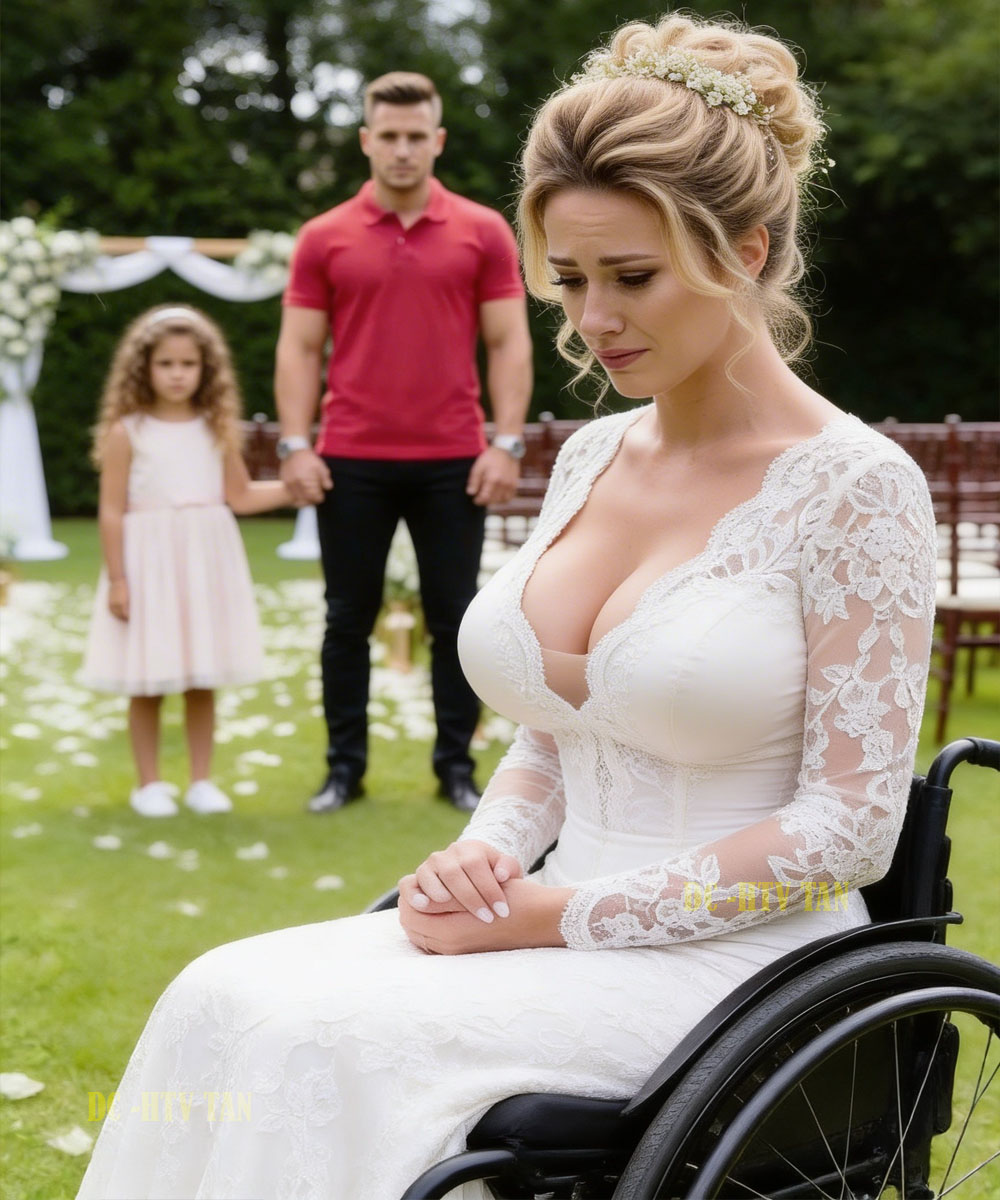
Poor bride rejected for being paralyzed—until a single dad did the unthinkable…
In the small town of Willow Creek, Ohio, Tessa Harper had always believed love could weather anything. At twenty-eight, she had survived a car accident that stole the use of her legs three years earlier, but it never stole her spirit. She taught third grade at the local elementary school, laughed easily, and decorated her classroom with so much color that even the grayest winter days felt bright. When David proposed on a snowy Christmas Eve, she said yes without hesitation. He had held her hand through physical therapy, promised forever, and told her the wheelchair changed nothing.
The wedding was planned for the old Presbyterian church on Maple Street—white roses, string lights, her mother’s vintage lace gown altered for a seated bride. Tessa had practiced rolling down the aisle in her chair, smiling at the mirror until the day felt real.
But thirty-two minutes before the ceremony, everything shattered.
David appeared in the bride’s room behind the sanctuary, still in his tuxedo, face pale. Guests were already seated. The organist was warming up. He closed the door and wouldn’t meet her eyes.
“I can’t do this,” he said.
Tessa’s stomach dropped. “What do you mean?”
“You’re… you’re always going to need help, Tess. Ramps, lifts, someone to push you everywhere. I thought I could handle it, but I look at our future and I see me carrying all the weight. I want kids, vacations, normal things. I don’t want pity. I don’t want people staring. I just… I can’t.”
The words landed like punches. Tessa stared at the bouquet in her lap—white lilies trembling in her grip. “You said it didn’t matter.”
“I lied to myself,” he whispered. “I’m sorry.” Then he turned and walked out.
She heard murmurs in the hallway, gasps from her bridesmaids. Someone tried to come in; her best friend, Lauren, blocked the door. Tessa sat frozen until the first sob broke free. She wheeled herself out the side door into the church garden, away from the crowd, away from the pitying faces. Rose petals had fallen from the trellis onto the grass. She stopped under an oak tree and let the tears come.
That’s where Malcolm Reed found her.
Malcolm was thirty-four, a landscaper who owned a small crew that mowed lawns and planted flower beds across Willow Creek. He had been hired to decorate the church grounds that morning—string lights, potted hydrangeas, the works. His eight-year-old daughter, Sophie, had come along because it was Saturday and the sitter canceled. Sophie was currently inside with the wedding coordinator, eating cookies and asking why the pretty bride wasn’t coming out yet.
Malcolm had stepped outside for air when he saw the woman in white sitting alone. He recognized Tessa from town—she had taught Sophie in second grade. He hesitated, then walked over.
“Miss Harper?” he said softly.
Tessa looked up, mascara streaked, veil crooked. “Please don’t. I just want to be alone.”
He didn’t leave. Instead he lowered himself to the grass beside her wheelchair, knees cracking. “I’m Malcolm. Sophie’s dad. You probably don’t remember me picking her up from your class.”
“I remember,” Tessa said dully. “She drew me a picture of a rainbow wheelchair once. Said it was magic.”
Malcolm smiled faintly. “She still has it taped to her wall.”
Silence stretched. A breeze moved the oak leaves above them.
“My fiancé just left me at the altar,” Tessa said, voice cracking. “Because I’m paralyzed. Because I’m… inconvenient.”
Malcolm exhaled slowly. “That’s not love. That’s cowardice.”
Tessa laughed bitterly. “Everyone’s going to say the same thing. Poor Tessa. Poor paralyzed bride. Rejected because she can’t walk.”
He looked at her then—really looked. “You’re not poor. You’re the teacher who stayed after school every Tuesday to help Sophie with fractions when she was failing. You’re the one who convinced the school board to put in an accessible playground so kids like her could play without feeling different. You’re wearing a dress most women would kill to look that good in, and you’re still sitting here with your head up. That’s not poor. That’s strong.”
Tessa’s lip trembled. “I don’t feel strong.”
“You don’t have to feel it to be it,” he said quietly.
Sophie appeared at the garden gate, still in her little flower-girl dress, clutching a half-eaten cookie. “Daddy? The lady in white is crying.”
Malcolm waved her over. Sophie approached cautiously, eyes wide.
“Hi, Miss Harper,” she whispered. “You look like a princess.”
Tessa managed a watery smile. “Thank you, sweetheart.”
Sophie glanced at her father, then back at Tessa. “Are you sad because the prince didn’t come?”
Tessa swallowed. “Something like that.”
Sophie frowned, thinking hard. Then she reached into her pocket and pulled out a small, folded piece of paper—the rainbow wheelchair drawing from two years ago, edges worn from being carried everywhere. “I kept this because you said rainbows mean hope. Maybe you need it back.”
Tessa took the paper with shaking hands. The colors were still vivid. She traced the wheels with her finger.
Malcolm cleared his throat. “Look, I know this is crazy, and you don’t know me well, but… the reception hall is paid for. The food’s ready. The band is tuning up. And Sophie and I were supposed to eat peanut-butter sandwiches in the truck tonight because I can’t afford much else this month. If you’re willing, we could go in there together. Not as a replacement. Just… as friends who refuse to let a coward ruin your day.”
Tessa stared at him. “You want to walk me down the aisle? In front of everyone?”
“Not walk,” he corrected gently. “Roll. And only if you want. Sophie can scatter the rest of the petals. We’ll make it ours.”
She looked from the drawing to Sophie’s hopeful face to Malcolm’s steady brown eyes. Something inside her shifted—not healed, but cracked open enough to let light in.
“Okay,” she whispered.
The sanctuary doors opened again. Guests whispered as Tessa rolled back in, veil straightened, bouquet clutched tight. Lauren gasped. Tessa’s mother stood, tears streaming.
Malcolm walked beside the chair, one hand resting lightly on the handle—not pushing, just there. Sophie skipped ahead, tossing petals in wild arcs.
At the front, the minister looked confused. The organist stopped mid-note.
Tessa lifted her chin. “I’m still getting married today,” she said, voice carrying. “Not to the man who walked away. But to the promise I made to myself—that I deserve joy. And if anyone wants to stay and celebrate that with me, there’s cake and dancing and a little girl who believes in magic rainbows.”
A beat of silence.
Then someone in the back began to clap. It spread. Soon the whole room was on their feet, cheering. Not out of pity. Out of awe.
Malcolm leaned down. “You sure about this?”
Tessa met his gaze. “I’m sure I don’t want to go home alone tonight.”
He nodded once. “Then let’s eat cake.”
The reception became something no one expected. Sophie danced with Tessa’s chair, spinning in circles until they were dizzy with laughter. Malcolm pushed Tessa onto the floor for the first “dance”—slow rolls to an acoustic guitar version of “At Last.” Guests joined in, forming a circle, clapping. Tessa’s father, who had been silent since the accident, finally spoke.
“You look happy, kiddo.”
“I am,” she said, surprised to mean it.
Later, when the lights dimmed and most guests had gone, Malcolm sat with Tessa at a corner table. Sophie slept on a pile of napkins nearby.
“I didn’t plan to propose today,” he said quietly. “I just… couldn’t leave you out there.”
Tessa smiled. “You didn’t propose.”
“Not yet.” He rubbed the back of his neck. “But I’d like to take you to dinner. And then maybe another. And maybe, someday, ask properly. No rush. No pressure. Just… two people figuring it out.”
Tessa looked at the rainbow drawing still in her lap. “I’d like that.”
Five months later, Malcolm did propose—on the accessible playground at school, under the rainbow slide Sophie loved. He got down on one knee so they were eye-level. Sophie held the ring box, bouncing with excitement.
Tessa said yes.
Their wedding was small, in the same church garden where everything began. No grand alterations, no expensive gown. Just Tessa in a simple white dress, Malcolm in a clean flannel shirt, Sophie in a sundress throwing real flower petals this time.
When the vows were spoken, Malcolm added his own.
“I promise to push when you need it, and to step back when you don’t. I promise to see you—not the chair, not the accident, just you. And I promise to build a life where ‘normal’ means whatever we decide it means.”
Tessa’s voice was steady. “I promise to trust again. To let you in. To believe that love isn’t about walking—it’s about staying.”
They kissed under the oak tree. Sophie cheered loudest.
Years later, people in Willow Creek still talked about the day the bride in white rolled back into the church with a landscaper and his daughter beside her. They called it the day hope won.
And every spring, Tessa and Malcolm planted new roses in that garden. Sophie helped. The petals always fell the same way—soft, inevitable, beautiful.
Tessa never walked again. But she never felt stuck.
Because sometimes the unthinkable isn’t a grand gesture. It’s simply refusing to leave someone alone on the hardest day of their life.
And that one choice can rewrite everything.