
“Pick Any Wife For Free,” The Judge Laughed — “I’ll Take The Obese Amish Girl.”
The courtroom in Lancaster County, Pennsylvania, was packed that morning—more crowded than anyone had seen in years. The case had drawn attention from all over the state, not because of violence or scandal, but because of something far stranger.
A will.
An old man named Harold Whitaker had died without children, leaving behind a massive estate—farmland, businesses, and a fortune rumored to be worth over thirty million dollars. But it wasn’t the money that shocked people.
It was the condition.
To inherit everything, a man had to marry one of the women listed in the will.
And not just any women.
They were women Harold had taken in over the years—orphans, abandoned daughters, and those cast aside by society. Some were plain, some were quiet, some were older than what most men would consider “ideal.” None of them had ever been chosen before.
Now, they sat in the front row of the courtroom, dressed modestly, eyes lowered.
Among them sat Mary.
Mary Stoltzfus.
She was Amish, wearing a simple gray dress and white bonnet. Her hands rested tightly in her lap, fingers intertwined. She didn’t look up—not when the judge entered, not when the murmurs rose, not even when someone in the back whispered something cruel.
Mary knew what people saw when they looked at her.
A large woman. Too large, they would say. Not beautiful. Not desirable.
Unchosen.
The judge, a tall man with a weary expression, adjusted his glasses and tapped his gavel.
“Let’s bring this to order.”
He looked over the courtroom, clearly unimpressed by the spectacle.
“I’ll say this once,” he began, his voice echoing across the room. “This is not a game. Mr. Whitaker’s will is legally binding. Any man who agrees to the terms must enter a lawful marriage with one of the listed women. The union must be genuine and maintained for at least five years before the inheritance is granted.”
A pause.
Then, with a hint of dry humor, he added, “So, gentlemen… choose wisely.”
A few chuckles rippled through the crowd.
Then he leaned back in his chair and said something that would be remembered for years.
“Pick any wife for free.”
Laughter broke out—loud, careless, cruel.
Mary’s fingers tightened.
One by one, men began stepping forward.
Some were young, clearly drawn by the money. Others were older, calculating, already thinking ahead to the inheritance. They studied the women like buyers at an auction—whispering, pointing, judging.
“I’ll take her,” one man said, nodding toward a petite brunette.
Another smirked. “That one looks manageable.”
Each choice felt colder than the last.
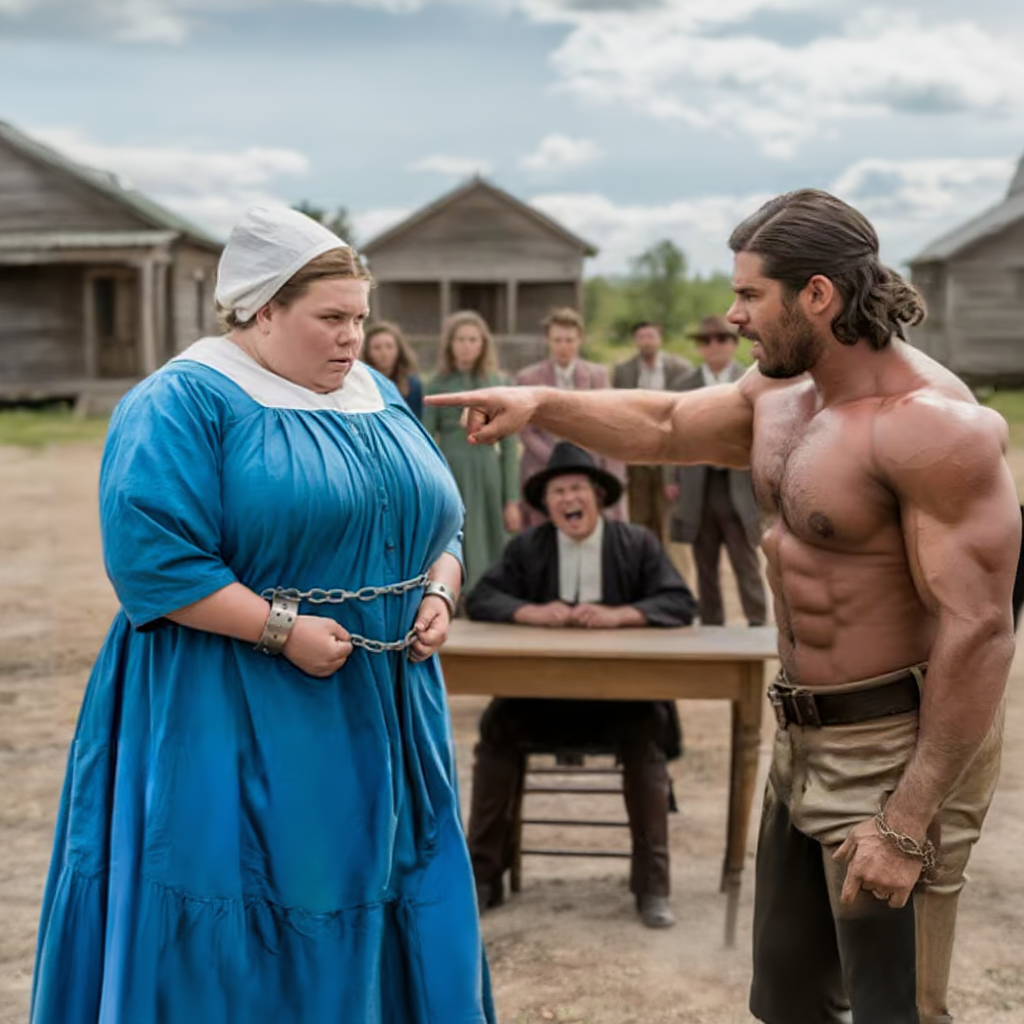
Mary kept her eyes down.
No one would choose her. She already knew that. She had known it her whole life.
Back in her Amish community, she had been the girl who worked harder than anyone else but was never asked to dance. The one who baked the bread, tended the animals, helped raise other people’s children—but was never seen as someone worth loving.
And now, here she was again.
Waiting to be overlooked.
Time passed.
More women were chosen. The row grew shorter.
Mary could feel the space around her opening, the absence growing heavier with each passing moment.
Then, silence fell.
Only two women remained.
Mary… and another, older woman who stared straight ahead with quiet dignity.
The judge glanced down at his list. “Two left.”
A man stood up from the back of the room.
He hadn’t spoken until now.
Tall. Broad-shouldered. Dressed simply, but not poorly. There was something different about him—not arrogance, not desperation. Just a calm presence.
He walked forward slowly.
People turned to look.
“Name?” the judge asked.
“Daniel Carter.”
The judge nodded. “You understand the terms?”
“I do.”
The judge gestured toward the remaining women. “Then go ahead, Mr. Carter. Your choice.”
A few people in the crowd leaned forward, curious.
Daniel didn’t hesitate.
He walked past the older woman.
And stopped in front of Mary.
For a moment, he said nothing.
Mary felt his presence before she dared to lift her eyes.
When she did, she expected to see the same thing she had always seen in others—judgment, pity, maybe even disgust.
But she didn’t.
His gaze was steady.
Kind.
“I’ll take the Amish girl,” he said quietly.
Then, after a brief pause, he added with certainty:
“Mary.”
The courtroom erupted.
Laughter. Gasps. Whispered disbelief.
“The obese one?” someone muttered loudly enough to be heard.
“Man’s either desperate or stupid.”
Even the judge raised an eyebrow.
“You’re sure about that, Mr. Carter?” he asked.
Daniel didn’t look away from Mary.
“I’m sure.”
Mary’s heart pounded.
No one had ever chosen her before.
Not like this.
Not in front of everyone.
The judge cleared his throat. “Very well. The court recognizes the union between Daniel Carter and Mary Stoltzfus, pending proper legal procedures.”
The gavel struck.
And just like that… everything changed.
The wedding was small.
Mary wore a simple dress—nothing extravagant, nothing new. Daniel stood beside her in a clean shirt and dark trousers.
There were no grand decorations. No music.
But there was something else.
Peace.
The first few weeks were awkward.
Mary moved into Daniel’s farmhouse, unsure of her place in a world so different from the one she had known. Electricity. Running water. Noise.
She kept to herself, waking early, working hard, speaking little.
Daniel didn’t push.
He noticed the way she cleaned the kitchen before he even woke up. The way she avoided mirrors. The way she flinched slightly when he entered a room too suddenly.
He also noticed something else.
Mary never complained.
Not once.
One evening, as the sun dipped low over the fields, Daniel found her sitting on the porch, staring out into the distance.
“You don’t have to work so hard,” he said gently, taking a seat beside her.
Mary shook her head. “It’s what I know.”
A pause.
Then she added, barely above a whisper, “I don’t know why you chose me.”
Daniel leaned back, looking at the sky.
“I do.”
She glanced at him, uncertain.
“I came to that courtroom early,” he said. “Before anyone else arrived.”
Mary frowned slightly. “Why?”
“I wanted to see the women before they were… chosen.”
He hesitated, searching for the right words.
“You were the only one helping the others. Adjusting their dresses. Fixing their hair. Making sure they were okay.”
Mary looked down.
“I saw the way you treated them,” he continued. “Not as competition. Not as rivals. Just… people.”
Silence stretched between them.
“I didn’t choose you for the money,” Daniel said finally. “I chose you because you were the only one who didn’t care about being chosen.”
Mary felt something shift inside her.
Something fragile.
Something new.
Months turned into years.
The farm flourished.
Mary found her rhythm—not just in the work, but in life itself. She began to laugh more. To speak more. To stand a little taller.
Daniel never rushed her.
He never demanded.
He simply stayed.
Steady. Patient. Present.
And slowly, something beautiful grew between them.
Not the kind of love that burns fast and bright.
But the kind that lasts.
The kind built on quiet moments, shared burdens, and unspoken understanding.
Five years passed.
On the anniversary of their wedding, a letter arrived.
The inheritance was theirs.
Thirty million dollars.
Daniel set the letter on the table.
Mary looked at it, then at him.
“What do we do now?” she asked.
Daniel smiled.
“We keep living.”
And they did.
They expanded the farm, not for profit, but to take in others—women like Mary once was. Forgotten. Overlooked. Unchosen.
They gave them work.
A home.
A second chance.
One evening, as Mary stood in the doorway watching the sun set over the fields, Daniel came up behind her.
“You ever regret it?” he asked softly.
She turned to him.
“For a long time, I thought I was invisible,” she said. “Like I didn’t matter.”
Her eyes met his.
“Then you saw me.”
A small smile touched her lips.
“No… I don’t regret it at all.”
Daniel took her hand.
And for the first time in her life, Mary Stoltzfus knew what it meant to be chosen—not for what she had, or what she could offer…
…but for who she truly was.
Part 2: The Weight of Being Seen
The money changed everything.
And somehow… it changed nothing at all.
The letter confirming the inheritance sat unopened on the kitchen table for nearly a full day. Mary walked past it twice before finally picking it up, her hands trembling—not from excitement, but from something deeper.
Fear.
Not of the money itself… but of what it might bring.
Daniel noticed.
“You don’t have to open it,” he said quietly from the doorway.
Mary looked down at the envelope, then back at him. “It won’t disappear if I don’t.”
He gave a small nod. “No… but neither will we.”
That was the thing about Daniel. He never made her feel rushed. Never made decisions for her.
So Mary broke the seal.
And just like that, they became wealthy beyond anything either of them had ever imagined.
At first, the world came to them gently.
A banker from Philadelphia. A lawyer from Harrisburg. Polite voices, careful smiles, firm handshakes.
They spoke in numbers. Investments. Opportunities.
Mary sat quietly beside Daniel during those meetings, her hands folded in her lap like she had done in that courtroom years ago. But this time… she wasn’t invisible.
Every now and then, Daniel would glance at her.
And wait.
Not for permission.
For partnership.
“What do you think, Mary?” he would ask.
The first time he said it, the room went still.
Mary blinked, caught off guard.
“I… I don’t know,” she admitted.
“That’s alright,” Daniel replied. “We’ll figure it out together.”
Together.
It was a word she was still learning how to hold.
But not everyone saw it that way.
News spread quickly.
The story of the “free wife” and the unexpected choice had already circulated once before—but now, with millions attached to their names, it exploded again.
This time, the tone was different.
Crueler.
“They only married for the money.”
“He picked the one no one wanted—smart move.”
“She got lucky. That’s all.”
Mary tried not to listen.
But words have a way of finding you… especially the ones that echo old wounds.
One afternoon, while in town buying supplies, Mary overheard two women whispering near the general store.
“That’s her, isn’t it?”
“The Amish one?”
“Hard to believe someone like her ended up rich.”
Mary kept walking.
But something inside her cracked just a little.
That night, she didn’t join Daniel for dinner.
He found her in the barn, sitting on a bale of hay, her shoulders slightly hunched.
“You missed supper,” he said gently.
“I wasn’t hungry.”
Daniel didn’t argue. He simply walked over and sat beside her.
For a while, neither of them spoke.
Then Mary exhaled slowly.
“Do you ever wonder… if they’re right?”
Daniel frowned. “Who?”
“Everyone.”
She looked down at her hands.
“Maybe you should have chosen someone else.”
The words hung heavy in the air.
Daniel didn’t respond immediately.
Instead, he reached out and gently took her hand—something he had learned she now allowed, even welcomed.
“I chose you,” he said simply.
Mary shook her head. “But why me?”
There it was again.
That question.
The one she thought had already been answered.
Daniel turned slightly, his voice steady but firm.
“Do you remember the first winter after you moved here?”
Mary nodded faintly.
“You woke up before dawn every day,” he continued. “You made sure the animals were fed, the house was warm, and there was food on the table before I even stepped outside.”
“That’s just work,” she said quietly.
“No,” Daniel replied. “That’s care.”
He paused.
“And do you remember when Mrs. Ellison’s boy got sick?”
Mary’s eyes flickered.
“You walked three miles in the snow to bring them food,” he said. “You stayed the night, even though you barely knew them.”
Mary swallowed.
“I didn’t do anything special.”
Daniel looked at her then—not with softness, but with something stronger.
“Mary… you keep saying that. Like kindness doesn’t count unless someone rewards it.”
Silence.
“You think I chose you because no one else did,” he went on. “But the truth is… no one else saw what I saw.”
Her breath caught.
“And that’s their loss. Not mine.”
The next morning, something shifted.
Not dramatically.
Not all at once.
But enough.
Mary stood a little straighter as she moved through the house. She met Daniel’s eyes a little more often. She spoke a little more during breakfast.
It was small.
But it mattered.
Weeks later, a letter arrived.
Not from a banker or a lawyer.
From one of the women in the courtroom.
Her name was Clara.
Mary remembered her—quiet, soft-spoken, with tired eyes.
The letter was simple.
Dear Mary,
I heard about what you and your husband have done with the farm. I wasn’t chosen that day… and I thought my life would never change. But seeing you… it gave me hope. If you’re still taking people in, I would like to come.
Mary read the letter twice.
Then a third time.
When Daniel came in that evening, she handed it to him.
“What do you think?” she asked.
He read it carefully, then looked up.
“I think it’s your decision.”
Mary hesitated.
Then, slowly… she smiled.
“Then let’s write back.”
Clara arrived two weeks later.
Thin. Nervous. Carrying everything she owned in a single worn suitcase.
Mary greeted her at the gate.
For a moment, neither of them spoke.
Then Clara whispered, “I didn’t think you’d really say yes.”
Mary reached out and took her hand.
“I didn’t think anyone would ever choose me either,” she said softly.
Clara’s eyes filled with tears.
And just like that… something new began.
More letters followed.
Women from different towns. Different pasts. Different stories.
Some had been overlooked.
Some had been abandoned.
Some had simply… never been seen.
Mary read every letter.
And every time, she saw a piece of herself in the words.
They didn’t take everyone.
They couldn’t.
But they took as many as they could.
And the farm changed.
It became louder.
Warmer.
Full of life.
Laughter echoed through the fields. Lights stayed on later in the evenings. The kitchen was never quiet anymore.
And at the center of it all… was Mary.
Not the woman who had once sat silently in a courtroom, waiting to be ignored.
But someone else.
Someone stronger.
One evening, as the sun dipped below the horizon, Clara approached Mary on the porch.
“Can I ask you something?” she said.
Mary nodded.
“Do you think… someone could ever choose me? The way Daniel chose you?”
Mary smiled gently.
“I think the right person doesn’t choose you the way the world does,” she said. “They choose you for the things the world overlooks.”
Clara considered that.
Then smiled faintly.
Later that night, Daniel found Mary standing in the doorway again, watching the land stretch out before her.
“It’s different now,” he said.
Mary nodded.
“Yes.”
“Better?”
She turned to him.
“Fuller.”
Daniel stepped beside her.
They stood there in silence for a while, the kind that no longer felt empty.
Then Mary spoke.
“You didn’t just choose me,” she said.
Daniel raised an eyebrow slightly.
“No?”
She shook her head.
“You taught me how to choose myself.”
Daniel didn’t reply.
He didn’t need to.
Because this time… Mary already knew she was seen.
And that made all the difference.