
He Lived Alone for Years — Until 6 Women Knocked on His Door
The prairie had a way of swallowing time.
Out beyond Dry Creek, where the grass turned brittle and gold beneath a relentless sun, Elias Turner lived alone in a weathered cabin that leaned slightly toward the west, as if tired of standing. The wind never stopped there. It hissed through the tall grass, rattled the porch boards, and whispered against the shuttered windows at night.
Elias hadn’t minded the silence.
Not at first.
After the war, quiet felt like medicine. No shouting, no smoke, no thunder of guns. Just sky stretching forever, the smell of dust, and the steady rhythm of work. He built the cabin himself, plank by plank. Dug the well. Fenced a small pasture. Raised two horses and a handful of chickens.
Years passed.
Neighbors moved away. The nearest ranch sold and went empty. The town of Alder Bend shrank to a single street and a stubborn general store. Elias rarely went in anymore. He preferred solitude.
People said he’d chosen it.
The truth was, solitude had slowly chosen him.
He woke before sunrise every day. Boiled coffee. Fed the animals. Walked the fence line. Ate beans or bread at noon. Repaired something in the afternoon. Sat on the porch at dusk watching shadows stretch across the prairie.
The routine never changed.
Until the morning six women appeared.
It started with dust.
Elias leaned against the porch post, mug in hand, when he noticed a faint line moving across the distant hills. At first, he thought it was cattle. Then wagons. But the shapes were too small.
He narrowed his eyes.
Figures.
Walking.
Toward him.
He set the mug down.
Nobody walked this far without reason.
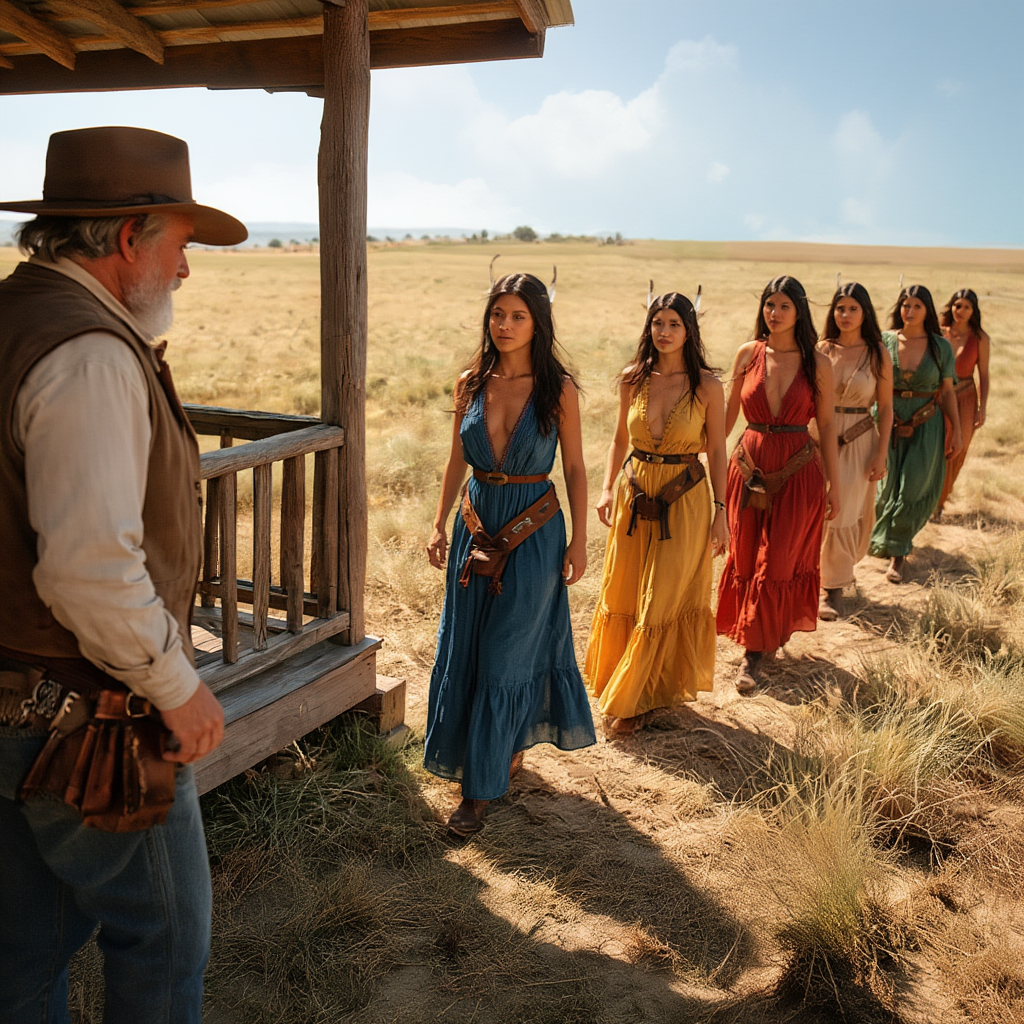
As they came closer, details emerged. Dresses moved in the wind. Long skirts brushing the dry grass. Colors — blue, yellow, red, beige, green, and one pale gray. Leather belts cinched at their waists. Wide hats shielding faces.
Six women.
Elias straightened slowly.
He hadn’t seen six people together out here in… years.
The women walked steadily, not hurried. Their line stretched across the prairie like something deliberate, purposeful. The sun cast long shadows behind them. Dust lifted with each step.
Elias adjusted his brown hat and stepped forward onto the porch.
His hand rested near his gun belt — not threatening, just habit. Out here, caution kept you alive.
They reached the fence first. One woman, tall with a blue dress, opened the gate. None of them spoke. They simply walked through and continued toward the cabin.
The wind quieted.
Even the horses lifted their heads.
By the time they reached the porch, Elias could see their faces. Tired, sun-worn, but determined.
The woman in blue stepped forward.
“Mr. Turner?” she asked.
His voice came rough from disuse. “That’s me.”
She nodded. “We were told we might find you here.”
“Who told you?”
“A man in Alder Bend. Said you lived alone. Said you might listen.”
Elias studied them. “Listen to what?”
The women exchanged glances. Finally, the one in yellow spoke.
“We need a place to stay.”
The words hung in the warm air.
Elias blinked. “All six of you?”
“Yes.”
“For how long?”
The woman in red answered. “We don’t know.”
He looked past them to the empty prairie. No wagons. No horses. Just six travelers on foot.
“You walked here?”
They nodded.
“From where?”
“Two days west,” the woman in beige said quietly.
That meant miles. Hard miles.
Elias leaned against the post, thinking. “Why here?”
The woman in blue took a breath. “Because you live alone.”
He almost laughed. “That’s not much of a reason.”
“It is when there’s nowhere else.”
Silence stretched.
The wind stirred again, lifting strands of hair and tugging at skirts.
Elias rubbed his jaw. “I don’t run a boarding house.”
“We don’t need one,” the woman in green said softly. “Just space. We’ll work.”
“Work?”
“We can cook. Mend. Plant. Clean. Anything.”
He studied their hands. Calloused. Not delicate. These weren’t women unused to labor.
“And if I say no?”
The woman in gray spoke for the first time. “Then we keep walking.”
The simplicity of it unsettled him.
No pleading. No drama. Just truth.
Elias looked at his cabin. One main room. Small loft. Lean-to kitchen. Not much space.
Then he looked at the land.
Endless.
“You got names?” he asked.
They introduced themselves one by one.
Anna, in blue.
Ruth, in yellow.
Martha, in red.
Clara, in beige.
Lena, in green.
And finally, quietest of all, Sarah, in gray.
Elias nodded slowly. “I’ve got one spare bed. Rest is floor.”
“That’s fine,” Anna said.
“Water’s from the well. Food’s simple.”
“We’re grateful.”
He hesitated.
Then he stepped aside.
“Well… you better come in.”
The shift felt immediate.
The women moved with quiet efficiency. Ruth set down a bundle and began sweeping dust from the floor. Clara checked the stove. Martha opened the shutters. Lena fetched water. Anna unpacked cloth from her bag. Sarah sat quietly, hands folded, watching.
Within an hour, the cabin felt different.
Alive.
Elias stood outside, unsure where to put himself. The sounds drifting out — footsteps, low voices, the clink of tin — felt unfamiliar.
He hadn’t shared space with anyone in years.
When Anna called him in, he hesitated before stepping across his own threshold.
The table had been cleared. A pot simmered. Bread dough rested under cloth.
“You had flour,” Ruth explained. “We hope that’s alright.”
Elias nodded slowly. “Didn’t know I had company coming.”
Clara smiled faintly. “Neither did we.”
They ate together that evening.
Simple stew. Fresh bread. Quiet conversation. The women spoke little about themselves. Only that they’d left a settlement that failed — drought, sickness, not enough work.
No families left.
No place to go.
Elias listened.
After supper, they laid blankets across the floor. The loft filled first. The rest spread near the stove.
The cabin glowed warm in lamplight.
Elias sat on the porch longer than usual that night.
Six women slept inside his house.
The prairie felt less empty.
Morning changed everything.
He woke to the smell of coffee.
Real coffee — stronger than his usual brew.
Ruth stood at the stove. Clara kneaded dough. Lena hung washed shirts outside. Martha repaired a loose board. Anna studied the fence line. Sarah fed chickens quietly.
They had already begun.
Days passed.
The women worked without asking. They planted a small garden. Repaired the roof. Cleaned years of dust from shelves. Sewed curtains from old cloth.
The cabin expanded — not physically, but somehow it felt larger.
Conversation grew easier.
Elias learned their stories in pieces.
Anna had led a wagon once. Ruth baked for a mining camp. Martha lost a brother to fever. Clara taught children. Lena ran a small orchard. Sarah… rarely spoke, but sang softly at night.
They didn’t ask much about him.
He appreciated that.
One evening, Elias returned from the far pasture and stopped mid-step.
A line of laundry fluttered across the yard.
The garden sprouted green.
Smoke curled from the chimney.
Laughter drifted through the open door.
His chest tightened unexpectedly.
He hadn’t realized how empty it had been before.
That night, they ate outside. The prairie glowed gold under sunset. Long shadows stretched across the grass.
“You could build another cabin,” Martha suggested gently.
Elias looked at her. “Why?”
“More space.”
“For you?”
“For all of us.”
The idea settled quietly.
Over the next weeks, they did exactly that.
Logs cut.
Posts set.
Six hands working beside his.
The second cabin rose slowly, then a third small shed. The land began to look less lonely.
Travelers passing through noticed.
Some stopped.
Some stayed briefly.
Word spread: Elias Turner wasn’t alone anymore.
One afternoon, he stood on the porch again — the same place where he’d first seen them.
The prairie stretched wide.
The women moved below — Clara gathering herbs, Ruth pulling bread from a makeshift oven, Lena watering seedlings.
Sarah sat on the step, humming.
Anna walked up beside him.
“You’re quieter than usual,” she said.
He nodded toward the hills. “Funny thing… I used to think silence was peace.”
“And now?”
He watched Martha laugh at something Lena said.
“Now I think peace sounds like people.”
Anna smiled.
The wind moved gently through dry grass.
Elias adjusted his hat and leaned against the porch rail.
Six women had walked across the prairie and knocked on his door.
He hadn’t known it then, but they hadn’t just asked for shelter.
They’d brought something with them.
Warmth.
Noise.
Life.
The prairie still stretched endless.
But it no longer felt empty.