
“I’ll Take Her — And Every One of Her Children.” The Mountain Man’s Choice Shocked the Town
The town of Briar’s End had a way of deciding people’s worth before they ever spoke a word.
It was the kind of place where everyone knew your name, your past, and—if they were being honest—your limits.
And no one in Briar’s End had more limits placed on her than Clara Whitmore.
“Five children,” Mrs. Hargrove whispered loudly enough for half the general store to hear. “And no husband to claim them.”
“Six, if you count the one she lost,” another woman added, shaking her head.
Clara kept her eyes down as she counted out coins for flour. Her fingers trembled slightly, but her voice, when she spoke, was steady.
“That’s enough for the week, Mr. Talley?”
The shopkeeper nodded, not unkindly, but not warmly either. “It’ll do.”
It always did.
Barely.
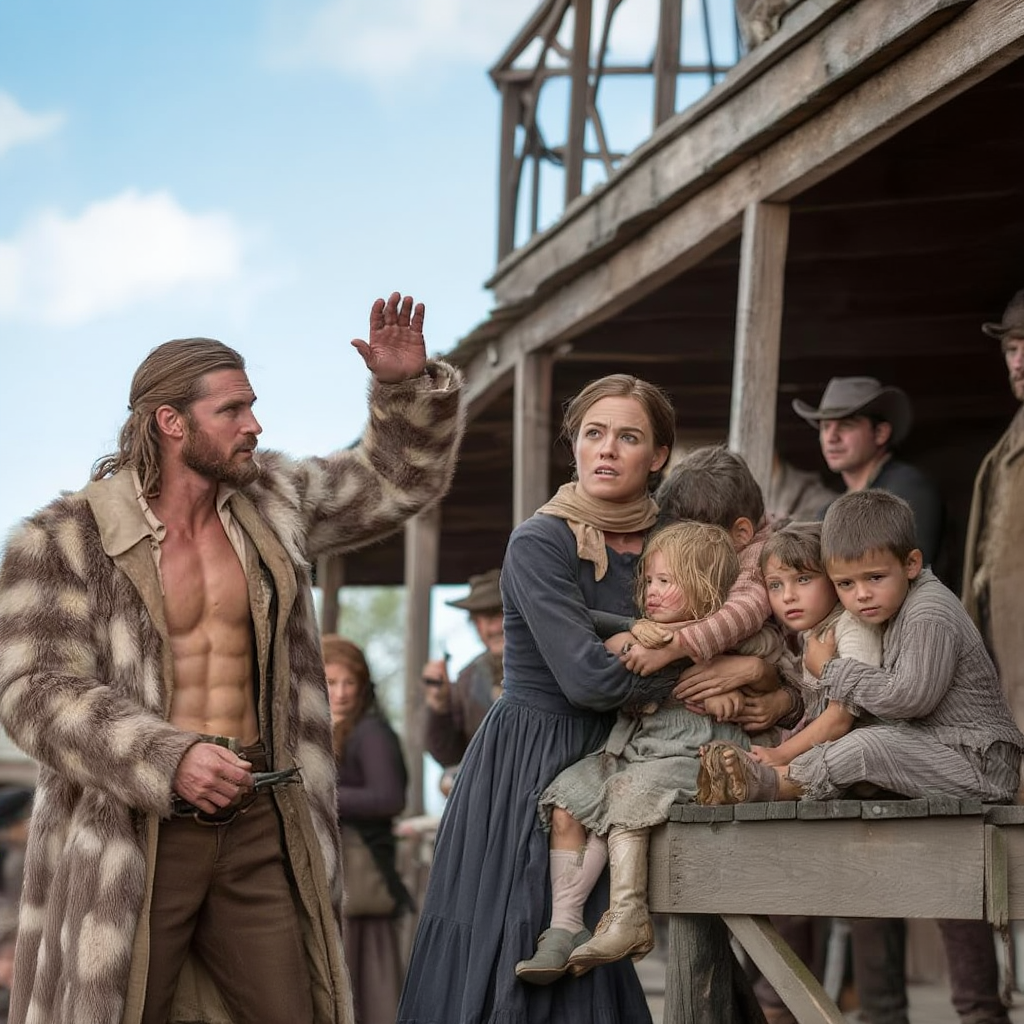
Clara gathered her things and turned, her children already clustering around her—small hands tugging at her skirt, soft voices asking questions she didn’t always have answers to.
To the town, they were a burden.
Too many mouths.
Too little future.
To Clara… they were everything.
—
They lived on the edge of town, in a weather-worn shack that leaned slightly to one side as if it, too, was tired of standing.
Clara worked every job she could find—laundry, mending, cleaning—anything that would keep food on the table and a roof over their heads.
But it was never enough.
Winter was coming.
And winter didn’t forgive weakness.
One evening, as the wind howled through the cracks in the walls, Clara sat by the dim glow of a lantern, staring at the last of their supplies.
Two days’ worth of food.
Maybe three, if she stretched it.
Her eldest, Thomas, sat beside her, trying to be quiet, trying to be strong in the way only a ten-year-old could.
“Ma,” he said softly, “we can eat less.”
Clara’s heart twisted.
“No,” she said firmly. “You’re growing. You need it.”
“So do you.”
She smiled faintly, brushing his hair back.
“I’ve learned how to make do.”
But the truth was… she was running out of ways to do that.
—
The notice came the next morning.
Nailed to her door.
Debt unpaid. Property to be seized within seven days.
Clara read it twice.
Then a third time.
Her chest felt tight, like the air had been pulled from her lungs.
Seven days.
Seven days before she and her children had nothing.
She sank onto the step, the paper crumpling slightly in her hand.
“What are we going to do?” Thomas asked quietly.
Clara didn’t answer.
Because for the first time in a long time… she didn’t have one.
—
The town gathered quickly when news spread.
It always did.
By afternoon, a small crowd had formed near the courthouse, voices low but eager.
“About time something was done.”
“She can’t take care of that many children.”
“It’s not right.”
“It’s not safe.”
Clara stood at the center of it all, her children pressed close to her sides.
She felt their fear.
Their confusion.
And it nearly broke her.
“I’m not asking for charity,” she said, her voice carrying more strength than she felt. “Just time.”
“You’ve had time,” one man replied.
“And what have you done with it?” another added.
Clara opened her mouth—
And then stopped.
Because no answer would satisfy them.
To them, she had already failed.
A murmur rippled through the crowd as a new figure approached.
He didn’t belong.
That was clear immediately.
His clothes were rough, worn from travel. His beard was thick, his presence solid in a way that made people instinctively step aside.
“Who’s that?” someone whispered.
“Don’t know,” came the reply.
The man stopped at the edge of the gathering, his eyes scanning the scene before settling on Clara.
On the children.
On the notice still clutched in her hand.
“What’s going on here?” he asked.
His voice was calm.
But it carried.
“None of your business,” one of the townsmen snapped.
The man didn’t look at him.
He kept his gaze on Clara.
“You going to answer that?” he asked her.
She hesitated.
Then, quietly, “We’re losing our home.”
The man nodded once, as if confirming something to himself.
“How much?”
The question caught everyone off guard.
“What?” Clara blinked.
“The debt,” he clarified. “How much is it?”
She swallowed.
“Eighty dollars.”
A few people scoffed.
“That’s more than she’s worth,” someone muttered.
The man finally turned his head.
Just slightly.
But the look he gave was enough to silence the voice.
Then he reached into his coat and pulled out a small leather pouch.
Coins clinked softly as he opened it.
He counted them out without hurry.
Without hesitation.
And placed them in Clara’s hand.
The weight of it stunned her.
“This should cover it,” he said.
The crowd erupted.
“You can’t be serious!”
“For her?”
“For all of them?”
The man straightened.
And for the first time, there was steel in his voice.
“I didn’t ask for your opinion.”
Clara stared at him, her heart racing.
“Why?” she whispered.
The man met her gaze.
And said the words that would echo through Briar’s End for years to come.
“I’ll take her,” he said.
A pause.
“And every one of her children.”
—
Silence.
Heavy.
Stunned.
Then laughter.
Disbelief.
“You don’t even know what you’re saying!”
“That’s not a bargain—that’s a burden!”
“Six mouths, man!”
The stranger didn’t flinch.
“Six lives,” he corrected.
Clara felt something inside her shift.
Fear.
Hope.
Confusion.
All tangled together.
“You don’t have to do this,” she said.
“I know,” he replied.
“Then why?”
He looked at her children again—at the way they clung to her, at the way she stood between them and the world like a shield.
“Because no one else will.”
—
His name was Jeremiah Cole.
A mountain man.
Lived far beyond the edges of Briar’s End, where the land grew wild and the rules of town life no longer reached.
“You can come with me,” he told Clara later, as the crowd slowly dispersed, still murmuring in disbelief. “Or you can stay. The debt’s paid either way.”
Clara looked down at her children.
At their thin faces.
At their tired eyes.
At the future waiting for them here.
Or not waiting.
“What would it mean?” she asked.
Jeremiah shrugged slightly.
“It means you’d have a place. Food. Work, if you want it.” He paused. “It means you wouldn’t be alone.”
Her throat tightened.
“That’s all?”
“That’s enough, isn’t it?”
She didn’t answer right away.
Because she wasn’t used to things being that simple.
“What do you get out of it?” she asked.
Jeremiah considered that.
Then said, “A home that isn’t empty.”
—
The journey took two days.
The children were quiet at first, unsure of this man who had changed everything with a handful of coins.
But Jeremiah was patient.
He answered their questions.
Showed them how to ride safely.
Even let the youngest sit in front of him, pointing out birds and tracks along the trail.
Clara watched it all.
Carefully.
Measuring.
Waiting for the moment something would feel wrong.
It didn’t come.
—
His cabin stood in a clearing surrounded by tall pines, a creek running nearby.
It wasn’t large.
But it was solid.
Strong.
And, most importantly—
Safe.
“This is it,” Jeremiah said.
The children stared, wide-eyed.
“It’s ours?” Thomas asked.
Jeremiah glanced at Clara.
“If your ma says yes.”
All eyes turned to her.
Clara took a slow breath.
Then nodded.
“Yes,” she said.
And just like that…
Everything changed.
—
Life in the mountains wasn’t easy.
But it was different.
There was always work to be done—chopping wood, tending the small garden, hauling water, mending clothes.
The children adapted quickly.
They laughed more.
Ran more.
Ate better.
Clara worked alongside Jeremiah, their movements gradually falling into rhythm.
They didn’t talk much at first.
Didn’t need to.
But something grew between them anyway.
Not sudden.
Not forced.
Just… steady.
One evening, as the children slept, Clara sat by the fire, watching the flames.
“You regret it?” she asked.
Jeremiah looked up from where he was sharpening a knife.
“No.”
“Not even a little?”
He shook his head.
“I knew what I was choosing.”
She studied him.
“Most men wouldn’t.”
“I’m not most men.”
A small smile touched her lips.
“No,” she agreed. “You’re not.”
—
Winter came.
And with it, the first real test.
Snow blanketed the mountains, cutting them off from the outside world.
Supplies had to last.
Work had to be constant.
But this time… Clara wasn’t facing it alone.
One night, as the wind howled outside, the children gathered close to the fire, their laughter filling the cabin.
Jeremiah watched them quietly.
Then looked at Clara.
“You were right,” he said.
“About what?”
“Six mouths being a burden.”
Her chest tightened.
“And?”
He shook his head.
“They’re not.”
Clara felt tears sting her eyes.
“They’re everything,” she whispered.
Jeremiah nodded.
“Yeah,” he said. “They are.”
—
Years later, people in Briar’s End still told the story.
About the day a mountain man walked into town and made a choice no one understood.
They called him foolish.
Reckless.
Crazy.
But they were wrong.
Because what Jeremiah Cole saw that day…
Wasn’t a burden.
Wasn’t a mistake.
Wasn’t a problem to be solved.
He saw a woman who refused to break.
Children who deserved a chance.
And a life that could be more than just survival.
So he chose it.
All of it.
And in doing so…
He built something the town never could.
A home.
Not because it was easy.
But because it was worth it.
“I’ll Take Her — And Every One of Her Children.”
Part 2: What a Home Is Made Of
The first winter in the mountains didn’t just test their strength—
It revealed their cracks.
Snow came early that year, thick and relentless, swallowing the paths Jeremiah had carefully marked before the cold set in. The world beyond the cabin disappeared, leaving only trees, wind, and the small circle of warmth they fought to maintain.
Inside, six children meant noise.
Movement.
Life.
But it also meant hunger came faster… and silence never lasted long enough to hide worry.
Clara felt it first.
Not fear—she had lived with that too long to mistake it.
This was something sharper.
Responsibility without margin.
She stood over the table one evening, dividing what little dried meat remained into careful portions. Her hands moved with precision, but her eyes betrayed her.
Jeremiah noticed.
“You’re cutting it smaller,” he said.
Clara didn’t look up. “Making it last.”
“We planned for this.”
“We planned for fewer mouths,” she replied quietly.
The words weren’t an accusation.
Just truth.
Jeremiah stepped closer, glancing at the portions.
Then at the children huddled near the fire.
Then back at Clara.
“I’ll hunt tomorrow,” he said.
She shook her head immediately. “The storm’s not letting up.”
“I’ve hunted in worse.”
“And nearly didn’t come back, I’d wager.”
That made him pause.
Because she wasn’t wrong.
“I won’t risk you,” she added, softer now. “Not when we need you here.”
The words lingered between them.
We need you.
Not I.
Not the children.
All of them.
Together.
Jeremiah exhaled slowly.
“We’ll stretch it,” he said.
Clara nodded.
But neither of them fully believed it.
—
The next morning proved harsher.
The youngest, little Sarah, woke with a fever.
Clara sat beside her, pressing a damp cloth to her forehead, her heart tightening with every shallow breath the child took.
“It’s just the cold,” Thomas said, trying to sound older than his ten years. “She’ll be alright.”
Clara forced a smile.
“Yes,” she said. “She will.”
But when she looked at Jeremiah across the room…
He saw the truth she wouldn’t say aloud.
This wasn’t something they could outwork.
Or outwait.
“We need medicine,” he said quietly.
Clara nodded.
“The town,” she whispered.
A day’s ride in good weather.
Nearly impossible now.
Jeremiah grabbed his coat.
“I’ll go.”
Clara stood quickly. “No.”
He turned. “We don’t have a choice.”
“We do,” she insisted. “We stay. We wait.”
“And if she gets worse?”
Clara’s voice broke.
“Then we pray.”
Jeremiah’s jaw tightened.
“I don’t sit and pray when something can be done.”
“And I don’t send the only man keeping this family together out into a storm that might take him from us!” she snapped.
Silence fell.
Heavy.
Sharp.
The children watched from the corner, wide-eyed.
Clara closed her eyes, regret washing over her.
“I’m sorry,” she whispered.
Jeremiah didn’t respond immediately.
Then, softer, he said, “You’re not wrong.”
She looked up.
“But neither am I,” he added.
Their eyes met.
And for the first time since coming to the mountain… they stood on opposite sides of a choice.
—
He left anyway.
Before dawn.
Quietly.
Clara woke to the sound of the door closing.
And her heart dropped.
She rushed outside, but the storm had already swallowed him.
Only faint tracks remained—quickly disappearing beneath fresh snow.
“You stubborn man…” she murmured, tears stinging her eyes.
But beneath the fear…
There was something else.
Understanding.
Because she would have done the same.
—
The day stretched endlessly.
Sarah’s fever rose.
The wind howled louder.
And Clara held her children together with nothing but will.
Thomas helped more than any boy his age should have to.
Fetching water.
Tending the fire.
Keeping the younger ones calm.
“You think he’ll come back?” he asked quietly at one point.
Clara didn’t hesitate.
“Yes.”
Because she had to believe that.
For all of them.
—
Night fell.
Still no sign of Jeremiah.
The cabin creaked under the weight of the storm.
Clara sat by the fire, Sarah in her arms, humming softly—a tune her mother had once sung to her long ago.
A tune she hadn’t remembered…
Until now.
“Ma…” one of the younger children whispered. “I’m scared.”
Clara looked at them.
All of them.
Six lives that had somehow become her strength instead of her burden.
“Come here,” she said.
They gathered close.
And she wrapped her arms around as many of them as she could.
“We’re alright,” she said softly.
Even if she wasn’t sure.
—
The door burst open just after midnight.
Wind and snow rushed in—
And then Jeremiah.
Covered in ice.
Breathing hard.
But standing.
Clara was on her feet in an instant.
“You fool—” she started, but the words broke as relief overtook everything else.
He held up a small bundle.
“Medicine,” he said.
That was all it took.
Clara closed the distance between them, grabbing his arm—not gently.
“You could have died,” she whispered.
He met her gaze.
“But I didn’t.”
Then, after a beat—
“Neither will she.”
—
Sarah’s fever broke by morning.
The storm passed by afternoon.
And something unspoken settled between Clara and Jeremiah.
Not tension.
Not distance.
Something deeper.
Respect.
Because they had both been willing to risk everything—
For the same reason.
—
Weeks later, as the snow began to melt, Clara stood outside the cabin, watching the children play.
Their laughter echoed through the trees.
Free.
Unburdened.
Jeremiah stepped beside her.
“You were right,” he said.
She glanced at him. “About what this time?”
He nodded toward the children.
“This isn’t just survival.”
Clara smiled faintly.
“No,” she said. “It never was.”
He was quiet for a moment.
Then—
“I didn’t just take you in,” he admitted. “Not really.”
She raised an eyebrow. “No?”
He shook his head.
“You built this as much as I did.”
Clara looked at the cabin.
At the smoke rising from the chimney.
At the life inside it.
Then back at him.
“We built it together,” she corrected.
Jeremiah nodded.
“Yeah,” he said. “We did.”
—
Spring came again.
And with it… something new.
Clara felt it before she said anything.
The quiet change.
The subtle shift.
The familiar signs she had known so many times before.
But this time…
It felt different.
She found Jeremiah by the creek one evening, repairing a broken tool.
“I need to tell you something,” she said.
He looked up.
Concern flickering instantly.
“What is it?”
Clara took a breath.
Then placed a hand over her stomach.
Understanding dawned slowly across his face.
Then fully.
“You’re—”
She nodded.
Silence followed.
Not shocked.
Not fearful.
Just… still.
“I know it’s a lot,” she said quickly. “Another mouth, another—”
Jeremiah stood, closing the distance between them.
And for once—
He didn’t let her finish.
“It’s ours,” he said simply.
Clara blinked.
“Ours?”
He nodded.
“All of it,” he added. “You. Them. This.”
Her eyes filled with tears.
Not from fear.
Not from exhaustion.
But from something she had never truly known before.
Belonging.
—
Back in Briar’s End, they still told the story.
About the mountain man who took a woman and all her children.
Most of them still didn’t understand it.
But that was because they were asking the wrong question.
It wasn’t why would he take so much?
It was—
Why had no one else been willing to?
Because what Jeremiah chose wasn’t burden.
It wasn’t sacrifice.
It was something far rarer.
He chose a ready-made life.
Messy.
Loud.
Difficult.
Real.
And in doing so…
He didn’t just give Clara and her children a home.
He became part of one.