
She Took 10 Lashes from the Whip Meant for a Native Girl—The Next Day, the Girl’s 5 Brothers Knelt..
The first crack of the whip cut the air like lightning splitting dry wood.
Everyone in the yard went still.
Dust hung motionless under the burning afternoon sun, and even the horses shifted uneasily, ears pinned back. The sound echoed against the low hills, sharp and ugly, the kind that made people look away before they even knew why.
Mary Caldwell didn’t look away.
She stood near the well, her sleeves rolled, hands still wet from drawing water. Across the yard, the Native girl—thin, barefoot, no older than sixteen—was being forced against the hitching post. Her wrists were tied. Her dark braid hung over one shoulder. She didn’t cry. She didn’t plead.
She only stared straight ahead.
Sheriff Dalton coiled the whip slowly, like a man preparing to demonstrate something rather than punish someone.
“Stealin’ grain,” he said loudly, so everyone could hear. “This town’s got rules.”
The girl spoke quietly. “My brother sick. He needs food.”
Dalton shrugged. “Then your tribe should’ve traded proper.”
“They tried. You turned them away.”
A few townsfolk shifted uncomfortably. Everyone knew it was true. The winter had been hard. The nearby Native camp had asked for help. The town had refused.
Dalton lifted the whip. “Ten lashes. Maybe next time you ask before takin’.”
Mary felt something twist inside her.
The girl’s back was bare where the dress had been pulled down. Thin shoulders. Old scars. She’d been punished before.
The whip snapped.
The first lash struck.
The sound was sickening—leather on skin. The girl jerked but made no sound.
Mary’s stomach turned.
Second lash.
The girl’s fingers clenched.
Third.
Someone in the crowd muttered, “That’s enough…”
Dalton ignored them.
Fourth.
Mary stepped forward without thinking.
“Stop.”
Dalton paused, surprised.
The entire yard turned.
Mary walked closer, heart pounding. She wasn’t tall, not strong, not anyone important. Just a ranch woman who sold butter and eggs in town. But something inside her refused to stay quiet.
“She took grain,” Dalton said. “Punishment stands.”
Mary swallowed. “She did it to feed her family.”
“That ain’t your concern.”
Mary looked at the girl’s trembling shoulders.
“It is,” she said.
Dalton smirked. “You volunteering?”
Mary didn’t hesitate.
“Yes.”
Silence dropped like a stone.
“You serious?” he asked.
She nodded.
Dalton studied her. “Ten lashes.”
“I heard.”
“You don’t know what that means.”
“I do.”
He shrugged. “Fine by me. Untie her.”
Two men hesitated, then loosened the ropes. The Native girl staggered, confused, staring at Mary.
Mary stepped forward and took her place against the post.
Someone whispered, “She’s crazy…”
Another muttered, “She’ll regret it.”
Mary gripped the wood.
Dalton raised the whip.
The first lash hit.
Fire exploded across her back. She gasped, teeth clenched.
She hadn’t expected the pain to be that sharp, that immediate. It stole her breath.
Second lash.
Her knees buckled, but she stayed upright.
Third.
Her vision blurred.
Fourth.
She tasted blood where she bit her lip.
The crowd grew silent.
Fifth.
Tears streamed down her face, but she didn’t cry out.
Sixth.
Her hands trembled.
Seventh.
Someone said, “Stop this…”
Dalton kept going.
Eighth.
Her world shrank to pain.
Ninth.
She nearly collapsed.
Tenth.
The final crack echoed long.
Dalton lowered the whip.
Mary slid to her knees.
The Native girl rushed forward, catching her before she hit the ground.
“You… why?” the girl whispered.
Mary struggled to breathe. “No one… should take that… alone.”
The girl’s eyes filled with tears.
The crowd parted as the girl helped Mary to her feet. No one spoke. Shame hung heavier than dust.
Dalton turned away, uneasy now. “Punishment served.”
Mary staggered toward her wagon. Someone handed her a blanket. Another offered water. No one met her eyes.
The Native girl stood beside her.
“My name… Aiyana,” she said softly.
Mary nodded weakly. “Mary.”
Aiyana pressed her hand to her heart. Then she slipped away, vanishing toward the hills.
Mary rode home slowly, every movement agony.
—
That night, fever came.
Her back burned. Every breath hurt. She lay in bed alone, biting down on cloth to keep from crying out.
Near midnight, she heard movement outside.
She reached for the small pistol under her pillow.
The door creaked open.
Aiyana stepped inside.
She carried herbs, cloth, and a bowl of steaming water.
“You shouldn’t be here,” Mary whispered.
Aiyana shook her head. “You saved me.”
She gently cleaned the wounds. Her hands were careful, practiced. She spread crushed leaves that cooled the burning.
Mary exhaled shakily. “You know medicine?”
“My grandmother taught me.”
She worked silently.
Before leaving, Aiyana said, “My brothers… they will know.”
Mary drifted into sleep.
—
Morning came quiet.
Mary woke stiff but alive. The pain remained, but the fever had broken.
She stepped onto the porch carefully.
Then she froze.
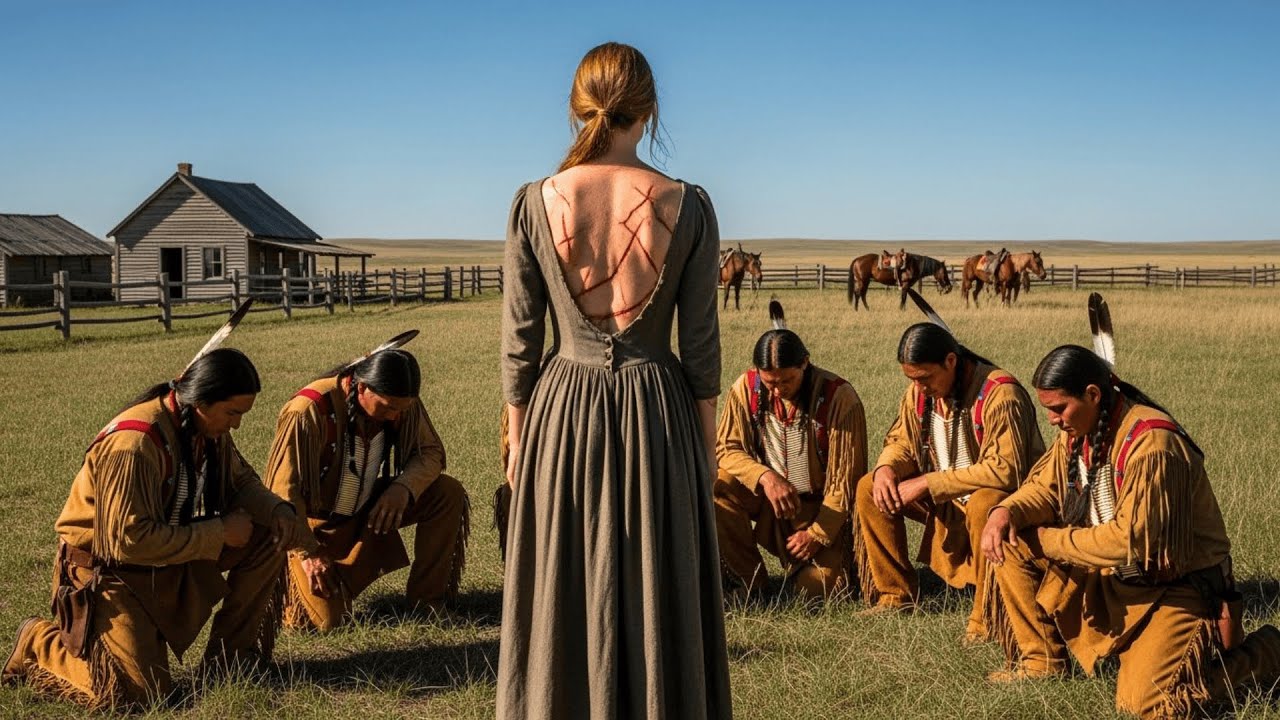
Five men stood in her yard.
Tall. Broad-shouldered. Dressed in worn buckskin. Each carried a rifle. Each wore a braid. Their expressions were solemn.
Aiyana stood beside them.
Mary’s heart raced.
The tallest man stepped forward.
He placed his rifle on the ground.
Then—slowly—he knelt.
The other four followed.
Mary stared, stunned.
Aiyana spoke softly. “These are my brothers.”
The eldest said, “You took pain meant for our blood.”
Mary swallowed. “I couldn’t watch—”
He raised a hand gently. “You showed honor.”
He lowered his head. “We kneel in respect.”
The other brothers did the same.
Mary felt overwhelmed. “You don’t have to—”
“We do,” he replied.
Aiyana stepped closer. “We owe you life.”
The eldest brother rose. “From today, you are under our protection.”
Mary blinked. “Protection?”
He nodded. “Anyone harms you… they answer to us.”
The brothers stood, silent as stone.
Word spread fast.
By noon, the entire town knew five Native warriors had knelt in Mary Caldwell’s yard.
Some scoffed.
Some worried.
Sheriff Dalton frowned.
Three days later, trouble came.
Two drunk cowhands rode up, laughing. “Heard you got redskin guards now,” one sneered.
Mary stood on the porch. “Leave.”
They dismounted anyway.
“You think you’re special?”
Before Mary could answer, five shadows stepped from the trees.
The brothers appeared without sound.
The cowhands froze.
The eldest brother spoke calmly. “You leave now.”
They mounted quickly and fled.
Mary exhaled slowly.
“You didn’t have to come,” she said.
Aiyana smiled. “We said we would.”
—
Weeks passed.
The brothers repaired her fence. Brought meat. Helped with chores. They never entered the house unless invited. Always respectful. Always quiet.
Town attitudes shifted.
Some people softened.
Others grew angry.
Sheriff Dalton rode out one afternoon.
“You stirred things,” he said.
Mary met his gaze. “I stopped a whipping.”
He frowned. “You embarrassed me.”
“You whipped a hungry girl.”
He shifted uncomfortably. “That’s law.”
She shook her head. “That’s cruelty.”
He rode away, unsettled.
—
Late one night, Mary heard hoofbeats.
She looked out.
Four riders approached—strangers.
They dismounted quietly, moving toward the barn.
Mary reached for her pistol.
Before she stepped outside, shapes moved in the darkness.
The five brothers emerged.
Silent. Deadly.
The riders froze.
The eldest brother spoke: “You leave.”
They didn’t argue.
They left.
Mary stepped onto the porch.
“You saved my barn,” she said.
“You saved our sister,” he replied.
The balance felt even—but deeper.
—
One evening, Mary asked Aiyana, “Why did they kneel?”
Aiyana smiled. “In our people… when someone takes pain for your blood… they become family.”
Mary’s chest tightened.
“Family?” she repeated.
Aiyana nodded.
Mary looked at the five brothers laughing quietly by the fire.
For the first time since her husband died, she didn’t feel alone.
—
Months later, the town gathered for market day.
Sheriff Dalton stood awkwardly near the well.
He saw Mary.
Then Aiyana.
Then the five brothers.
He cleared his throat.
“About before…” he muttered. “Maybe… maybe I was too harsh.”
Mary nodded.
Aiyana smiled faintly.
The tension eased.
The whip never cracked in that yard again.
And people never forgot the day a ranch woman took ten lashes for a Native girl…
…and the next morning…
five warriors knelt—
not in defeat—
but in respect.