
He Just Needed a Cook—Until the Giant Cowboy Fell for the “Unwanted” Girl
The first thing people noticed about the girl was that she didn’t belong.
She stood at the edge of the dusty frontier town like a misplaced brushstroke—too soft, too clean, too quiet for a place carved out of wind and stubbornness. Her cornflower-blue dress caught the late-afternoon light, lace collar fluttering gently, while boots too worn for the color of the fabric sank into the dirt.
The second thing they noticed was the man behind her.
He looked like something the mountains themselves had shaped.
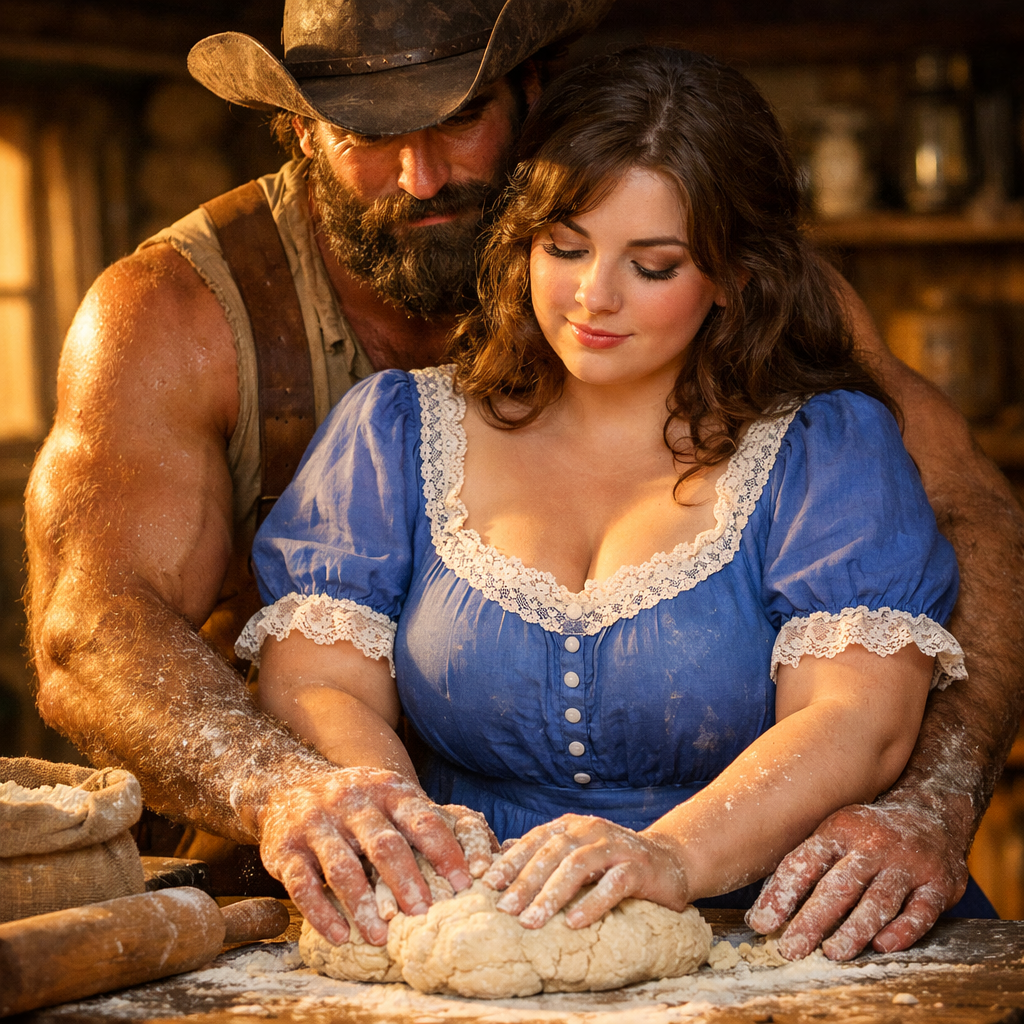
Tall enough to block the sun. Shoulders broad as a barn door. Sleeveless tan shirt stretched tight across thick chest and massive biceps. Leather suspenders pulled over muscles hardened by years of chopping wood, hauling grain, and wrestling cattle. A weathered cowboy hat shadowed dark eyes, and a thick beard framed a face carved in rough lines.
Eli Carter didn’t just enter rooms.
He filled them.
And right now, he stood directly behind the girl in the doorway of Miller’s Boardinghouse kitchen, his flour-dusted hands hovering near hers as if unsure whether to guide or protect.
“Hands like that,” he said, voice low and gravelly, “you ever kneaded dough before?”
The girl didn’t look up. “No, sir.”
Her voice was soft. Almost lost under the creak of the wooden walls.
Eli watched her small fingers sink awkwardly into the sticky mass of dough on the table. She pressed too gently, like she was afraid it might break.
“It won’t bite,” he muttered.
She nodded quickly, cheeks flushing.
Behind them, Mrs. Miller leaned against the doorframe, arms crossed. “You sure about this, Eli? She don’t look strong enough to lift a skillet.”
“I didn’t ask for a blacksmith,” he replied.
The girl flinched slightly at the attention. Eli noticed. He noticed everything.
Golden hour sunlight spilled through the dusty window, landing across the table. It lit the contrast between them—his tanned, scarred hands and her pale, soft ones. His forearms corded with muscle, hers rounded and delicate. His movements steady, hers hesitant.
He reached forward.
His massive hands gently covered hers.
“Like this,” he murmured.
He guided her wrists, folding the dough, pressing forward. The size difference made it look almost impossible—his hands engulfing hers, flour dusting both their skin.
She inhaled sharply.
“Too hard?” he asked.
“No… just… no one’s ever—” She stopped.
He withdrew slightly. “Ever what?”
“Taught me.”
Silence stretched.
Mrs. Miller snorted. “That’s because nobody hires girls like her.”
The words hung heavy in the air.
The girl lowered her eyes further.
Eli’s jaw tightened.
“What’s your name?” he asked.
“Clara.”
“Last name?”
She hesitated. “Just Clara’s fine.”
Mrs. Miller scoffed. “Means she don’t want folks asking questions.”
Eli ignored her.
Clara pressed the dough again, more firmly this time. It stuck to her fingers. She tried to pull away, but it stretched awkwardly, making her panic.
He chuckled softly.
“Relax,” he said. “Dough’s stubborn. You gotta be more stubborn.”
He folded it again, guiding her hands. The sunlight caught in the flour dust floating between them. Outside, horses stomped, wind rattled the sign, someone shouted across the street—but inside, the moment felt strangely quiet.
“You don’t talk much,” he added.
“I talk when I’m supposed to.”
“Who told you that?”
“My aunt.”
“That the one who sent you?”
Clara nodded.
Mrs. Miller cut in. “She didn’t send her. She dropped her. Said the girl eats too much, works too slow, scares customers. Asked if anyone needed cheap help.”
Eli’s eyes flicked to Clara.
Her shoulders curled inward.
“She say why?” he asked quietly.
Mrs. Miller shrugged. “Said nobody wants a soft girl who ain’t pretty enough to marry and ain’t strong enough to farm.”
Clara’s hands stopped moving.
The dough sagged.
Eli didn’t speak for a long moment.
Then he nudged her gently.
“Keep going,” he said.
She obeyed.
“You eat a lot?” he asked.
She blinked. “I… I don’t think so.”
Mrs. Miller laughed. “You should’ve seen her plate at lunch.”
Eli ignored her again.
“You hungry now?”
Clara shook her head quickly. “No, sir.”
Her stomach growled loudly.
The sound echoed in the small kitchen.
Mrs. Miller burst out laughing.
Clara froze, face burning.
Eli reached behind him, grabbed a biscuit from a tin, and set it beside her hand.
“Eat while you work,” he said.
She hesitated.
“You hired me?” she asked quietly.
“I said I needed a cook.”
“I’m not a cook.”
“You will be.”
Mrs. Miller raised a brow. “You’re serious?”
Eli met her gaze. “I don’t repeat myself.”
Clara picked up the biscuit slowly. She took a small bite, like she expected someone to take it back.
He watched her chew.
Watched the tension in her shoulders ease slightly.
“You got somewhere to stay?” he asked.
She shook her head.
Mrs. Miller added, “Her aunt left before sunset. Girl’s been carrying that bag all day.”
Eli glanced toward the corner. A worn canvas duffle bag sat on the floor.
“That all you got?”
“Yes, sir.”
“You can use the spare room above my kitchen.”
Mrs. Miller straightened. “Eli—”
“I need a cook.”
Clara’s eyes widened. “You… you mean it?”
He shrugged. “You knead dough. That’s a start.”
She looked down at her flour-covered hands.
A small smile—barely there—touched her lips.
Outside, the sky turned gold.
Inside, something shifted.
—
The ranch sat just beyond the hills, where the wind smelled of dry grass and open sky. Eli’s cabin stood alone—thick timber walls, wide porch, smoke curling from the chimney.
Clara stepped down from the wagon slowly.
“This… is yours?” she asked.
He nodded.
“It’s big.”
“Kitchen’s bigger.”
He led her inside. The main room smelled of coffee, leather, and woodsmoke. The kitchen dominated the back half—wide table, iron stove, shelves lined with jars.
Clara’s eyes lit up.
“You cook for… how many?” she asked.
“Just me.”
Her brows lifted.
“You eat all this alone?”
“Used to.”
She turned slowly, taking it in.
The silence between them felt less awkward now.
“Room’s upstairs,” he said.
She climbed carefully, one hand on the railing. He watched until she disappeared.
He didn’t know why he’d hired her.
She wasn’t strong.
She wasn’t experienced.
She wasn’t what anyone would call practical.
But when she’d stood there—small, soft, unwanted—something in his chest had shifted.
And he didn’t like leaving things broken.
—
The next morning, the smell of burned biscuits filled the cabin.
Eli walked in to find Clara staring at a tray of blackened rounds.
“I… I tried,” she said quickly.
He picked one up. Knocked it against the table. It clunked.
He took a bite.
She winced.
He chewed slowly.
“Needs work,” he admitted.
She looked crushed.
“But better than my first batch.”
She blinked. “You burned biscuits?”
“Set the stove on fire once.”
Her lips twitched.
He reached past her, grabbing flour.
“Again,” he said.
She nodded.
They worked side by side.
Her movements steadier now. His hands guiding less, watching more. Sunlight streamed through the window, catching flour in the air.
“You don’t laugh,” she said suddenly.
“Do too.”
“You almost smiled yesterday.”
He snorted.
She pressed the dough harder.
“You didn’t have to hire me,” she added.
“Didn’t have to.”
“Why did you?”
He thought about it.
“You looked like someone who needed a chance.”
She swallowed.
“No one’s ever said that.”
He shrugged.
“Well. I did.”
Days passed.
Then weeks.
Clara learned fast. Bread rose properly. Stew thickened. The kitchen filled with warm smells instead of smoke.
She laughed more.
Eli noticed.
She moved easier.
He noticed that too.
And one evening, as golden sunlight spilled across the table again, she kneaded dough with confident rhythm. He stood behind her, arms folded, watching.
“You don’t need me anymore,” he said.
She glanced back.
“I like when you’re here.”
He felt something shift again.
“You do?”
She nodded.
“You make me less nervous.”
He stepped closer.
“Clara.”
“Yes?”
“You know folks in town talk.”
“They always do.”
“They say I only needed a cook.”
She turned fully now.
“And?”
He looked at her—flour on her cheek, soft smile, blue dress dusted white.
“I think I needed more than that.”
Her breath caught.
The sunlight wrapped around them.
And for the first time, the giant cowboy realized the unwanted girl had quietly become the center of his world.