
She Was Left With Nothing but a Dry Well… Until She Turned It Into a Hidden Home That Defied the Great Blizzard
The first time Eleanor Hayes saw the deed, she laughed.
Not because it was funny.
Because after three weeks of lawyers, probate hearings, whispered family arguments, and her older brothers dividing up every acre, every machine, every horse, and every dollar their father had ever owned…
The paper in her hands listed exactly one thing.
Parcel 17.
One abandoned stone well.
No assessed value.
“That’s yours,” her brother Mark had said, sliding the folded paper across the oak table without even looking at her. “Dad must’ve felt sentimental.”
The others laughed.
Eleanor folded the paper carefully, tucked it into her coat pocket, and walked out of the courthouse without saying a word.
Outside, December wind cut across the plains of western South Dakota like a blade.
She was thirty-two years old, recently widowed, nearly broke, and now officially the owner of a dry hole in the middle of frozen farmland.
By every practical measure…
She had inherited nothing.
Her father’s old property sat twenty miles outside the tiny town of Wall, where endless grasslands met winter sky.
The brothers had already claimed the main house, the cattle barns, the tractors, even the old windmill.
Parcel 17 sat on the northern edge of the property, near a field nobody had planted in years.
When Eleanor arrived, snow crunched beneath her boots.
The stone well rose from the frozen earth like the spine of some ancient creature—circular, waist-high, built from hand-cut limestone blackened by age.
Nearby stood an old blue metal barn, half buried in drifting snow.
She walked to the well and peered inside.
Darkness.
Then—
Thunk.
She dropped a small rock.
Three seconds later, it hit.
Not water.
Earth.
Dry.
Dead.
Worthless.
Just like her brothers said.
Eleanor leaned against the stone rim, staring across the white prairie.
The wind howled.
And for the first time since her husband Caleb had died the year before…
She cried.
Not loudly.
Not dramatically.
Just silently, while snow gathered on her shoulders.
“I don’t know what I’m supposed to do,” she whispered.
The prairie gave no answer.
But the well…
The well gave an echo.
And something about that echo made her stop.
She dropped another stone.
Thunk.
She listened carefully.
The sound wasn’t right.
Not a simple vertical shaft.
There was space below.
Hollow space.
The next morning she came back with a flashlight, rope, and an old climbing harness.
The brothers thought she was insane.
Mark saw her loading gear into her truck.
“You gonna move into your hole?”
She didn’t answer.
She just drove.
Snow drifted across the road as she parked near the barn.
By noon, she was lowering herself into the darkness.
Stone walls slid past.
Ten feet.
Fifteen.
Twenty.
Then her boots touched packed dirt.
She aimed her flashlight.
And froze.
The shaft opened into a chamber.
Not natural.
Built.
Carved.
Wooden support beams.
Stone arches.
Old shelves.
A rusted lantern.
Someone had built something down here.
Something hidden.
Something forgotten.
Her father had never mentioned it.
Neither had her grandfather.
Yet the chamber stretched wider than the farmhouse cellar.
A tunnel disappeared into darkness.
Eleanor’s heart hammered as she followed it.
Thirty feet.
Forty.
Then the tunnel opened into a second chamber.
And there—
A cast-iron stove.
A wooden cot.
Glass jars.
Firewood.
Tools.
A ladder leading upward into solid earth.
An underground shelter.
Old.
Hand-built.
Brilliant.
She stood in silence.
Then whispered:
“Dad…”
Suddenly everything made sense.
Her father had known.
He hadn’t left her a useless well.
He’d left her the one thing nobody else understood.
A way to survive.
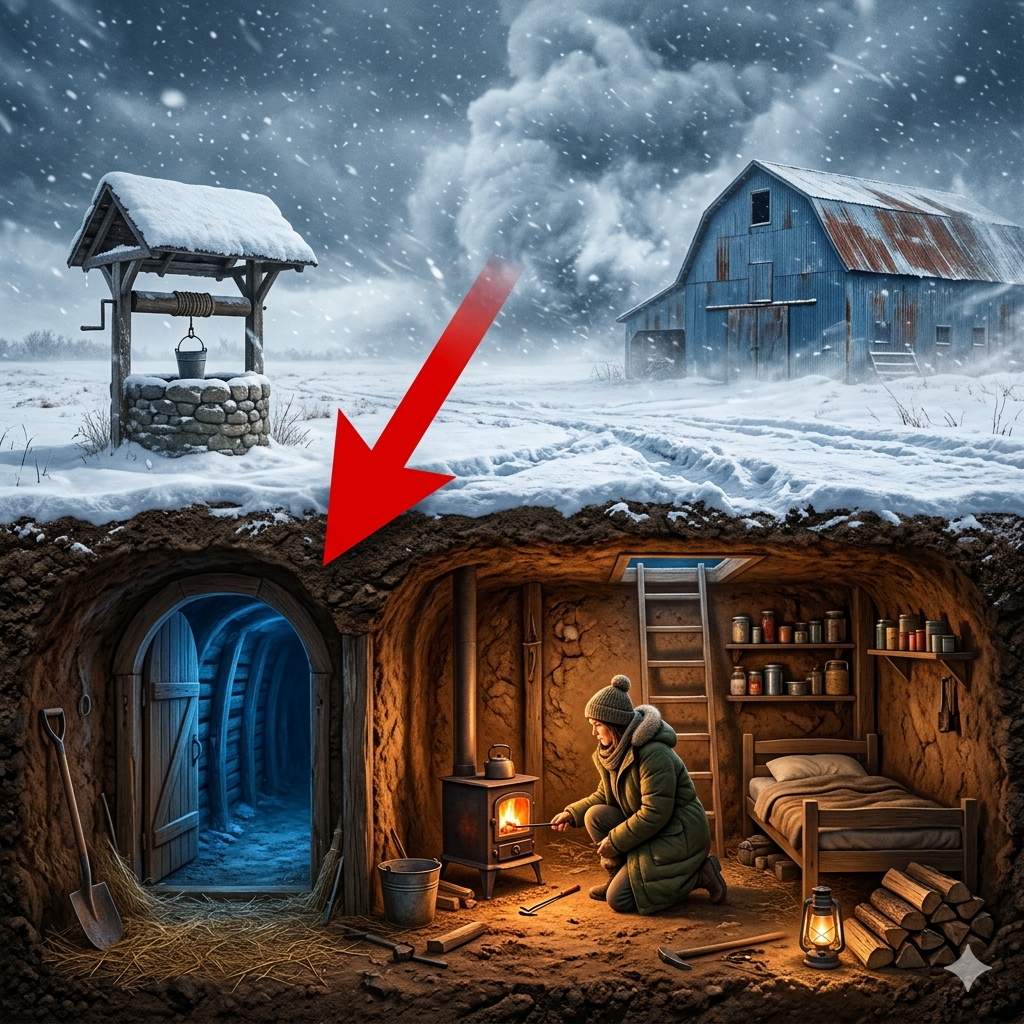
For the next two months, Eleanor worked alone.
Every morning before sunrise.
Every evening after dark.
She cleaned decades of dust.
Repaired cracked beams.
Sealed drafty walls with clay.
Replaced rotten shelves.
Dragged supplies down the shaft one bucket at a time.
Canned food.
Blankets.
Kerosene.
Water barrels.
Firewood.
The blue barn became her staging ground.
The well became her front door.
And deep beneath the frozen prairie…
A hidden home began to live again.
She found journals tucked behind a loose stone.
Her grandfather’s handwriting.
Entries from 1936.
Dust Bowl years.
Then entries from 1949.
Blizzards.
Crop failures.
Starvation.
One sentence was underlined.
The land above can betray you. The earth below remembers how to keep you alive.
Eleanor read it three times.
Then pinned the page above the stove.
By late January, weather reports grew darker.
The radio called it historic.
Arctic pressure.
Record winds.
Conditions not seen in thirty years.
Towns across the plains began boarding windows.
Farmers moved livestock.
Schools closed.
Gas stations ran out of fuel.
At the diner in Wall, people spoke in nervous voices.
“Could be worse than ’96.”
“Could bury houses.”
“Could freeze pipes solid.”
Someone noticed Eleanor buying sacks of flour.
“Where you planning to ride this out?”
She smiled.
“Home.”
The storm arrived on February 3rd.
It began with silence.
Then wind.
Then white.
By noon, visibility dropped to nothing.
By three o’clock, roads disappeared.
By sunset, drifts reached second-story windows across the county.
Eleanor stood beside the old stone well, staring at the swirling madness.
The blue barn was nearly invisible.
Snow hit her face like broken glass.
She climbed down the ladder, pulled the hatch closed above her…
And descended into warmth.
The stove glowed orange.
Shelves brimmed with jars.
Blankets waited.
Water sat ready.
Firewood stacked to the ceiling.
For the first time in years…
She felt safe.
Above ground—
The Great Blizzard raged.
Wind screamed at ninety miles per hour.
Trees snapped.
Power lines fell.
Roofs collapsed.
Entire roads vanished beneath mountains of snow.
Families huddled in darkness.
Emergency crews stopped responding.
No one could move.
No one could see.
No one could help.
But thirty feet underground…
Eleanor read her grandfather’s journals by lantern light.
She cooked stew on the iron stove.
She slept warm beneath heavy quilts.
She listened to the storm hammer the earth overhead…
And smiled.
Because for once in her life—
She wasn’t surviving by luck.
She was surviving by preparation.
By inheritance.
By wisdom.
By a dry well everyone else had laughed at.
On the third day…
The pounding changed.
At first she thought it was ice.
Then it came again.
BANG.
BANG.
She grabbed the lantern.
Silence.
Then—
A faint voice.
“Help!”
Eleanor’s blood ran cold.
She climbed the ladder to the upper tunnel.
Opened the emergency hatch leading toward the barn.
Snow packed against it.
She pushed.
Harder.
Again.
Finally—
Light exploded inside.
Wind screamed through the opening.
And there—
Half buried in snow…
Was Mark.
Her brother.
Face blue.
Hands bleeding.
Barely conscious.
“Ellie…”
She pulled him inside.
Dragged him down the tunnel.
Wrapped him in blankets.
Set him beside the stove.
For two hours he shook uncontrollably.
Then finally looked up.
Eyes wet.
“What… is this?”
Eleanor handed him hot broth.
“Parcel 17.”
He stared around the underground shelter.
The shelves.
The tunnel.
The stove.
The journals.
The warmth.
And for the first time in his life…
Mark had no joke.
Two more brothers arrived before morning.
Then a neighbor.
Then an old rancher from three miles east.
Word had spread before communication died:
If you can reach the well… she can save you.
By nightfall—
Eight people sat underground.
Eating soup.
Sharing blankets.
Listening to wind that could have killed them all.
No one laughed at Parcel 17 anymore.
When the storm finally passed on day six…
They climbed back into sunlight.
And stood in absolute silence.
The world had vanished.
The blue barn was buried halfway to its roof.
Fence posts disappeared.
Roads were gone.
Fields looked like frozen oceans.
But the stone well still stood.
Snow piled around it.
Untouched.
Unmoved.
Ancient.
Defiant.
Like it had survived a hundred winters…
And intended to survive a hundred more.
Mark stood beside Eleanor, staring across the white plains.
“Dad knew.”
She nodded.
“Yes.”
He swallowed hard.
“And he left it to the right person.”
Eleanor looked at the horizon.
At the sun breaking through clouds.
At the land that had nearly taken everything from her.
Then back at the hidden doorway beneath the stone.
And for the first time since Caleb’s death…
She believed the future might still hold something beautiful.
Not because someone gave it to her.
Not because anyone rescued her.
But because when everyone else saw a dry well…
She had climbed down.
And built a home inside the earth…
That even the Great Blizzard could not touch.