
He Built His Walls From Glass Bottles and Clay — Light Came Through but Cold Never Did
The first bottle Elias Turner pressed into the mud was green.
Not because green was stronger.
Not because it fit better.
But because it had once belonged to his wife.
He held it in both hands for several seconds, kneeling in the cold prairie dirt while a hard wind rolled across the Kansas grasslands and bent the dry brush nearly flat. The bottle was smooth from years of handling, the glass thick and imperfect, tiny bubbles trapped inside from some factory in Missouri fifty years earlier.
He could still see Anna standing by the stove, sunlight pouring through that same bottle as she washed it for reuse.
“Nothing built by hand should ever be thrown away,” she used to say.
Elias swallowed hard, pushed the bottle neck-first into wet clay, and began building the strangest house anyone in Red Creek had ever seen.
By the winter of 1891, most men in Red Creek thought Elias Turner had lost his mind.
He was thirty-eight years old, broad-shouldered, quiet, with dark hair beginning to silver at the temples long before its time. Years of blacksmith work had left his hands thick as oak roots, his palms crosshatched with old burns and cuts.
People respected his strength.
They respected his honesty.
But after Anna died, they no longer understood him.
A fever had taken her in six days.
By the seventh, Elias had stopped talking except when absolutely necessary.
By the tenth, he had sold his forge.
By the twentieth, he’d moved alone to forty acres of windswept prairie eight miles west of town, where only coyotes, buffalo grass, and stubborn men survived.
And by the thirtieth day…
He was collecting empty bottles.
Hundreds of them.
Then thousands.
At first, folks assumed he’d taken to drink.
That rumor lasted about three days—until they realized Elias wasn’t buying whiskey.
He was buying empties.
He paid children a penny for every bottle.
Paid saloon owners two cents.
Paid widows for old medicine jars.
Paid travelers for broken crates of beer bottles.
Soon his wagon rattled across town every week, loaded with green, amber, and clear glass that clinked like church bells over every rut.
Old Martha Crowley, who ran the general store, leaned over her counter one afternoon and asked him directly.
“Elias… what in God’s name are you doing with all that glass?”
He looked at her, expression unreadable.
“Building.”
She frowned.
“Building what?”
He tipped his hat.
“Something warm.”
And left.
His land sat on a shallow rise where prairie winds struck without mercy.
No trees.
No river.
No hills.
Only grass.
And one old log cabin, half-collapsed, its stone chimney still standing like a gravestone.
That cabin had belonged to Anna’s grandfather.
It had survived forty winters.
Barely.
Its walls leaked cold through every crack.
Its floor groaned.
Its roof sagged.
Most men would have repaired it.
Elias tore it down.
Board by board.
Beam by beam.
By autumn, all that remained was the chimney.
And a square foundation of stone.
Then he began kneeling in the mud.
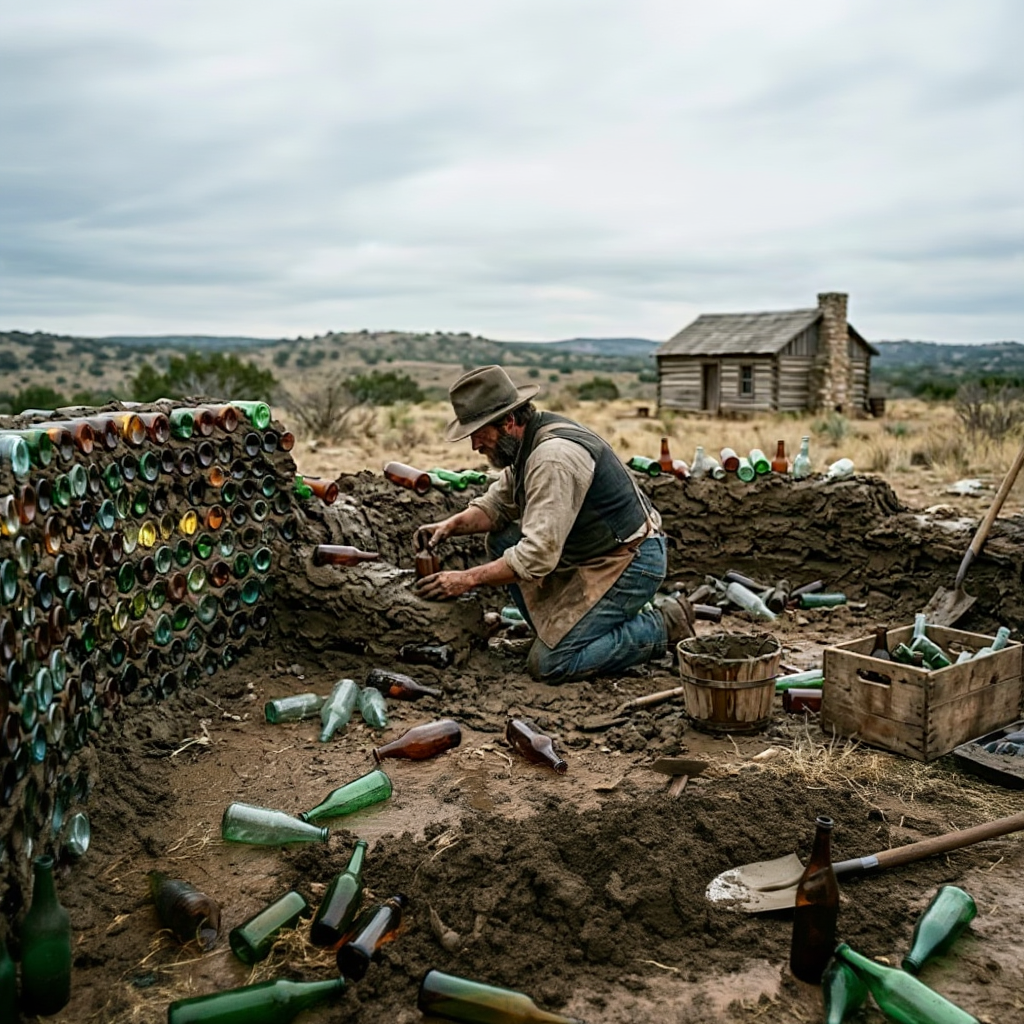
The first time anyone saw what he was actually building, they laughed.
Hard.
Three ranchers passing through stopped their horses and stared.
Elias, knee-deep in clay, worked silently, pressing bottles sideways into thick walls of prairie mud mixed with straw, sand, and lime.
Bottle necks pointed inward.
Rounded bottoms pointed outward.
Hundreds of circles of green and amber glass caught the weak sunlight like gemstones.
One rancher barked a laugh.
“Turner!”
Elias kept working.
“You building a saloon?”
The others roared.
Another called out.
“Or a greenhouse?”
Still no answer.
Then the oldest rider shook his head.
“That wall won’t last till Christmas.”
Elias finally looked up.
Wind tugged at his hat brim.
His eyes were calm.
“Then I’ll know by January.”
And he returned to work.
By October, the walls stood chest-high.
By November, shoulder-high.
By December…
People stopped laughing.
Because no matter how hard the prairie winds blew…
The walls didn’t move.
Clay dried into something closer to stone.
The bottles locked together like bones in a spine.
And every sunrise turned the unfinished structure into a lantern.
Green circles.
Amber circles.
Clear circles.
Hundreds of tiny windows glowing across the grassland.
Even from miles away, travelers could see it.
A strange jewel in the prairie.
Some called it foolish.
Some called it beautiful.
Anna would have called it practical.
Elias worked alone.
Every day.
Before dawn.
After dark.
Snow.
Mud.
Rain.
It didn’t matter.
He mixed clay with his boots.
Carried water in buckets.
Lifted crates of bottles until his shoulders screamed.
At night he slept in a canvas tent beside the foundation, wrapped in army blankets, waking every few hours to feed the fire.
Sometimes he spoke aloud.
To no one.
Or perhaps…
To Anna.
“South wall’s holding.”
“Need more straw.”
“Found twenty-two blue bottles today.”
“Wish you could see this.”
And then silence.
One evening in late December, twelve-year-old Tommy Crowley rode out with a sack of bottles tied to his saddle.
His mother had sent him.
Tommy found Elias kneeling by the west wall, lantern hanging nearby.
“Mr. Turner?”
Elias looked up.
The boy dismounted nervously.
“Ma said these are free.”
He held out the sack.
Elias took it.
Looked inside.
Blue medicine bottles.
Rare.
Perfect.
“Tell your mother thank you.”
Tommy nodded.
But didn’t leave.
Instead, he stared at the walls.
Moonlight shone through hundreds of bottle bottoms.
The structure looked alive.
“Does it… really keep the cold out?”
Elias studied the unfinished wall.
Then touched it with one rough hand.
“Come here.”
Tommy hesitated, then stepped closer.
Elias placed the boy’s palm against the clay.
“Feel that?”
Tommy blinked.
“It’s… warm.”
Elias nodded.
“Glass traps air.”
He tapped the wall.
“Air traps heat.”
Tommy’s eyes widened.
“So… it’s not crazy.”
Elias almost smiled.
“No.”
He looked up at the stars.
“Just different.”
The first blizzard came three weeks later.
Hard.
Fast.
Merciless.
Winds screamed at nearly sixty miles an hour.
Snow erased roads.
Buried fences.
Killed cattle.
Families stayed indoors and prayed their roofs would hold.
In town, people wondered about Elias.
Then forgot.
Because survival leaves little room for curiosity.
Three days later…
When the storm finally passed…
The men of Red Creek rode west expecting to find rubble.
Or worse.
Instead…
They found smoke rising calmly from Elias Turner’s chimney.
And sunlight shining through glass walls.
The riders dismounted in silence.
Snowdrifts stood shoulder-high.
But around the house…
Snow had melted in a perfect ring.
Heat.
Inside.
One of the men knocked.
The door opened.
And warm air rolled out.
Warm.
Dry.
Smelling of cedar and bread.
Elias stood there in shirtsleeves.
No coat.
No gloves.
No frost on his beard.
Just calm eyes.
“Morning.”
Nobody spoke.
Finally, old Ben Harper stepped forward.
“How?”
Elias stepped aside.
“Come see.”
Inside…
The men stared like children.
The bottle walls glowed with winter sunlight.
Green.
Amber.
Blue.
Tiny circles of color danced across the clay floor.
A cast-iron stove burned in the center.
But it wasn’t roaring.
Barely glowing.
Yet the room felt like spring.
Ben touched a wall.
Warm.
Another man whispered.
“Lord…”
Elias poured coffee into tin cups.
“Heat stays.”
He pointed.
“Clay holds it.”
Then to the bottles.
“Air keeps it.”
Silence.
Then Ben laughed softly.
Not mockery.
Wonder.
“You stubborn fool.”
Elias nodded.
“Usually.”
Ben raised his cup.
“To stubborn fools.”
Everyone drank.
By February…
People came from three counties away to see the bottle house.
Farmers.
Builders.
Widows.
Teachers.
Children.
Some brought bottles.
Some brought questions.
Some brought notebooks.
Elias answered when he felt like it.
Worked when he didn’t.
And slowly…
The lonely man who had buried his wife in spring became something else by winter.
Not a widower.
Not a blacksmith.
Not a madman.
A builder.
Years later, long after Elias Turner was gone…
The house still stood.
Prairie winds still struck it.
Snow still buried its foundation.
Sun still poured through thousands of colored circles.
And travelers still stopped to stare.
At first, they noticed the beauty.
Then the warmth.
Then, if they looked closely near the front door…
They noticed one green bottle, placed higher than all the others.
Different.
Older.
Smoother.
And beside it, carved into dried clay:
Nothing built by hand should ever be thrown away.
Anna Turner.
And somehow…
Neither had Elias.