
“She’s Preparing for Apocalypse”—Widow Inherits Cabin, Discovers Why Her Aunt Stockpiled for Years
By the time Eleanor Brooks reached Black Hollow Ridge, the sun had already disappeared behind the Colorado pines, leaving the mountain road washed in blue-gray shadow.
Her fingers tightened around the steering wheel as her aging pickup climbed the final gravel incline. The tires crunched over frost-hardened stone, echoing through the silent forest.
She almost turned back.
Twice.
At thirty-four, Eleanor had already buried a husband, sold a home, lost nearly every certainty she once believed permanent, and discovered that sympathy from friends lasted exactly six months before becoming awkward silence.
Now she was driving toward a cabin she’d inherited from an aunt she hadn’t seen in fifteen years.
Aunt Margaret Lawson.
The woman everyone in the family called crazy Maggie.
Or, when they thought Eleanor wasn’t listening—
“She’s preparing for apocalypse.”
Margaret collected seeds.
Margaret canned enough food to feed an army.
Margaret stored barrels of water.
Margaret refused banks, hated city governments, and once spent Thanksgiving explaining how “comfort makes people forget survival.”
Everyone laughed.
Everyone except Eleanor.
Because when Eleanor was ten, Aunt Margaret had looked her directly in the eye and said:
“One day, little bird, you’ll understand why some people prepare while others pretend.”
At the time, Eleanor thought it sounded dramatic.
Now, after burying her husband Daniel two winters earlier—
she wasn’t so sure.
The cabin appeared suddenly through the trees.
Small.
Weathered.
Built from hand-hewn pine logs.
Smoke curled gently from a stone chimney.
Eleanor frowned.
Smoke?
That was impossible.
The lawyer said the property had been vacant for six months since Margaret died.
She parked.
Killed the engine.
Silence.
Then—
A bark.
Deep.
Sharp.
She froze.
Another bark.
Then movement in the shadows.
A large German Shepherd emerged from beside the porch.
Its ears stood tall.
Its amber eyes locked onto hers.
Eleanor swallowed.
“Well…”
The dog didn’t move.
Neither did she.
Then the animal’s tail wagged once.
Slowly.
As if deciding.
Then it turned toward the porch and barked again.
Like it expected her to follow.
The cabin smelled exactly as she remembered.
Pine sap.
Wood smoke.
Dried herbs.
And something sweeter—
cinnamon.
She stepped inside cautiously.
The dog stayed close, never more than two steps away.
“Did you live here alone with her?”
The Shepherd tilted its head.
A faded leather collar read:
Ranger.
“Of course,” Eleanor whispered.
“Aunt Margaret would have a dog named Ranger.”
The kitchen looked untouched.
Cast iron pans.
Copper kettle.
Wood-burning stove.
Everything clean.
Organized.
Intentional.
Not abandoned.
Preserved.
Like Margaret had simply stepped outside.
And forgotten to return.
On the table sat a handwritten note.
Eleanor’s breath caught.
It was addressed to her.
For Eleanor.
If you’re reading this, I was right about your coming here.
And wrong about living long enough to explain why.
Start in the cellar.
Trust Ranger.
And don’t tell your cousins anything until you know the truth.
—M.
Eleanor read it twice.
Then a third time.
Her cousins had already called three times asking about “selling the old mountain shack.”
Her uncle wanted the land.
Her brother wanted timber rights.
No one had asked about Margaret.
Not really.
Ranger barked.
Then walked toward a wooden trapdoor.
Cellar.
Eleanor’s pulse quickened.
“Alright.”
She grabbed the lantern.
Opened the hatch.
And climbed down.
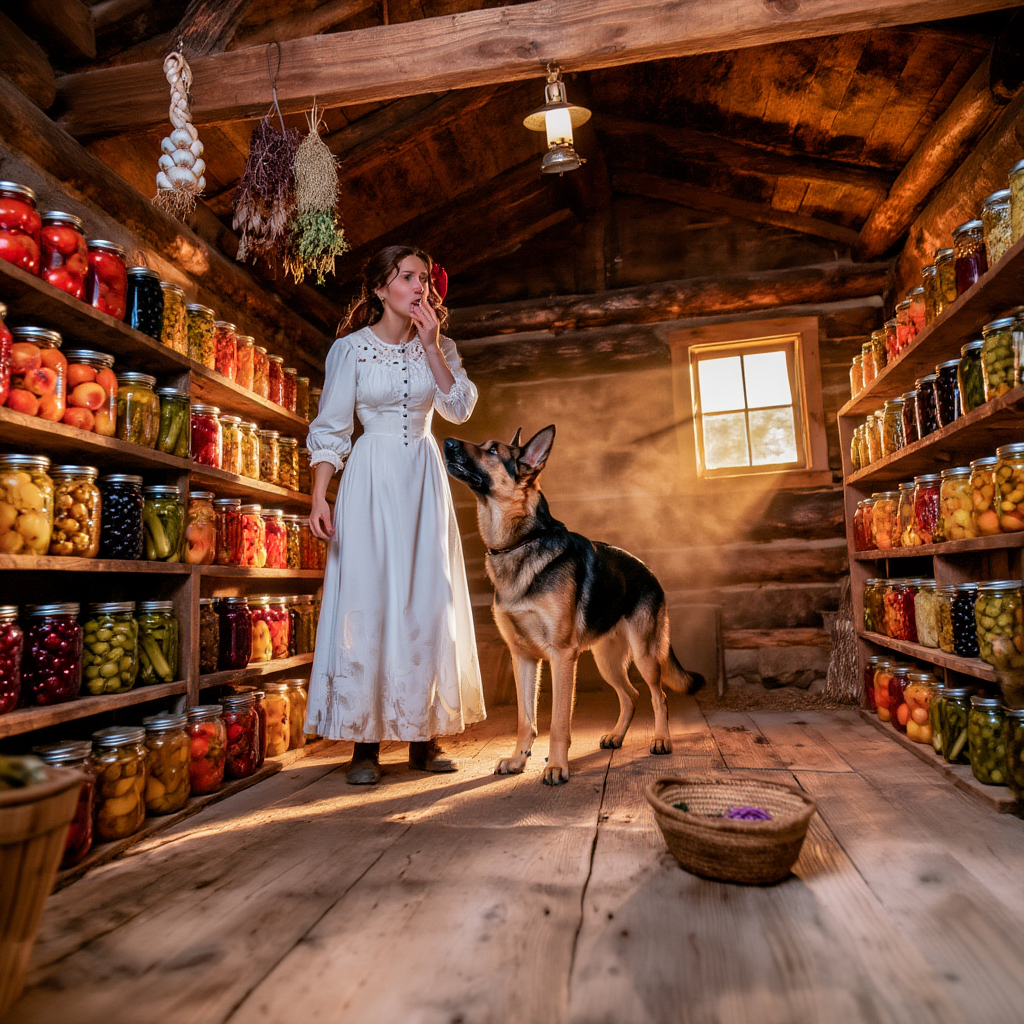
The cellar stole her breath.
Shelves lined every wall.
Floor to ceiling.
Thousands—
literally thousands—
of glass jars.
Peaches.
Beans.
Tomatoes.
Corn.
Pickles.
Preserved meat.
Dried fruit.
Medicinal herbs.
Honey.
Salt.
Rice.
Flour.
Vacuum-sealed grains.
Neatly labeled.
Dated.
Categorized.
Some dated fifteen years back.
Others—
just months before Margaret died.
Eleanor stood frozen.
In her long white dress, illuminated by golden lantern light, dust drifting in sunbeams from the small square window—
she looked less like a widow…
and more like someone stepping into another life.
Ranger sat beside her silently.
Watching.
Waiting.
Eleanor covered her mouth.
“Oh my God…”
No.
Not apocalypse.
This was something else.
This was…
systematic.
Scientific.
Intentional.
Then she noticed the notebooks.
Twenty-three of them.
Stacked neatly in wooden crates.
Each labeled by year.
She opened the first.
And everything changed.
Margaret wasn’t paranoid.
She was documenting.
Crop failures.
Drought cycles.
Wildfire expansion.
Supply chain vulnerabilities.
Water rights disputes.
Fuel shortages.
Disease outbreaks in livestock.
Federal land acquisitions.
Insurance collapses.
Population migration patterns.
Local reservoir levels.
And beneath every entry—
handwritten probabilities.
Predictions.
Dates.
Outcomes.
Eleanor’s heart pounded.
Because too many predictions…
had come true.
She opened notebook seventeen.
And stopped breathing.
One page was marked:
For Eleanor, if Daniel dies first.
Her hands shook.
She read.
If you are reading this, grief found you before wisdom did.
I’m sorry.
Daniel was always too kind for the world he worked in.
But loss sharpens vision if it doesn’t kill you.
Read carefully.
Tears blurred the ink.
“How…”
Ranger nudged her hand gently.
She kept reading.
The stockpile isn’t for apocalypse.
It’s for transition.
Systems fail slowly… then all at once.
Banks. Power. Food. Trust.
Most people notice too late.
I prepared not because the world ends—
but because comfort always does.
Eleanor sat on the wooden floor.
And cried.
For Daniel.
For Margaret.
For herself.
For all the years she spent trying to return to a life that no longer existed.
The next morning, her phone finally found signal.
Twelve missed calls.
Her cousin Richard.
Three voicemails.
She played the latest.
“Ellie, don’t get sentimental. The cabin’s worth half a million with the timber. Sign the papers.”
She deleted it.
Then another message.
Her brother.
“You’re not seriously moving into that survival bunker, are you?”
Delete.
Then one final message—
from the lawyer.
“Miss Brooks… there’s one thing your aunt requested. Please call me immediately.”
She called.
The lawyer’s voice sounded uneasy.
“Your aunt left additional instructions.”
“What instructions?”
A pause.
Then—
“She didn’t leave you the cabin.”
Eleanor frowned.
“What?”
“She left you… the valley.”
Silence.
Then the lawyer continued.
“Three hundred and forty acres. Water rights. Mineral rights. Two natural springs. Timber leases. And…”
He cleared his throat.
“A trust currently valued at 8.4 million dollars.”
Eleanor nearly dropped the phone.
“What?”
“She invested in agricultural commodities, infrastructure funds, and land acquisitions… for twenty-seven years.”
Her knees weakened.
“Why me?”
Another pause.
Then—
“She left a recorded message.”
The tape crackled.
Margaret’s voice filled the room.
Older.
Tired.
But sharp as ever.
“Because Eleanor understands loss.
And only people who lose everything learn what actually matters.
Money doesn’t build resilience.
Land does.
Water does.
Community does.
And if my family sells this place… they’ll destroy the one refuge hundreds may someday need.”
Eleanor’s throat tightened.
Then Margaret’s voice softened.
“If Ranger still trusts you… I made the right choice.”
Ranger rested his head against her knee.
And for the first time in two years—
Eleanor laughed through tears.
That winter came early.
Hard.
By November, three mountain roads closed.
By December, a blizzard buried half the county.
Power lines snapped.
Fuel deliveries stopped.
Grocery shelves emptied in forty-eight hours.
And suddenly—
everyone remembered crazy Maggie.
By the third day—
cars lined Eleanor’s driveway.
Neighbors.
Families.
Children.
People who once laughed.
Now shivering.
Hungry.
Ashamed.
Eleanor opened the door.
And smiled.
“Come in.”
The cellar fed thirty-two people.
Then forty.
Then fifty-three.
Ranger guarded the porch every night.
The wood stove never died.
The spring never froze.
And Margaret’s notebooks became survival manuals.
Not for apocalypse.
For community.
For transition.
For truth.
By spring—
Black Hollow Ridge wasn’t a dying mountain town anymore.
It was a working cooperative.
Gardens.
Livestock.
Solar panels.
Shared labor.
Shared food.
Shared purpose.
And above the cellar door—
Eleanor hung a wooden sign carved by hand.
Margaret’s words.
The words nobody laughed at anymore.
COMFORT ALWAYS ENDS.
PREPARATION BECOMES COMPASSION.
And every evening—
as golden light spilled through the cellar window onto thousands of colorful jars—
Eleanor would look at Ranger…
and whisper:
“She wasn’t preparing for the end.”
The old dog would thump his tail.
As if agreeing.
And Eleanor would smile.
“No…”
“She was preparing us for what comes after.”