
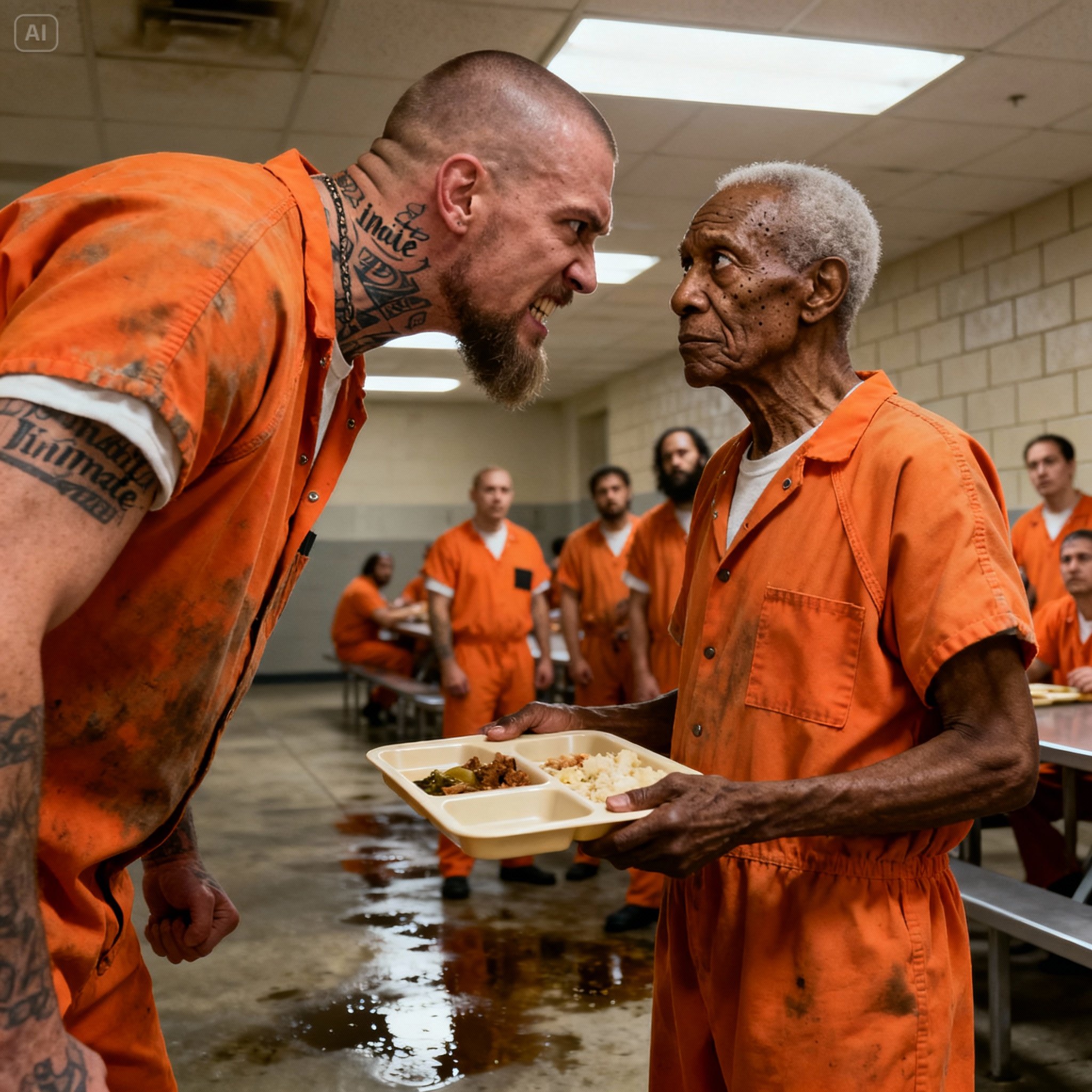
When the 72-year-old prisoner shuffled into the cafeteria, the predators saw only a frail old man. They never imagined his peaceful eyes held a sleeping giant, and their taunts were the one sound that would finally wake him.
The first thing everyone noticed about him was how slowly he moved.
The old man entered the cafeteria with a tray trembling in his hands, shoulders rounded as if the years themselves had bent him. His hair, thin and white, clung to his scalp like frost. His prison uniform hung loose, swallowed by a body that looked more memory than muscle. The guards barely glanced his way. In a place like Stonebridge Federal, attention was a currency the weak couldn’t afford.
The predators noticed him immediately.
They always did.
Stonebridge’s cafeteria was a theater of survival. Noise ricocheted off concrete walls—metal trays clanging, men shouting over one another, laughter sharp as broken glass. Strength ruled here, or at least the illusion of it. The strong took seats where they pleased. The weak learned to keep their eyes down.
The old man—Prisoner #44729—didn’t seem to know the rules. Or maybe he simply didn’t care.
He shuffled forward, squinting at the menu board as if he might find something new written there. Meatloaf. Powdered potatoes. Canned peas. Same as always. His hands shook when he reached for a plastic cup.
“Hey, Grandpa,” someone called. Laughter followed.
A group of younger inmates sat near the center tables, broad shoulders, tattoos crawling up their necks and arms. Their leader, a man named Vickers, leaned back in his chair and smiled like a wolf that had found a limping deer.
“Lost your walker?” Vickers said. “This ain’t bingo night.”
The old man paused. He turned his head slowly, as though sound took time to reach him. His eyes—pale blue, almost gentle—met Vickers’ for a brief moment.
Then he looked away.
Some men would have apologized. Others would have scurried off, tray clutched tight. But the old man simply continued walking, careful step after careful step, as if the taunts were just another background noise, like the hum of fluorescent lights.
That annoyed Vickers more than fear ever could.
“Hey!” Vickers snapped. He kicked his chair back and stood. “I’m talking to you.”
The cafeteria quieted a little. Men pretended not to watch while watching everything.
The old man stopped. His shoulders rose and fell with a soft breath. For a moment, he seemed impossibly tired.
“My hearing isn’t what it used to be,” he said calmly. His voice was low, steady, almost kind. “You’ll have to forgive me.”
The table erupted in laughter.
“Oh, he’s polite,” one of them said. “Ain’t that cute?”
Vickers stepped closer, towering over him. “You don’t sit unless someone says you can,” he growled. “That’s how it works.”
The old man nodded slowly, as if considering this new information. “I see.”
He took one more step toward an empty table by the wall.
That’s when Vickers slapped the tray.
Plastic clattered. Food spilled across the floor—brown gravy, pale peas, a dry slice of meatloaf. The cup tipped and rolled.
The cafeteria went silent.
The old man stared down at the mess. Something passed through his eyes then—not anger, not fear, but memory. Deep, distant memory.
Seventy-two years old.
That’s what the file said.
But the file didn’t mention the jungles.
It didn’t mention the nights without sleep, the months without mercy, the men who had learned—too late—not to mistake calm for weakness.
The old man knelt slowly, his joints protesting, and began to gather what he could from the floor. A guard shifted, watching lazily. Nothing unusual yet. Just inmates being inmates.
“Look at him,” Vickers said loudly. “Cleaning up like a good little—”
The old man spoke again, still quiet. “You should step back.”
Vickers blinked. “What did you say?”
“I said,” the old man repeated, his voice unchanged, “you should step back.”
The calmness unsettled them more than shouting would have.
Vickers smirked. “Or what? You gonna gum me to death?”
He reached out and shoved the old man’s shoulder.
The shove wasn’t hard. It didn’t need to be.
But something inside the old man shifted.
Later, men would argue about the exact moment it happened. Some would say it was when his spine straightened. Others would swear it was the eyes—that the peaceful blue went cold, distant, like a switch flipped behind them.
What everyone agreed on was this:
The air changed.
The old man rose to his feet, not hurried, not rushed. His hands stopped shaking. His shoulders squared.
When he looked at Vickers now, he wasn’t looking at a bully.
He was looking at a threat.
“You remind me of someone,” the old man said softly. “A long time ago. He thought noise made him powerful too.”
Vickers laughed once, uncertain. “You’re done, old man.”
He swung.
It should have ended there. A younger, stronger man against a frail seventy-two-year-old.
Instead, Vickers’ wrist was caught mid-swing.
The old man’s grip was iron.
There was no dramatic motion, no flashy move. Just a simple turn of the wrist, a step inside Vickers’ balance, and suddenly the younger man was bent forward, face inches from the table.
The sound that followed wasn’t a crack. It was a dull, final thud as Vickers collapsed to his knees, gasping.
The cafeteria exploded.
Chairs scraped back. Men shouted. Guards reached for batons.
But the old man wasn’t finished.
Two of Vickers’ friends rushed him, confidence turning to confusion as he moved—not fast, but precise. A hand to the elbow. A shift of weight. A body redirected into another. One man hit the floor hard, wind knocked clean out of him. The other stumbled back, eyes wide.
The old man stood in the center of it all, breathing evenly.
“Enough,” he said.
No one moved.
The guards finally charged in, shouting orders. Batons raised. The old man raised his hands immediately, palms open, compliance itself.
“It’s over,” he said. “I won’t resist.”
They cuffed him, rougher than necessary. As they dragged him away, men stared in stunned silence.
Vickers lay on the floor, groaning, pride shattered far worse than his body.
They put the old man in solitary.
The hole.
A concrete room barely larger than a closet. A thin mattress. A steel toilet. No noise but the echo of your own breathing.
He sat on the bed with his hands folded, eyes closed.
For the first time in years, the memories came back uninvited.
The jungle heat. The weight of a rifle. The responsibility of men younger than his own grandchildren now. He had learned long ago that violence was a door that, once opened, was hard to close again.
That’s why he had slept.
That’s why he had stayed quiet.
He wasn’t in prison because he was weak. He was there because once, decades ago, he had failed to stop when he should have. Because the giant had stayed awake too long.
A guard stopped outside his cell later that night.
“You okay in there, old-timer?” the guard asked, less mockery than before.
“Yes,” the old man replied.
The guard hesitated. “What were you… before?”
The old man smiled faintly in the darkness. “Someone who learned the cost of being noticed.”
Word spread fast in Stonebridge.
Predators learned to look away when the old man passed. Tables opened up near walls. Taunts died in throats.
He returned to the cafeteria days later, moving just as slowly as before, hands trembling again as he lifted his tray. To anyone watching closely, it might have seemed like nothing had changed.
But no one touched him.
No one laughed.
Because now they knew.
Peaceful eyes didn’t mean harmless.
Sometimes, they meant controlled.
And somewhere deep inside the seventy-two-year-old prisoner, the giant lay back down—not gone, just resting—waiting for the day he would never have to wake again.