
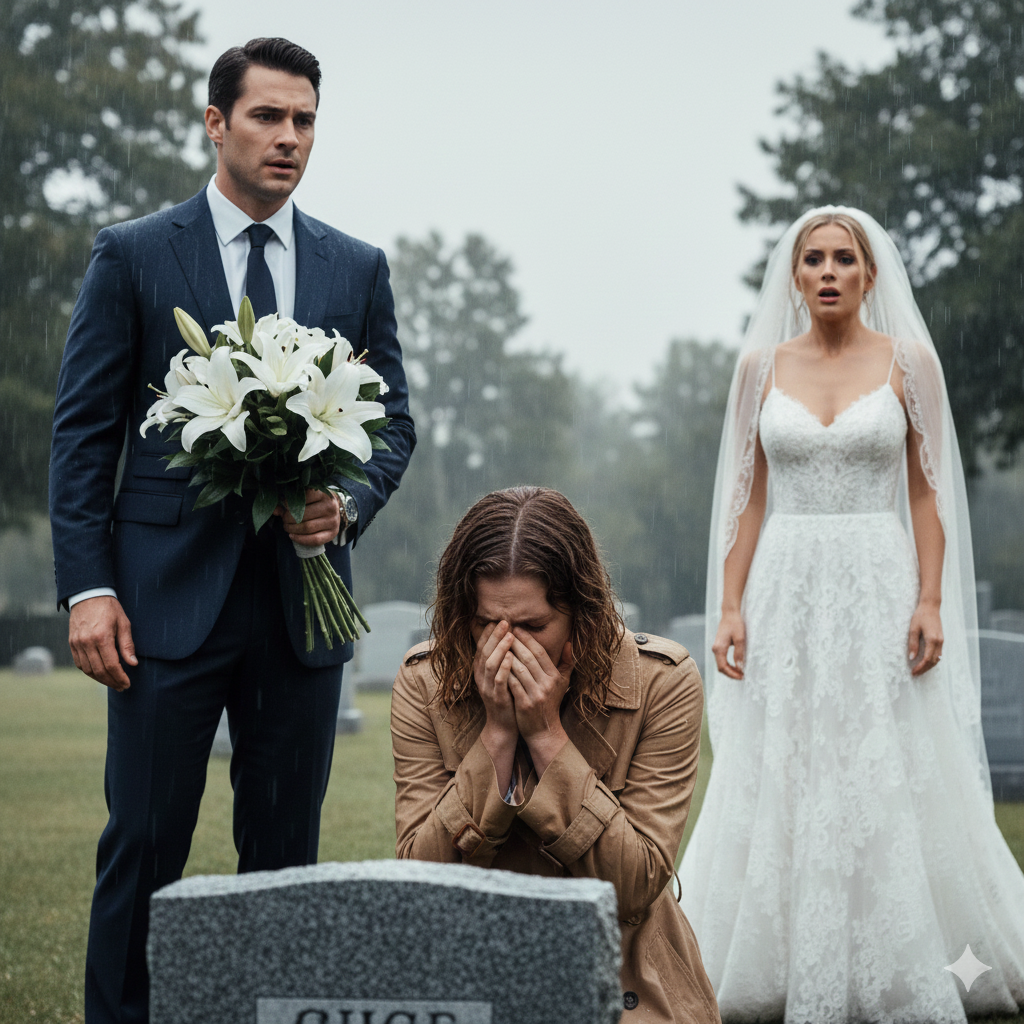
The Day Before My Wedding, I Went to Say Goodbye to My Late Wife — I Thought It Would Bring Me Peace, But Meeting a Mysterious Woman Beside Her Grave Revealed a Secret That Could Have Shaken the Marriage I Waited Years to Begin
I should have felt nothing but joy the day before my wedding.
Nervous excitement, sure. Maybe a little disbelief that after so many lonely years, I had found love again.
Instead, I felt a familiar heaviness settle in my chest as I drove up the winding road to Cedar Hill Cemetery, a bouquet of white lilies in the passenger seat.
They used to be her favorite.
My late wife, Emily, had once joked that lilies smelled like clouds—soft and clean and too good for this world.
She had been right about that.
She had been right about many things.
But she wasn’t here anymore.
She had been gone for three years, taken by a rare complication after an unexpected surgery—one of those tragedies people shake their heads at and say, “How could that happen to someone so young?”
I had spent months afterward half-alive, going through the motions, barely functioning. My friends didn’t think I would ever return to myself.
But then Rachel came into my life—slowly, gently, without pushing.
And eventually… with time, grief softened.
I learned how to laugh again, how to plan for a future instead of looking backward.
Tomorrow, I was supposed to marry her.
But today, I needed one last moment with Emily—one last conversation, even if it was with the quiet stone that bore her name.
A goodbye.
A blessing.
Something.
The Stranger at the Grave
The cemetery was unusually quiet. Even the breeze felt respectful, stirring fallen leaves in soft circles.
I parked, grabbed the lilies, and walked the familiar path to the far corner where Emily lay. I could have found it blindfolded.
But today, something was… unusual.
A woman stood in front of Emily’s headstone—tall, slender, wrapped in a pale gray coat that fluttered in the breeze. Her dark hair drifted across her face.
At first, I thought she must have been lost.
Then I thought—maybe she was visiting someone nearby.
But no.
She was staring directly at my wife’s grave.
My steps slowed.
She didn’t move, didn’t turn, didn’t speak.
And then, as though she had somehow sensed me, she whispered:
“You must be Michael.”
A chill slid down my spine.
“Yeah,” I said cautiously. “Do I… know you?”
She turned toward me.
Her eyes were soft but sad, framed by long dark lashes. She looked to be in her late twenties—around the same age Emily had been.
“No,” she murmured. “You don’t know me. But I knew your wife.”
Something in her tone—gentle, steady, threaded with pain—made the air feel thinner.
“You knew Emily?” I asked. “How?”
She gave a small, hesitant smile.
“I’m Laney,” she said. “Emily’s sister.”
I blinked.
“My wife didn’t have a sister,” I said automatically. “She was an only child.”
Her expression softened with pity.
“That’s what she told you.”
The breeze stilled.
I stared at her, my heart beginning to pound.
“What are you talking about?” I said, trying to keep my voice even. “Emily didn’t have any siblings. Her mother—”
“—her mother gave me up,” Laney said quietly. “When I was two. Emily was five.”
The ground felt unstable beneath me.
“What?” my voice cracked.
“I’m her biological sister,” she repeated. “We share the same mother. Different fathers.”
I stood frozen, lilies dangling uselessly in my hand.
None of this made sense.
Emily would have told me.
She would have told me something this important.
Wouldn’t she?
A Truth Buried in Silence
I glanced at Emily’s headstone, as though it might suddenly speak, explain, reassure.
Laney followed my gaze, her voice gentle.
“She never told you because she didn’t want to hurt you. Or be a burden.”
“A burden?” I echoed. “A sister isn’t a burden.”
Laney gave a sad smile.
“You didn’t know her mother. Or how deep the wounds went.”
I swallowed hard.
I knew some of it—Emily had confided bits and pieces about her mother’s instability, her unpredictable moods, the childhood she preferred not to remember.
But a secret sister?
Why would she hide something like that?
Laney spoke softly, as though reading my thoughts.
“When I was two, social services took me away. Her mother refused to get treatment. Emily’s father was already gone. There was no one stable enough to keep us together.”
Laney’s voice trembled but didn’t break.
“I grew up in and out of foster homes. Emily grew up thinking she wasn’t good enough to save me. Her mother made sure she believed that.”
My stomach twisted.
No wonder Emily had never spoken of this.
She had carried this weight—this guilt—alone.
“Did you ever reconnect?” I asked.
Laney nodded slowly.
“As adults, yes. She found me. She was terrified I’d reject her, but I didn’t.”
She smiled faintly. “She was the best thing that ever happened to me. Kind. Brave. She helped me get through school. Visited me whenever she could.”
I felt a pressure building behind my eyes.
“She never mentioned you,” I whispered. “Not once.”
Laney inhaled shakily.
“She didn’t want you to see her past. She thought you deserved someone unbroken.”
The words stabbed deeper than I expected.
Emily—sweet, stubborn Emily—always trying to carry everything alone.
Always trying to protect everyone except herself.
Laney placed her hand gently on the cold stone.
“When she died,” she said softly, “I thought about coming to see you. But I didn’t want to intrude on your grief. And then I heard you were finally getting married again. I thought… today might be the only moment I’d get.”
I felt tears sting my eyes.
“I’m glad you came,” I whispered.
She exhaled a shaky breath of relief.
The Missing Goodbye
Laney looked down.
“I wasn’t there when she passed,” she said. “We had spoken the week before. She told me you were her safe place, that you made her believe in gentle things.”
My throat tightened.
“She talked about you all the time,” Laney continued. “The way you held her hand when she was scared. The way you made pancakes that looked like crime scenes. The way your laugh made her feel like things could still be okay.”
I laughed softly through the ache in my chest.
“That bad, huh?”
Laney smiled.
“Terrible. She said you should never open a restaurant.”
I wiped at my eyes.
The ache of loss was still there—but something else was rising too.
Warmth. Gratitude.
“She loved you,” Laney said. “More than she ever thought she could love someone.”
She hesitated, then added:
“And she wanted you to live again. To love again. She made me promise… if I ever met you, to tell you that.”
The tears spilled freely then.
I didn’t try to hide them.
I sank down onto the cold stone bench beside the grave, and Laney silently sat next to me.
For a long time, we just sat there—two strangers bound by someone who loved us both.
The Letter
After a while, Laney reached into her coat pocket.
“I brought something,” she whispered. “Emily wrote it before she passed. She asked me to give it to you someday, when it felt right.”
My breath caught.
A small envelope rested in her palm, worn at the edges but carefully preserved.
My name was written in Emily’s hand.
Everything inside me wanted to tear it open instantly—but something in me needed to wait.
To breathe. To steady myself.
With trembling fingers, I opened it.
Inside was a short letter, written in her familiar looping handwriting:
My love,
If you’re reading this, it means you chose to live. And that makes me the happiest woman who ever existed.
You once asked me what scared me most. It wasn’t dying. It was leaving you stuck in the sadness I carried for so many years.
You deserve someone who can walk beside you in the sunlight, not someone whose heart lived too long in the dark.
Love again. Please. I want that for you. I want you to feel laughter in your bones.
And when you stand at my grave someday, don’t come with guilt. Come with gratitude. I loved you with everything I had.
—Emily
The words blurred as my vision swam.
When I finally looked up, Laney’s eyes were shining too.
“She wanted you to be free,” she said softly.
A New Kind of Goodbye
We stayed there for nearly an hour, sharing stories, laughter, tears—pieces of Emily that each of us had known separately.
As we finally stood to leave, Laney placed a hand on my arm.
“I’m sorry if finding out today… complicated things,” she murmured. “On the eve of your wedding.”
I shook my head.
“No,” I said firmly. “It didn’t complicate anything. It completed something.”
She looked startled.
“I’ve been holding onto guilt,” I admitted. “For moving on. For loving again. But today… you and Emily gave me something I didn’t even know I needed.”
“Peace,” she whispered.
I nodded.
“For the first time since she passed.”
Laney’s smile trembled.
“I’d like to come by again,” I said. “To hear more stories about her. If you’re open to that.”
Her eyes softened.
“I would like that very much.”
The Wedding Day
The next morning, I woke with something I hadn’t felt in years: lightness.
At the altar, when Rachel walked toward me—her eyes bright, her smile trembling with emotion—I felt present in a way I hadn’t known I was capable of.
She took my hands and whispered:
“You look peaceful.”
I smiled.
“I am.”
During our vows, as my voice steadied, I silently thanked Emily.
Not for letting me go, but for loving me enough to want me to keep living.
After the ceremony, I stepped aside for a moment, gazing up at the bright, endless sky.
And for the first time since losing her, I felt no guilt.
No chains.
Just gratitude for the love that had shaped me—and for the new love waiting to shape everything that came next.
Epilogue — What She Left Behind
A month later, I met Laney for coffee.
She brought a small box filled with photos, postcards, tiny pieces of a life Emily had shared with her sister but hidden from everyone else.
We laughed.
We cried.
We learned each other.
And in doing so, a new bond formed—one Emily never got to witness, but somehow, I believe she hoped for.
Grief, I realized, doesn’t disappear.
It transforms.
It expands.
It opens doors when we finally stop locking them.
Saying goodbye the day before my wedding didn’t break me.
It healed me.
Because love—past or present—doesn’t compete.
It builds.
It teaches us how to hold more.
And in that quiet cemetery, with a stranger who shared my wife’s blood and her smile, I learned the one truth that set my heart free:
Letting go doesn’t mean loving less.
It means making room for the life waiting to begin.