
US Delta Force Mocked the Old Veteran’s Tattoo — Until the General Rolled Up His Sleeve
The bar was loud in the way only a military town bar could be—half laughter, half bravado, and just enough bitterness floating in the air to remind everyone that war never really stayed overseas.
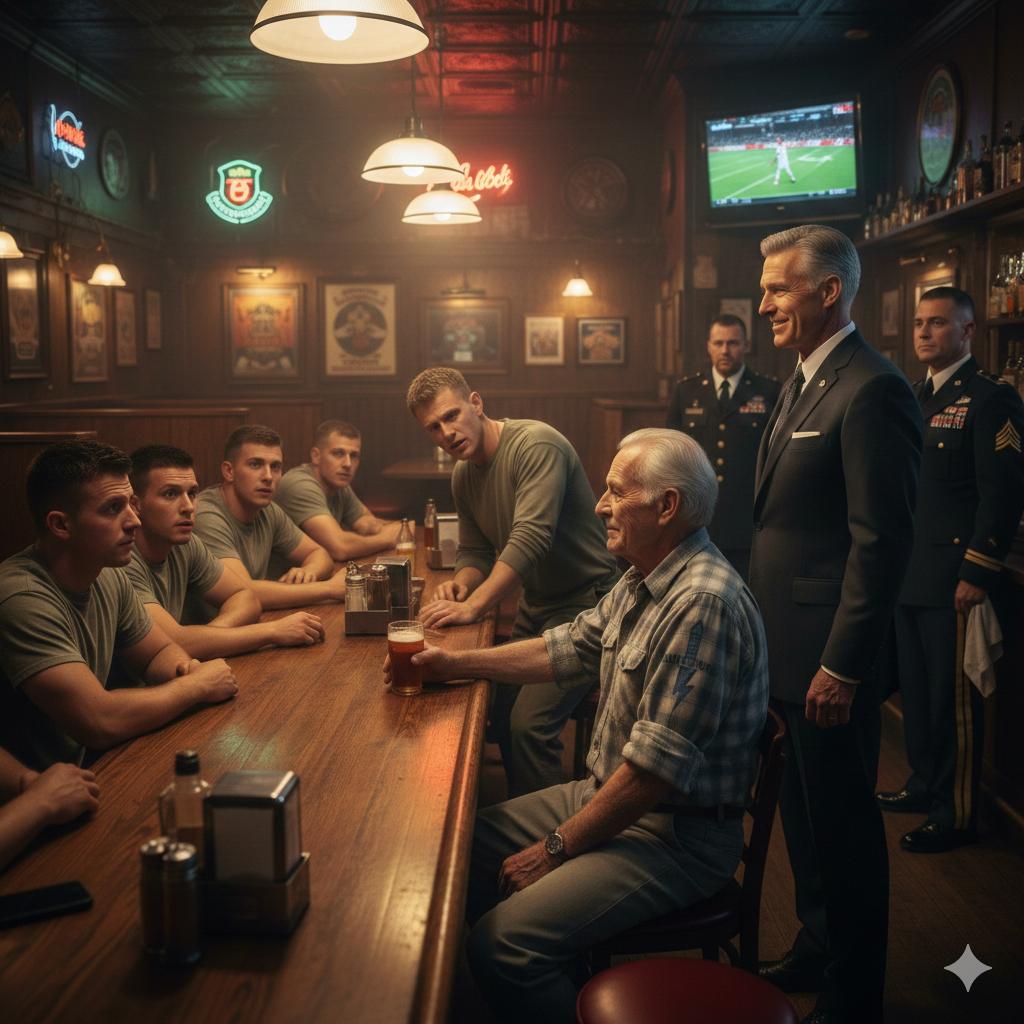
It was a Friday night in Fayetteville, North Carolina, just a few miles from Fort Liberty. Delta Force operators—active-duty, young, hardened, and confident—filled the long wooden table near the back. They wore civilian clothes, but their posture, the quiet way they scanned the room, and the short haircuts gave them away instantly.
At the far end of the bar, almost invisible, sat an old man.
He couldn’t have been less noticeable if he tried. His back was slightly hunched, his hair silver and thinning, his flannel shirt faded from decades of washing. A half-empty beer sat untouched in front of him. He watched the television quietly, not cheering, not complaining—just observing.
What did stand out, however, was his forearm.
As he reached for his drink, the sleeve slid back just enough to reveal an old tattoo. The ink had faded to a dull blue, the lines softened by age, but it was still clear enough:
A dagger piercing a lightning bolt.
Above it, in block letters:
“WHO DARES WINS.”
One of the Delta operators noticed it first.
He nudged the guy next to him and smirked.
“Hey. Check out grandpa over there.”
The others followed his gaze.
Another leaned forward, squinting. “Is that… supposed to be SAS?”
Laughter rippled across the table.
“Come on,” a third said, shaking his head. “That tattoo looks like it was done with a rusty needle in the ’70s.”
“Probably some old biker symbol he thinks is special forces,” someone else added.
They laughed louder this time, emboldened by beer and youth.
One of them stood up, swaggering slightly as he walked toward the old man. He leaned against the bar next to him, pretending to stretch.
“Hey, old-timer,” he said casually. “Nice ink.”
The old man didn’t look at him immediately. He took a slow sip of his beer, then turned his head.
“Yes?” he replied calmly.
The operator pointed at the tattoo. “That supposed to be special forces?”
The old man glanced at his own arm, as if noticing it for the first time in years.
“I suppose it is,” he said.
The operator chuckled. “You know that’s a real unit, right? Not just a cool slogan.”
“I’m aware.”
“Well,” the operator grinned, “no offense, but you don’t exactly look like someone who’d survive selection.”
More laughter erupted from the table behind them.
The old man didn’t flinch. His expression didn’t change.
“You’d be surprised what people can survive,” he said.
That only made things worse.
Another operator shouted from the table, “Hey, grandpa, where’d you get that tattoo? Cracker Jack box?”
The bartender shot them a warning look, but the damage was done.
The old man set his beer down gently.
“May I ask you something?” he said, looking directly at the young operator beside him.
“Sure,” the man said, still smirking.
“Why did you join?”
The question seemed to catch him off guard.
“What?”
“Why did you choose this life?” the old man repeated. “The long nights. The training. The risk.”
The operator shrugged. “To be the best. To protect this country. To be part of something elite.”
The old man nodded slowly.
“Good answers.”
He turned back toward the TV, signaling the conversation was over.
But before the operator could walk away, the bar door opened.
And the room shifted.
Conversation softened, then stopped entirely.
A tall man in a dark suit entered, flanked by two officers in uniform. His posture was unmistakable—straight-backed, deliberate, authoritative. His hair was gray, his expression sharp, his presence commanding in a way that didn’t ask for attention but demanded it.
The bartender froze.
Someone whispered, “Holy hell…”
The man scanned the room once, then his eyes landed on the old man at the bar.
A smile flickered across his face.
He walked straight past the Delta operators, ignoring their stunned expressions, and stopped beside the old man.
“Didn’t think I’d find you here,” he said warmly.
The old man chuckled. “Didn’t think I’d be found.”
The suited man extended his hand.
“General Robert H. Caldwell,” he said—though nearly everyone already knew who he was.
The Delta operators stiffened.
The general turned slightly toward them, his gaze calm but piercing.
“Gentlemen,” he said. “Mind if I join my friend?”
“Sir—no, sir,” one of them stammered.
The general sat down.
Then, slowly, deliberately, he rolled up the sleeve of his crisp white shirt.
The room went silent.
On his forearm was the same tattoo.
A dagger.
A lightning bolt.
WHO DARES WINS.
But beneath it, etched deeper, darker, more precise, was something else:
A small set of coordinates.
The old man finally spoke.
“Looks like yours aged better than mine,” he said dryly.
The general smiled. “You always let yours fade first.”
One of the Delta operators swallowed hard.
“Sir… with all due respect… what is this?”
The general looked at them for a long moment before answering.
“This,” he said, tapping the tattoo, “is brotherhood. This is history. This is the reason you’re able to sit here tonight pretending you know what elite means.”
The room was so quiet you could hear the ice melting in glasses.
The general continued.
“Before Delta Force had a name, before there were patches or budgets or recruiting posters, there were men like him.”
He nodded toward the old man.
“Vietnam. Laos. Cambodia. Black operations so classified they didn’t officially exist. Missions that couldn’t fail and couldn’t be acknowledged if they did.”
The old man stared into his beer.
“They trained us,” the general said softly. “They bled so we could learn what not to do.”
One of the operators spoke, voice barely above a whisper.
“Sir… is he—?”
The general cut him off.
“He’s the reason Delta Force exists.”
The old man sighed.
“That’s an exaggeration.”
“Not to me,” the general replied.
He turned back to the operators.
“You laughed at his tattoo,” he said evenly. “But that ink was earned when half of you weren’t even a thought yet. Every line was paid for in sweat, blood, and friends who never made it home.”
The operator who had first approached the old man stepped forward.
“Sir… I didn’t know.”
The old man finally looked at him again.
“Of course you didn’t,” he said. “And that’s okay.”
He paused.
“What matters is what you do after you learn.”
The operator straightened, eyes glistening.
“I’m sorry, sir.”
The old man extended his hand.
The young man shook it, gripping tighter than expected.
“Don’t apologize to me,” the old man said. “Honor the ones you haven’t met yet.”
The general stood.
“Gentlemen,” he said to the Delta operators, “remember this night. Skill fades. Strength fades. Titles fade.”
He nodded toward the old man one last time.
“But legacy doesn’t.”
As the general left, the bar slowly came back to life—but nothing felt the same.
The Delta operators returned to their table in silence.
And the old man?
He finished his beer, pulled his sleeve back down, and walked out unnoticed—just another veteran disappearing into history, carrying stories too heavy for tattoos alone.