
I Saved a Life & Got Fired. 20 Minutes Later, Special Forces Landed on the Roof and Screamed My Name
The day I got fired started like any other Tuesday.
I was three minutes late, which in the world of private security might as well have been a felony. The elevator was slow, my coffee was cold, and my supervisor, Brent Wallace, was already standing behind the front desk with his arms crossed, tapping his watch like he enjoyed it.
“You’re late again, Miller,” he said loudly enough for the lobby to hear.
“I know,” I replied. “The bus—”
“Excuses,” he cut in. “One more slip and you’re done.”
I nodded and clipped my badge to my belt.
I needed this job.
Thirty-eight years old. Divorced. One teenage son I barely saw because child support didn’t care about excuses either. Being a security guard at a downtown Chicago medical research tower wasn’t glamorous, but it paid the bills.
And that building… that building held things I didn’t fully understand.
Floors with no names. Labs with biometric locks. People who never made eye contact and carried themselves like they were always being watched.
I was told my job was simple: observe and report.
Not intervene.
Not improvise.
Just watch.
At 10:42 a.m., everything went wrong.
I was monitoring the cameras when I noticed a man stumbling near the restricted elevator bank on Level 7. He was wearing a lab coat, but his movements were off—unsteady, disoriented.
I zoomed in.
His face was pale. Sweat soaked his collar.
Then he collapsed.
Protocol said I should call it in and wait.
But something in my gut twisted.
I grabbed my radio. “Medical emergency on seven. I’m going up.”
“Negative,” Brent snapped back instantly. “Wait for response.”
“I don’t think he has time,” I said, already running.
I took the stairs two at a time.
When I reached Level 7, the man was convulsing. His lips were turning blue.
I dropped to my knees, checked his pulse—weak and erratic.
“Hey,” I said, shaking him gently. “Stay with me.”
His eyes fluttered open just long enough to focus on my face.
“Don’t… let them take me back,” he whispered.
Then his body went limp.
I pressed my ear to his chest. His heartbeat stuttered.
I didn’t think.
I acted.
I rolled him onto his side, cleared his airway, and remembered something from my EMT training years ago—training I never finished because life had gotten in the way.
His breathing was shallow, irregular.
I used my radio again. “I need a crash cart NOW.”
Static.
Then Brent’s voice, sharp and furious. “Miller, you violated protocol. Step away from the patient.”
“He’s dying,” I shouted.
Security arrived moments later. Not medical.
They tried to pull me back.
I shoved one of them away. “Give me thirty seconds!”
I pressed hard on the man’s chest when his breathing stopped completely.
One. Two. Three.
Then—gasp.
A violent inhale.
The man coughed, sucking air like he’d been underwater.
Relief flooded through me.
And immediately after—anger.
Brent stormed down the hall, face red.
“You’re DONE,” he yelled. “Badge. Now.”
Medical staff finally arrived, rushing the man onto a gurney.
As they wheeled him away, he grabbed my sleeve weakly.
“They’re watching,” he whispered. “Tell them… the Falcon protocol is compromised.”
Before I could ask what that meant, he was gone.
Brent yanked my badge off my belt.
“You’re fired for insubordination,” he said. “Escort him out.”
Just like that.
No thank you.
No questions.
I was out of the building by 11:05 a.m.
I sat on the curb with my box of belongings, hands shaking.
I’d saved a man’s life.
And lost mine in the process.
Twenty minutes later, the sky roared.
At first, I thought it was construction.
Then I heard the chop-chop-chop of rotor blades.
People screamed.
I looked up.
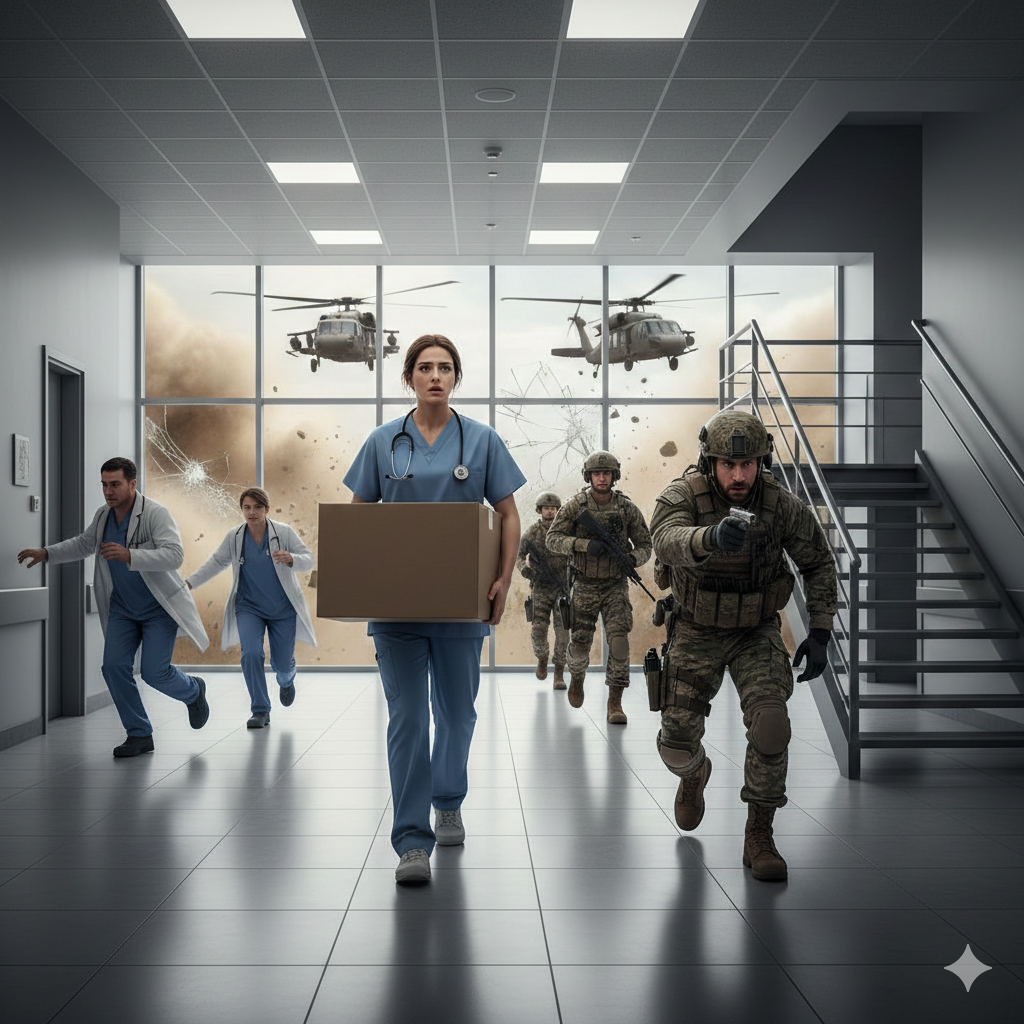
Two black helicopters descended between buildings like something out of a war zone. Ropes dropped. Men in full tactical gear slid down with terrifying precision.
They didn’t touch the street.
They landed on the roof.
Sirens wailed. Police cars screeched to a halt.
Then someone grabbed my shoulder from behind.
I turned—and stared into the barrel of a rifle.
“Don’t move,” a voice commanded.
“I—I’m a civilian,” I stammered.
Another soldier approached, eyes locked on my face.
“Name,” he barked.
“Daniel Miller.”
The man froze.
Then he pressed his hand to his earpiece.
“We’ve got him,” he said. “Target confirmed.”
My stomach dropped.
Target?
They hauled me to my feet and dragged me toward the building I’d just been thrown out of.
“Wait!” I yelled. “I didn’t do anything!”
One of them leaned close and said quietly, “You did exactly what you were supposed to.”
They took me to the roof.
A command center had been set up in minutes. Screens. Satellites. Armed men everywhere.
Then a woman stepped forward.
She wore civilian clothes, but her posture screamed authority.
“Mr. Miller,” she said calmly. “I’m Colonel Rebecca Hayes, U.S. Special Operations Command.”
My knees nearly gave out.
“You saved Dr. Alan Pierce,” she continued. “One of the most protected assets in this country.”
I blinked. “He was dying.”
“Yes,” she said. “Because someone tried to kill him.”
She showed me a tablet.
Footage of the lab.
A syringe. A disguised toxin. A delayed reaction.
“Dr. Pierce is leading a classified defense project,” she said. “Code-named Falcon.”
The word hit me like ice.
“He mentioned Falcon,” I whispered.
Her eyes sharpened. “What exactly did he say?”
I told her everything.
The whisper. The warning.
The compromised protocol.
When I finished, the colonel nodded slowly.
“You just exposed a breach that could have cost thousands of lives,” she said.
“But I got fired,” I said weakly.
She smiled—just slightly.
“That’s about to change.”
Within an hour, the building was locked down. Brent was escorted out in handcuffs.
Turns out, he’d been paid to delay response times. To enforce protocol too strictly.
The man I’d saved?
He lived.
And he insisted on seeing me.
Dr. Pierce was pale, hooked to monitors, but when he saw me, he smiled.
“You ignored orders,” he said.
“Yeah,” I replied. “Cost me my job.”
He shook his head. “No. It earned you a new one.”
A week later, I stood in a federal office, signing papers I barely understood.
I wasn’t becoming a soldier.
I wasn’t becoming a spy.
I was becoming what they called a civilian safeguard—someone whose instincts had proven more valuable than rules.
Colonel Hayes shook my hand.
“We can train skills,” she said. “We can’t train courage.”
My son visited me that weekend.
“What happened, Dad?” he asked.
I smiled.
“I did the right thing,” I said. “And it almost ruined me.”
He nodded slowly.
“Would you do it again?”
I didn’t hesitate.
“Every time.”
Because sometimes, the moment you lose everything—
Is the moment the world finally notices who you are.