
She Built a Secret Room Under Her Cabin and Was the Only One Who Stayed Warm During the Blizzard
The wind began as a whisper along the eaves, the kind of restless breath that rattled loose shingles and tugged at the edges of a quiet afternoon. By nightfall, it had grown teeth.
Clara Whitmore paused at the small window of her cabin, her fingers still dusted with flour. Outside, the Wyoming valley had turned gray, the horizon dissolving into a wall of moving snow. The cottonwoods along the creek bent like old men bowing under invisible hands. She had seen storms before—three winters on this land had taught her that—but something about this one felt deliberate, patient, and heavy.
She wiped her hands on her apron and glanced across the room. Her cabin was small: one table, one iron stove, one narrow bed, and shelves built from rough pine. It was enough. It had always been enough. But Clara’s eyes drifted to the trapdoor beneath the braided rug.
No one else knew about it.
Not the McAllisters from two miles downriver. Not the traveling preacher who’d visited last autumn. Not even her late husband, Daniel, who had died before she finished it. The secret room beneath the cabin had been her quiet insurance, a stubborn idea she refused to abandon even when neighbors laughed.
“You planning to hide from ghosts down there?” old Mr. McAllister had asked.
Clara had smiled politely and kept digging.
Now, as the first violent gust slammed snow against the window, she crossed the room and rolled the rug aside.
The wooden hatch blended almost perfectly with the floorboards. She knelt, slid her fingers into the narrow groove, and lifted. The hinges creaked softly. A wooden ladder descended into darkness.
Warmth drifted up to meet her.
She exhaled, relief loosening the tension in her shoulders. The fire below was still alive.
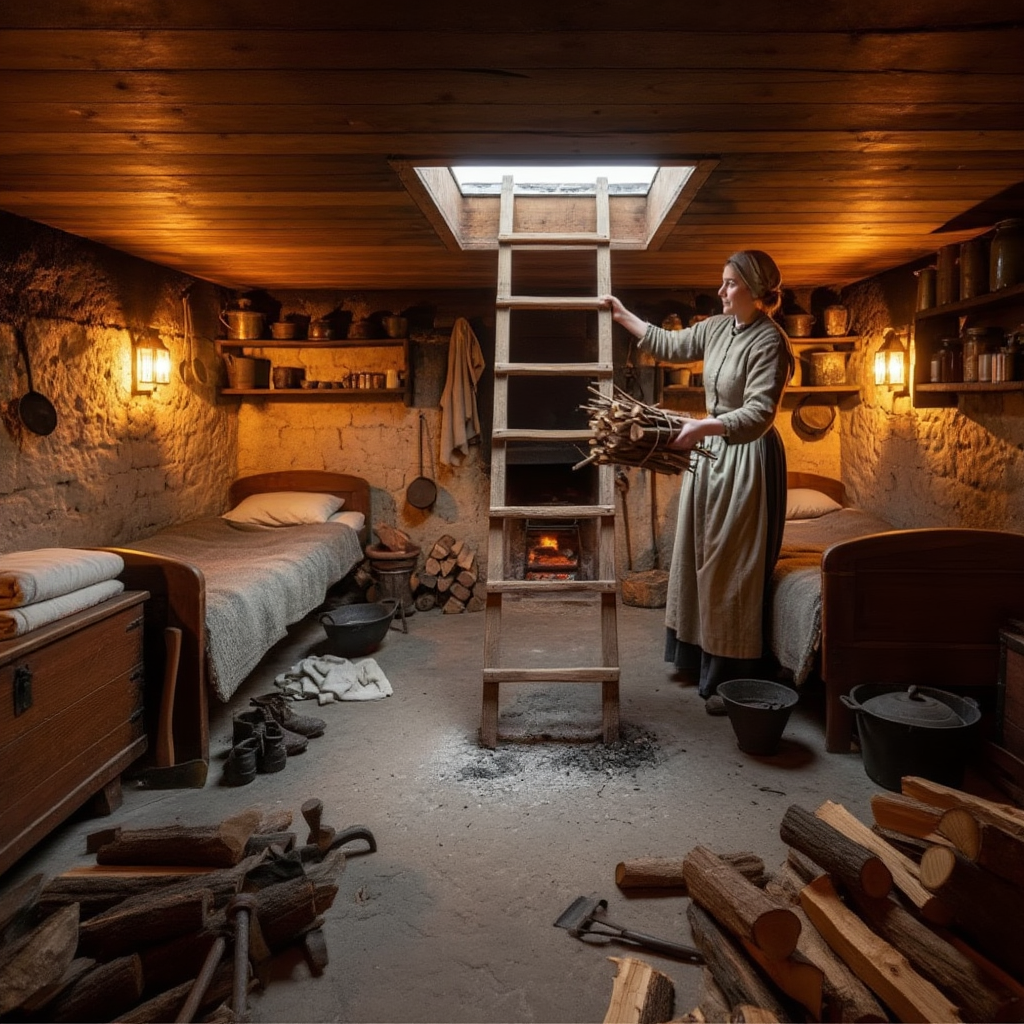
Clara descended carefully, boots finding each rung. The light from above fell in a bright square through the open hatch, illuminating the underground room she had carved from stubborn clay and stone.
It was wider than the cabin above. Stone walls curved slightly inward, reinforced with timber beams cut by hand. The ceiling was low but sturdy, thick with earth that insulated against wind and cold. A small chimney tunnel angled upward from the fireplace, cleverly hidden within the cabin’s outer wall.
In the center, the ladder rose toward a small skylight—really just a reinforced glass panel set into a shallow shaft. Daylight poured down in pale silver, mixing with the amber glow of lanterns and the fire.
Clara set the bundle of thin wooden sticks beside the hearth and added them carefully. Flames licked upward, brightening the room.
To the left of the ladder stood a simple wooden bed covered with a textured gray blanket. She had stuffed the mattress herself with dried grasses and wool scraps. A white pillow rested at its head. On the right, another bed—unfinished when she first built it—now stood ready, identical, waiting.
She never told anyone why she built two.
Wooden chests lined the far wall, filled with dried beans, salted pork, and sacks of flour. Firewood was stacked in careful towers. Cast iron pots sat on the stone floor. Shelves held jars of preserves—peaches, carrots, wild berries—glowing like stained glass in the lantern light.
Clara moved slowly, checking each corner like a captain inspecting her ship before a storm.
Above her, the wind howled.
Snow struck the skylight in bursts, a soft drumming that grew heavier with each passing minute. The sound reminded her of Daniel hammering nails years ago, back when the cabin was just a frame and a dream.
She sat on the edge of the left bed and rubbed her hands together. Already, the cold that seeped into her bones upstairs began to loosen.
The storm hit fully an hour later.
The wind roared like a freight train, and the skylight dimmed until daylight became a muted glow. Snow piled against the shaft, turning the light bluish and thin. Clara climbed halfway up the ladder and pushed gently against the hatch. It resisted.
Good. That meant snow was sealing the cabin.
She climbed back down, pulling the hatch closed above her. The latch clicked softly. The room settled into a cocoon of warm gold.
For the first time since afternoon, she allowed herself to rest.
She stirred a pot of beans over the fire, listening to the storm rage beyond the earth walls. The heat stayed trapped below, thick and comforting. She loosened her collar and leaned back against a wooden chest.
Daniel had called her stubborn.
“You don’t build a cellar like this unless you’re planning for the end of the world,” he’d joked.
She had answered quietly, “No. Just winter.”
The first night passed slowly. Clara slept lightly, waking often to feed the fire. The stone floor held warmth surprisingly well, and the insulated ceiling prevented drafts. She wrapped herself in a wool shawl and drifted between sleep and listening.
On the second morning, the skylight showed nothing but white.
She brushed frost from the glass inside the shaft and frowned. The snow above had packed thick, blocking most of the light. She lit another lantern.
The storm continued.
By midday, she heard something faint—distant knocking. Clara froze, head tilted. The sound came again, muffled and irregular.
She climbed the ladder, pressed her ear to the hatch.
Voices.
She unlatched the door and pushed. It moved only an inch. Snow resisted heavily. She shoved harder, creating a narrow gap. Cold air sliced down like a blade.
“Hello?” she called.
A man’s voice answered weakly. “Clara? That you?”
She recognized it. Thomas McAllister.
“Hold on,” she said.
It took several minutes of digging from both sides. Finally, the hatch opened enough for a blast of white light to flood the cellar. Thomas’s bearded face appeared, red with cold. Behind him stood his daughter, Emily, wrapped in blankets.
“Our stove went out,” he said, breath trembling. “Roof’s half buried. Didn’t know where else—”
“Come down,” Clara said.
They descended slowly, boots dropping clumps of snow onto the stone floor. Emily stared wide-eyed at the warm room, at the beds, the fire, the shelves of food.
“You built all this?” she whispered.
Clara nodded. “Sit. Warm yourselves.”
Thomas sank onto the right bed, shaking. “I thought… I thought you were foolish digging under your house.”
Clara handed him a tin cup of hot broth. “Sometimes foolish is just early.”
Emily stretched her hands toward the fire, eyes shining. “It’s warm,” she said, as if surprised warmth could exist at all.
They stayed.
By evening, the storm grew worse. The skylight vanished completely under snow, turning the room into an underground lantern-lit world. Clara rationed food carefully. The second bed proved its purpose. Emily slept there, wrapped in blankets, while Thomas leaned against a chest.
On the third day, another sound.
This time it was scraping. Clara opened the hatch again with effort. A neighbor named Jacob stumbled in, carrying his injured wife, Martha. Frost clung to their coats.
The cellar filled.
Clara didn’t hesitate. She moved supplies, added blankets, and kept the fire alive. The small fireplace glowed constantly now, its warmth spreading through the insulated room. The air smelled of woodsmoke and beans.
They spoke quietly at night, voices softened by the earth around them.
“You saved us,” Martha said one evening.
Clara shook her head. “I just built a room.”
Thomas looked around at the stone walls, the stacked wood, the beds. “You built more than a room. You built time.”
Outside, the blizzard raged for four days.
Snow buried fences, swallowed wagons, and sealed doors. Cabins across the valley froze. But beneath Clara’s cabin, the underground room stayed warm, steady as a heartbeat.
They told stories. Emily counted jars. Jacob repaired a broken lantern. Clara kept the fire alive and listened to the wind fade.
On the fifth morning, the skylight brightened.
Sunlight broke through, golden and sharp. Melted frost dripped slowly down the shaft. Clara climbed the ladder and pushed. The hatch opened easily this time.
Cold air entered, but the wind had stopped.
They emerged one by one into a transformed world. Snow lay shoulder-high across the valley. The sky was a hard, brilliant blue. Smoke rose from only a few chimneys.
Thomas stood silently beside Clara. “If not for you…”
She looked back at the hatch, now just another piece of floor hidden beneath the rug.
“I built it because winter always comes,” she said softly.
Emily squeezed her hand. “You stayed warm.”
Clara smiled faintly. “No. We did.”
They began digging paths to the other cabins, sharing food and warmth. Word spread quickly: Clara Whitmore had built a secret room under her cabin, and it had saved them all.
By spring, the valley changed.
Men began digging cellars. Women stacked firewood underground. Children played in half-finished shelters. Clara’s idea spread like seeds in thawing soil.
One evening, as snow melted into rivulets along the creek, Thomas approached her with a grin.
“You started something,” he said.
Clara looked at the cabin, at the hidden room below, at the valley preparing for the next winter.
“I just didn’t want to be cold,” she replied.
He laughed. “You were the only one who stayed warm.”
She shook her head gently, watching smoke curl from distant chimneys.
“Next time,” she said, “no one will be.”