
The Dying Man Asked a Stranger to Raise His 5 Kids — She Said Yes Without Knowing What It Meant
The wind came low across the prairie, carrying dust, dry grass, and the smell of sunbaked earth. It rolled over the hills of eastern Montana like an old memory, touching every fence post, every patch of sagebrush, every weathered plank of every forgotten homestead.
And on that late summer afternoon in 1874, it carried something else.
A goodbye.
Miss Eleanor Hayes had been walking for nearly six miles when she saw the cabin.
It stood alone against the endless sky, built from thick pine logs darkened by years of storms and hard winters. Smoke no longer rose from its chimney. The corral fence leaned crooked. Firewood sat stacked by the porch, untouched.
And on the dusty ground in front of the cabin—
A man was dying.
Eleanor stopped so suddenly that her satchel slipped from her shoulder and fell into the dirt.
“Oh dear God…”
She hurried forward, her plain skirt gathering dust around her ankles. Her boots sank into the dry earth as she crossed the yard.
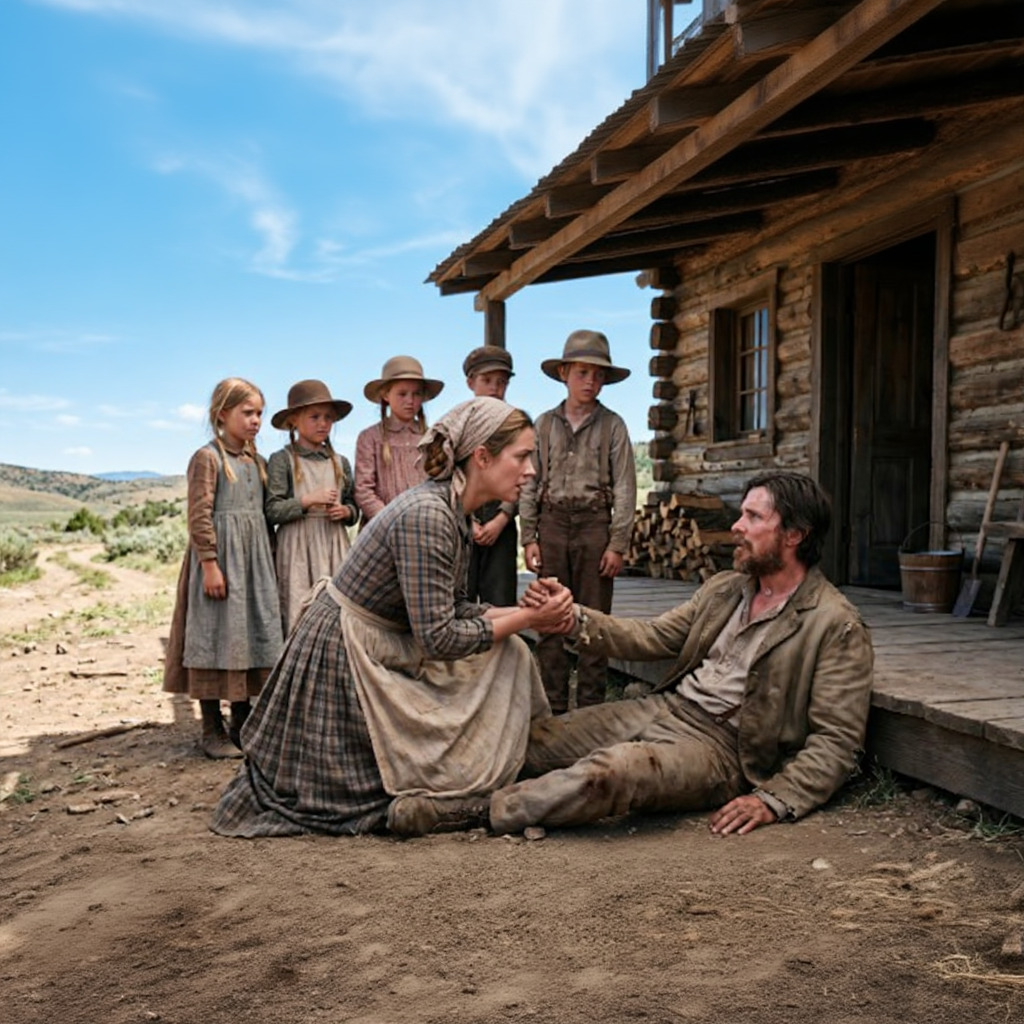
The man sat slumped against a porch post, his breathing shallow and ragged. Blood had soaked through the side of his brown jacket.
Five children stood behind him.
Silent.
Watching.
Three girls in faded dresses. Two boys wearing suspenders and oversized hats.
None of them cried.
That frightened Eleanor more than anything.
She dropped to her knees beside the man.
“Sir… can you hear me?”
The man opened one eye.
Gray.
Clouded.
Still sharp.
“Water…” he whispered.
Eleanor pulled her canteen from her satchel and lifted it carefully to his lips.
He drank once.
Twice.
Then coughed hard enough to bring fresh blood to his mouth.
Eleanor swallowed.
She had seen death before.
Cholera in St. Louis.
Influenza in Kansas.
A wagon accident in Nebraska.
But there was something different here.
This wasn’t a man fighting to live.
This was a man making peace with dying.
“What happened?” she asked softly.
“Horse threw me… three days back.”
She stared.
“Three days?”
He nodded faintly.
“Kids… dragged me home.”
Eleanor looked behind him.
The oldest boy—perhaps twelve—stood taller than the others, his jaw clenched tight.
Three days.
These children had kept their father alive for three days.
Alone.
No neighbors.
No doctor.
No help.
Only each other.
The dying man studied her face.
“You passing through?”
“Yes.”
“Where to?”
She hesitated.
“Nowhere.”
Something flickered in his eyes.
Understanding.
He looked toward the children.
Then back to her.
“What’s your name?”
“Eleanor Hayes.”
He nodded slowly.
“Thomas Walker.”
He winced, gripping his side.
“Miss Hayes…”
She leaned closer.
“Yes?”
His voice dropped to almost nothing.
“I need… a promise.”
Eleanor looked at his wound.
Looked at the children.
Looked back.
“What kind of promise?”
Thomas’s eyes filled—not with fear.
But desperation.
The kind only a parent knows.
“Raise them.”
Eleanor froze.
The prairie wind seemed to stop.
“What?”
“My children.”
He coughed.
Blood ran down his chin.
“Raise… all five.”
Eleanor stared.
She had never been married.
Never had children.
Never even stayed in one place longer than a year.
She was thirty-two years old, with one mule, one satchel, and less than eight dollars to her name.
And this dying stranger…
Was asking her to become a mother.
To five children.
She opened her mouth—
Closed it.
Opened it again.
“I—I’m not…”
Thomas grabbed her wrist with surprising strength.
“Please.”
His voice cracked.
“They got nobody.”
Eleanor looked at the children.
The youngest girl—maybe four—held a rag doll missing one button eye.
She stared at Eleanor with quiet, frightened hope.
The oldest boy stared with suspicion.
The others looked too tired to feel anything at all.
Thomas whispered:
“Don’t let them get split up.”
And suddenly Eleanor understood.
Orphan trains.
Work farms.
Households taking one child but not another.
Brothers never seeing sisters again.
Children becoming labor.
Children disappearing.
She’d seen it.
God help her—
She’d seen it.
And these five…
Would never survive it.
Thomas’s grip weakened.
“Please…”
Eleanor felt something inside her break.
Maybe it was fear.
Maybe loneliness.
Maybe the part of her that had spent ten years pretending she needed nobody.
She took his hand.
And said—
“Yes.”
Thomas closed his eyes.
Not from pain.
From relief.
A single tear slipped down the side of his face.
“Thank you…”
And before the wind shifted again—
Thomas Walker was gone.
—
Nobody moved.
Not Eleanor.
Not the children.
Not even the prairie birds.
Finally the oldest boy stepped forward.
He looked at his father.
Then at Eleanor.
And asked:
“You mean it?”
Eleanor looked into his eyes.
Dark.
Sharp.
Old for twelve.
She nodded.
“Yes.”
He crossed his arms.
“People lie.”
Eleanor stood slowly.
“I know.”
He stared another moment.
Then said:
“My name’s Caleb.”
He pointed.
“Lucy.”
The oldest girl.
“Anna.”
Middle girl.
“Rose.”
Youngest.
“Ben.”
The smaller boy.
He looked at the doll-holding child.
“And that’s Emma.”
Eleanor smiled softly.
“Hello.”
Nobody smiled back.
Fair enough.
She looked at Thomas’s body.
“We need to bury your father.”
Caleb nodded once.
“We already dug the spot.”
Eleanor’s throat tightened.
Of course they had.
—
The funeral took place at sunset.
No preacher.
No hymns.
No neighbors.
Only six children.
And one stranger.
Afterward they sat in silence around the supper table.
Cornbread.
Beans.
Cold venison.
Caleb watched Eleanor like a guard dog.
Finally he asked:
“Why’d you say yes?”
Eleanor paused.
Then answered honestly.
“I don’t know.”
Rose frowned.
“That’s not a good answer.”
For the first time—
Eleanor laughed.
And for the first time—
One of them smiled.
—
The first month was war.
Caleb refused to call her anything.
Ben hid food under his bed.
Lucy did all the cooking because she didn’t trust Eleanor.
Anna cried every night.
Emma wet the blankets.
And Rose asked impossible questions.
“Can coyotes smell fear?”
“Can ghosts ride horses?”
“If God lives in the sky, why doesn’t He fall?”
Eleanor had no answers.
Only patience.
And patience turned out to be stronger than certainty.
—
Winter came early.
By November, snow buried the prairie.
Food ran low.
Firewood lower.
One night a blizzard hit so hard the cabin walls groaned.
The roof shook.
Emma screamed.
Ben cried.
Anna prayed.
Caleb grabbed the rifle.
Eleanor stood in the middle of them all.
And something happened.
Without thinking—
She opened her arms.
“Come here.”
One by one—
They did.
Even Caleb.
For one long night…
Six frightened children slept against her.
And Eleanor didn’t sleep at all.
Because she finally understood what Thomas had asked.
He hadn’t asked for food.
Or clothes.
Or schooling.
He hadn’t asked for survival.
He had asked for something much harder.
Belonging.
—
Spring came.
Then summer.
Then another winter.
And another.
Eleanor stopped talking about leaving.
Stopped counting her money.
Stopped imagining other roads.
The cabin became home.
Caleb learned to trust.
Lucy learned to laugh.
Anna stopped crying.
Ben stopped hiding food.
Emma stopped waking from nightmares.
And Rose…
Never stopped asking impossible questions.
—
Ten years later—
A young man rode up to the Walker homestead.
Strong.
Broad-shouldered.
Twenty-two.
Caleb Walker.
He had been away for six months driving cattle.
And now he stood in the yard holding a small wooden box.
Eleanor, now silver at the temples, stepped onto the porch.
“Well?”
Caleb looked nervous.
Which amused her.
He opened the box.
Inside—
A silver ring.
Not for marriage.
Engraved.
To Ma.
Eleanor froze.
Caleb swallowed hard.
“You kept your promise.”
Her hands trembled.
“I tried.”
He shook his head.
“No.”
His voice broke.
“You didn’t raise five kids.”
He looked back toward the fields where his brothers and sisters laughed in the sun.
“You saved six.”
Eleanor’s eyes filled.
“Six?”
Caleb smiled.
“You forgot yourself.”
And for the first time in twenty years—
Eleanor Hayes cried.
Not because of what she had lost.
But because of what one dying stranger had seen…
Before she ever saw it herself.