
He Found a Cylinder Twice the Size and Fit His Whole Family Inside — It Held Heat Like an Oven
The first time Jack Mercer saw the cylinder, he thought it was a wreck.
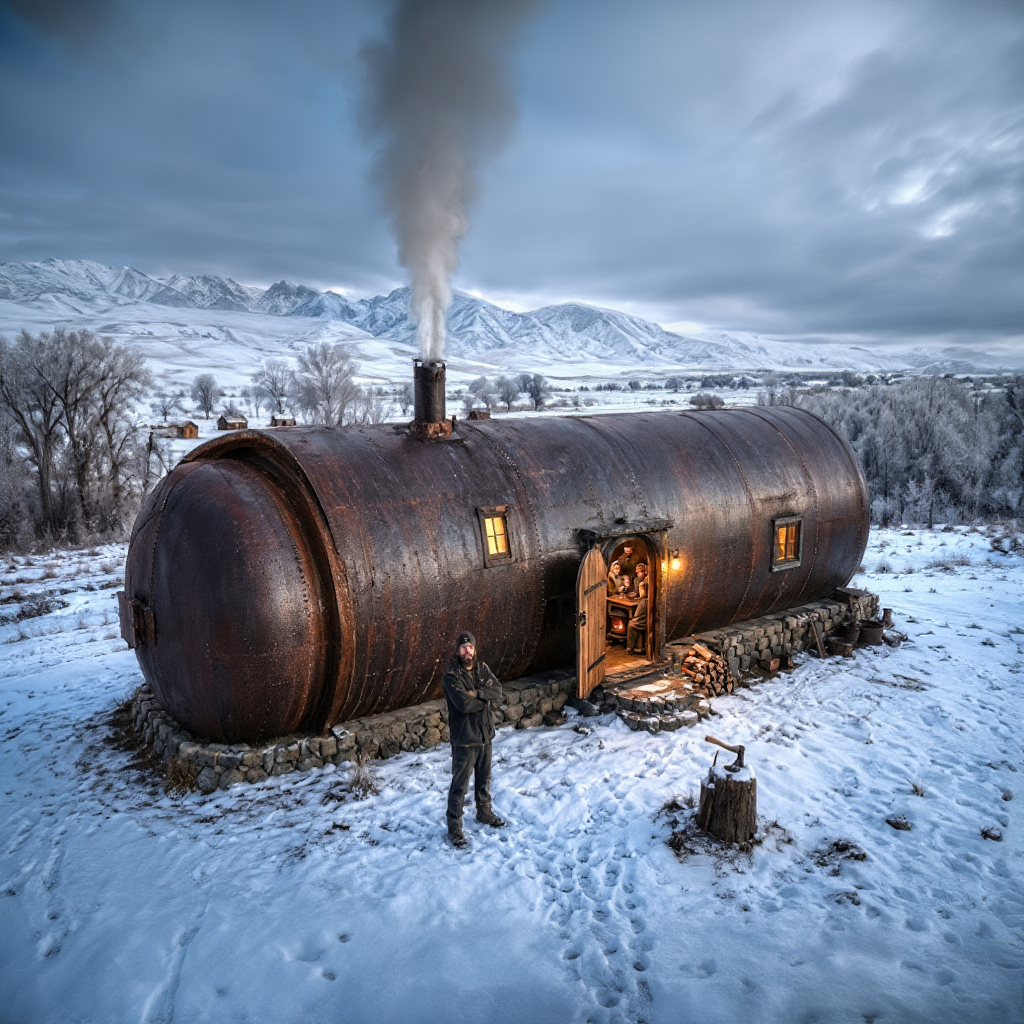
It lay half-buried in snow at the edge of the valley, a massive rusted shell rising out of the white like something abandoned by another world. The wind moved across it with a hollow, metallic whisper, slipping through seams and scars in the steel.
Jack stood still for a long moment, boots crunching into the crusted snow, breath fogging the air.
“What in God’s name…” he muttered.
From a distance, it looked like an old oil tank. Up close, it felt bigger. Longer. Rounded on both ends like a submarine dragged far from any ocean and left to freeze where it stopped.
He adjusted his beanie and stepped closer.
The metal was thick—he could tell that just by the way the cold seemed to cling to it. Not flimsy scrap. Not junk.
Something built to hold pressure.
Or survive it.
Jack ran a gloved hand along the surface.
Cold. Solid. Still.
But not useless.
Not to him.
Three miles away, his family was running out of time.
The house they lived in wasn’t really a house anymore. It had been patched too many winters in a row, each repair holding just long enough to make the next one feel possible—until it didn’t.
The wind came through the walls now. Not in drafts, but in steady, cutting lines of cold that refused to stay out.
The wood stove burned through fuel faster than Jack could split it.
And this winter—
This winter was already worse than the last.
“Temperature’s dropping again tonight,” his wife, Lila, said quietly that morning, glancing at the old thermometer nailed outside the window.
Jack didn’t need to look.
He could feel it.
“How low?” he asked.
She hesitated.
“Below minus thirty.”
Jack exhaled slowly.
Their daughter Emma sat at the table, wrapped in a blanket, trying to keep her hands warm as she read. Their youngest, Ben, was close to the stove, watching the fire like it might decide to disappear at any moment.
“We’ll manage,” Jack said.
But the words felt thinner than the walls around them.
That afternoon, he went back to the cylinder.
Not out of curiosity this time.
Out of necessity.
Snow had drifted higher around it, piling against the sides, partially insulating the base. The wind still swept across the valley, but something about the structure disrupted it—redirected it, softened it.
Jack circled it slowly.
The shape mattered.
That was the first thing he noticed.
No sharp corners.
No flat walls to catch the wind.
Just a continuous curve, allowing the air to slide around it instead of tearing into it.
“Less heat loss,” he murmured.
He crouched near the base, brushing snow away with his glove.
The cylinder sat on a rough stone foundation—old, but stable. Whoever had put it here had known what they were doing.
He moved to one end.
There—a door.
Not metal.
Wood.
Arched, reinforced, weathered but intact.
Jack gripped the handle.
“Please don’t be locked,” he said under his breath.
He pulled.
The door creaked.
Then opened.
Warmth didn’t hit him right away.
But the absence of wind did.
Inside, the air was still.
Not warm yet—but not biting cold either.
Jack stepped in, closing the door behind him.
Silence.
Thick, insulated silence.
His boots echoed faintly against the metal floor as his eyes adjusted.
The interior was larger than he expected.
The curved walls arched overhead, forming a tunnel-like space that stretched the full length of the cylinder. Small, square windows lined the sides, their glass fogged but intact.
At the center—
A stove.
Old, cast iron, connected to a pipe that ran up through the top of the cylinder.
Jack approached it slowly, resting his hand against the surface.
Cold.
But functional.
He turned slowly, taking it all in.
Sleeping cots along one side.
A rough wooden table bolted to the floor.
Shelving built into the curve of the walls.
This wasn’t storage.
It had been lived in.
Jack stood there for a long time.
Thinking.
Calculating.
Because something about this place made sense in a way the house never had.
The shape.
The material.
The way the earth and snow partially buried the lower half, creating natural insulation.
And most of all—
The steel.
Steel held heat.
Once warmed, it didn’t give it up easily.
“Like an oven,” he whispered.
The idea hit him all at once.
Not just shelter.
Survival.
By the time he returned home, the sky had darkened into that heavy gray that meant the temperature was already falling again.
Lila looked up immediately.
“Where were you?”
“I found something,” Jack said.
Something in his voice made her stand.
“What kind of something?”
Jack hesitated.
Then he said, “A place we might actually stay warm.”
They moved the next day.
Not everything.
Just what mattered.
Blankets. Food. Tools. Firewood.
Emma carried what she could, determination tightening her small frame. Ben followed close, asking questions Jack didn’t always answer.
When they reached the cylinder, Lila stopped.
“That’s… what you found?” she asked.
Jack nodded.
“It’s better inside.”
She looked unconvinced.
Until he opened the door.
The first fire changed everything.
Jack fed the stove carefully, adjusting the draft, watching the flames take hold.
At first, the heat stayed close.
But then—
Slowly—
It spread.
Into the air.
Into the metal walls.
Into the structure itself.
Within an hour, the difference was undeniable.
Within two, it was astonishing.
“It’s holding the heat,” Lila said, disbelief in her voice.
Jack nodded.
He could feel it too.
The warmth didn’t vanish the moment the fire settled. It lingered. Built. Wrapped around them.
The cylinder wasn’t just warming up.
It was storing it.
That night, as the temperature outside plunged toward -38°, something remarkable happened.
Inside—
They were comfortable.
Not just surviving.
Comfortable.
Emma sat at the table, reading without gloves for the first time in weeks.
Ben slept without curling into a tight ball near the stove.
Lila leaned back against the curved wall, eyes closed, a quiet expression of relief on her face.
Jack stood near the door, arms crossed, listening.
Not to the wind.
But to its absence.
The storm howled outside.
But inside—
The world was still.
Days turned into a rhythm.
Fire in the morning.
Fire in the evening.
The steel walls absorbing, holding, releasing heat slowly and steadily.
The snow piled higher around the base, sealing gaps, strengthening the insulation.
Jack made small improvements—sealing cracks, reinforcing the door, stacking more firewood nearby.
Each change made the space better.
Stronger.
More theirs.
One evening, as the light faded and the stove glowed steady, Emma looked up from her book.
“Dad?”
“Yeah?”
“Why didn’t anyone else use this place?”
Jack considered the question.
“Maybe they didn’t see it,” he said.
“It’s huge.”
He smiled faintly.
“Doesn’t mean people notice what matters.”
Weeks later, the valley remained locked in winter.
The trees stood frozen, their branches heavy with frost. The mountains loomed under a sky that rarely cleared.
But the cylinder—
The strange, rusted shell that once looked like nothing more than scrap—
Stood as something else entirely.
Smoke curled from the chimney.
Warm light glowed through the windows.
Life existed inside it.
One morning, Jack stepped outside early.
The cold hit him immediately—sharp, relentless.
He turned back, looking at the structure.
At the curved steel.
At the footprints in the snow leading to the door.
At the faint warmth radiating even through the metal.
He shook his head slightly.
“All this time,” he murmured.
Not hidden.
Not buried.
Just… overlooked.
Inside, Lila called out, “You coming back in or freezing out there on purpose?”
Jack smiled.
“Coming.”
He stepped back inside, closing the door behind him.
The warmth wrapped around him instantly.
And for the first time in a long time—
Winter didn’t feel like something they had to survive.
It felt like something they had already beaten.