
“You need a roof over your head, and I need a mother for my daughters. Come with me,” the landowner said.
The wind swept low across the Kansas plains, dragging dust in thin, restless ribbons that whispered against the wooden posts of the abandoned train station. Emma Carter pulled her coat tighter around her shoulders, though it did little to keep out the cold. It wasn’t just the weather—it was everything.
Three days.
Three days since she’d arrived with a suitcase, a letter, and hope she now realized had been misplaced.
The job at the general store had already been given away. The boarding house was full. And the last of her money had gone to stale bread and a cup of weak coffee that morning.
Now, as the sun dipped low and painted the sky in fading gold, Emma sat alone on a bench with nowhere left to go.
“You’ll catch your death out here.”
The voice startled her.
She turned.
A man stood a few feet away, tall and broad-shouldered, his shadow stretching long across the platform. His hat cast a dark line over his eyes, but she could see enough—strong jaw, weathered skin, and a kind of quiet that didn’t belong to strangers.
“I’m fine,” she said, though her voice betrayed her.
He glanced at her small suitcase, then at the empty platform.
“No, you’re not.”
Emma swallowed. Pride rose instinctively, but it felt thin and useless now.
“I’ll manage.”
He nodded once, like he’d heard that lie before.
For a moment, neither of them spoke. The wind filled the silence.
Then he said it—simple, direct, and without hesitation.
“You need a roof over your head, and I need a mother for my daughters. Come with me.”
Emma blinked.
“I’m sorry… what?”
He stepped closer, not threatening, just certain.
“My name’s Daniel Hayes. I own land about ten miles west of here. I’ve got two girls—Lucy and May. They lost their mother two winters ago.” His voice didn’t waver, but something deeper moved beneath it. “They need someone. I need help. And you…” His eyes met hers. “You need a place to stay.”
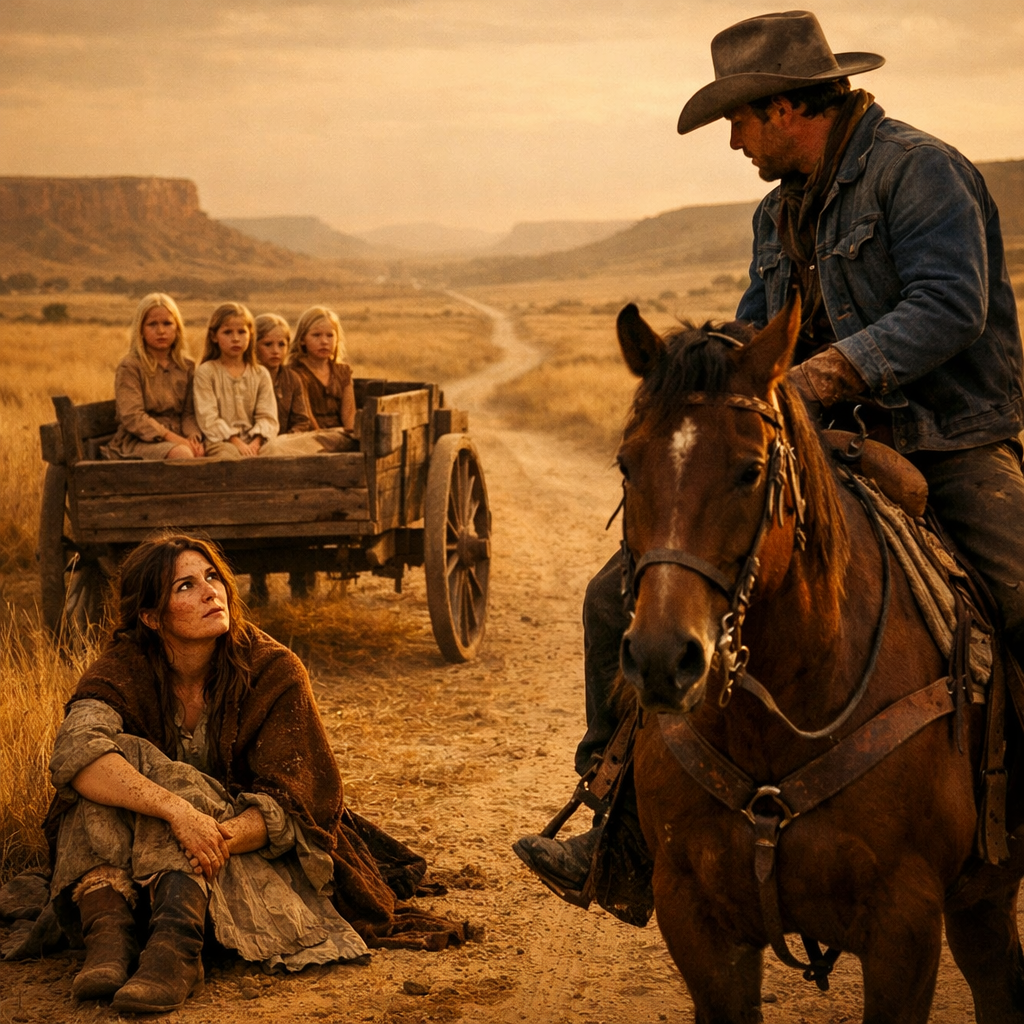
Emma stared at him, unsure whether to laugh or run.
“You’re asking me to marry you?” she said.
“I’m asking you to come with me,” he replied. “The rest can be figured out in time.”
“That’s not how life works.”
“It is out here.”
She searched his face for any sign of mockery or danger. There was none. Just a man who looked like he’d made too many decisions alone.
“And if I say no?”
He tipped his hat slightly. “Then I wish you luck, Miss…?”
“Carter. Emma Carter.”
“Well, Miss Carter,” he said, “it’s going to be a cold night.”
He turned as if to leave.
“Wait.”
The word slipped out before she could stop it.
Daniel paused.
Emma stood slowly, gripping the handle of her suitcase.
“This… this isn’t a joke?”
“No.”
“And you’re not expecting…” She hesitated, unsure how to phrase it.
His gaze softened just slightly.
“I’m expecting honesty,” he said. “Hard work. And someone who won’t walk out on them.”
Them.
Not him.
That mattered more than she expected.
Emma looked out across the empty horizon, the fading light, the uncertainty waiting in every direction.
Then she looked back at him.
“I don’t know anything about raising children.”
“They’ll teach you.”
“I don’t know anything about running a farm.”
“I’ll teach you.”
She hesitated one last time.
“Alright,” she said quietly. “I’ll come.”
The Hayes farm was larger than Emma expected.
A wide stretch of land rolled out beneath a sky so open it made her feel small. The house itself was sturdy but worn, its white paint faded and peeling in places. Smoke curled from the chimney, a sign of life that felt strangely comforting.
Two small figures stood on the porch as the wagon approached.
“Pa!” one of them shouted.
They ran forward, skirts bouncing, braids flying.
Daniel climbed down first, lifting each girl in turn.
“Easy now,” he said, though a rare smile touched his face.
“This is Emma,” he added, turning to her. “She’ll be staying with us.”
The girls looked at her curiously.
The older one—Lucy, perhaps ten—studied her with cautious eyes.
The younger—May, no more than six—grinned openly.
“Are you gonna be our new mama?” May asked.
Emma froze.
Daniel cleared his throat. “That’s something we’ll talk about later.”
Lucy crossed her arms slightly.
“We don’t need a new mama.”
The words weren’t cruel—just guarded.
Emma knelt down, meeting her gaze.
“That’s alright,” she said gently. “I’m not here to replace anyone.”
Lucy didn’t respond, but something in her posture softened.
May slipped her small hand into Emma’s.
“I like her,” she declared.
Emma smiled despite herself.
Maybe, she thought, this wouldn’t be impossible.
The days that followed were harder than anything Emma had ever known.
She woke before dawn, learned to cook over a stubborn stove, scrub floors, mend clothes, and tend to chickens that seemed determined to escape her at every turn.
Daniel was patient but distant.
He taught her what she needed to know, spoke when necessary, and worked harder than anyone she’d ever seen.
But at night, after the girls were asleep, he often sat alone on the porch, staring out into the dark.
Emma never asked what he was thinking.
Some silences deserved to be left alone.
The girls were different.
May attached herself to Emma almost immediately, following her from room to room, asking endless questions, offering help that often made things more difficult—but also brighter.
Lucy took longer.
She watched.
Measured.
Waited.
Until one evening, as Emma struggled to fix a torn dress by lamplight, Lucy quietly sat beside her.
“You’re doing it wrong,” she said.
Emma smiled faintly. “Then show me.”
Lucy hesitated… then did.
It wasn’t much.
But it was a beginning.
Winter came early that year.
The first storm hit hard, blanketing the land in snow so thick it swallowed fences and roads alike.
Supplies ran low.
The wind howled through the night, rattling windows and testing the strength of the house.
And then, one evening, May fell ill.
Her fever rose quickly, her small body burning as she lay trembling beneath blankets.
Emma stayed by her side, wiping her forehead, whispering softly, doing everything she could.
Daniel paced like a caged animal.
“I should’ve gone to town sooner,” he muttered. “Should’ve—”
“Daniel,” Emma said firmly. “Stop.”
He looked at her, frustration and fear etched deep into his face.
“She needs you steady,” Emma continued. “Not blaming yourself.”
He exhaled slowly, nodding once.
Hours passed.
Then more.
Finally, as dawn broke pale and cold across the horizon, May’s fever began to break.
Her breathing eased.
Her small hand tightened weakly around Emma’s.
“Don’t go,” she murmured.
“I’m not going anywhere,” Emma whispered.
Across the room, Daniel watched.
And something changed.
That night, after the girls were asleep, he found Emma in the kitchen.
“You stayed,” he said.
She looked up. “Of course I did.”
“You didn’t have to.”
“Yes, I did.”
He studied her for a long moment.
“I meant what I said before,” he added quietly. “About needing someone who wouldn’t walk out.”
Emma met his gaze.
“I’m not her,” she said gently. “But I’m not leaving either.”
He nodded.
“That’s enough,” he said.
But the way he looked at her now… it wasn’t just gratitude.
It was trust.
Spring came slowly, but when it did, it brought life back to the land—and something new to the house.
Laughter came easier.
Meals felt warmer.
And one evening, as the sun dipped low and painted the sky in soft gold, Lucy approached Emma on the porch.
“Can I ask you something?” she said.
“Of course.”
Lucy hesitated.
Then, quietly—
“Would it be alright… if I called you Mama?”
Emma’s breath caught.
She glanced toward Daniel, who stood a few feet away, watching silently.
Then back at Lucy.
“It would be more than alright,” she said.
Lucy smiled.
And for the first time since Emma had arrived, the house felt whole.
Later that night, Daniel joined Emma on the porch.
“You’ve done more than I ever expected,” he said.
Emma shook her head. “I just stayed.”
“That’s what matters.”
Silence settled between them—but it was no longer empty.
“Emma,” he said after a moment, “when I asked you to come with me… I didn’t know what this would become.”
“Neither did I.”
He turned to face her fully.
“But I do now.”
Her heart began to race.
“This isn’t just an arrangement anymore,” he continued. “At least… not for me.”
Emma held his gaze.
“It’s not for me either,” she admitted.
A small, rare smile touched his lips.
“Then maybe,” he said, “it’s time we make it something real.”
She nodded.
“I’d like that.”
The wind still swept across the plains.
The seasons still turned, as they always would.
But inside that once-quiet house, something steady had taken root.
Not out of convenience.
Not out of desperation.
But out of choice.
And in the end, that made all the difference.
Title: A House Built on Quiet Promises
Part 2: What Grows After Winter
The morning Daniel Hayes married Emma Carter, the sky stretched wide and blue over the Kansas plains, as if the land itself had decided to bear witness.
There was no grand ceremony.
No rows of guests or polished shoes.
Just a preacher from the next town over, Lucy and May standing close, and the steady wind moving through the tall grass like a quiet hymn.
Emma wore a simple cream dress she had sewn herself.
Daniel wore the same dark coat he reserved for Sundays.
And when they stood side by side, hands joined, something about it felt less like a beginning—and more like something that had been waiting to happen all along.
“Do you promise…” the preacher began.
Emma didn’t hear all the words.
Not because they didn’t matter—but because she already knew her answer.
“I do.”
Daniel’s voice came just as steady.
“I do.”
And that was it.
No applause.
No celebration.
Just a promise spoken into the open air—and a life that would now have to prove it true.
Marriage, Emma quickly learned, did not change everything overnight.
The work was still there.
The early mornings.
The long days.
The quiet evenings where exhaustion settled into their bones like an old habit.
But something had shifted.
Before, she had been staying.
Now, she belonged.
And that difference showed in the smallest ways.
Daniel no longer hesitated before reaching for her hand when passing her in the kitchen.
Lucy no longer watched from a distance—she leaned in, laughed more freely, argued even, like a child who finally trusted she wouldn’t be left behind.
And May…
May blossomed.
She followed Emma like sunlight follows the day, her laughter brighter, her sleep easier, her small world steadier now that it had someone new at its center.
But life, Emma would soon learn, had a way of testing even the strongest beginnings.
It started with the land.
Spring rains came late that year.
Too late.
The soil cracked beneath the sun, dry and stubborn, resisting every effort Daniel made to coax life from it.
Crops struggled.
Livestock grew thin.
And each evening, Daniel’s shoulders seemed to carry more weight than the day before.
“We’ll manage,” he said.
But Emma heard what he didn’t say.
Not forever.
One night, after the girls had gone to bed, she found him at the table, papers spread before him—numbers, debts, calculations.
“You’re thinking about selling,” she said quietly.
He didn’t look up.
“I’m thinking about surviving.”
“At what cost?”
He exhaled, rubbing a hand over his face.
“This land… it’s everything. But if it can’t sustain us—”
“It can,” Emma interrupted gently.
He finally looked at her.
“You don’t know that.”
“No,” she admitted. “But I know we haven’t tried everything.”
Daniel leaned back slightly.
“Such as?”
Emma hesitated.
“I grew up in Missouri,” she said. “My father… he struggled too, some years. But my mother—she started preserving food, trading with neighbors, selling what we didn’t need. Not just crops—skills.”
Daniel frowned slightly.
“Skills?”
“Sewing. Baking. Mending. Teaching.”
He studied her, something thoughtful in his expression.
“You think that’s enough?”
“I think it’s something,” she said. “And right now, something is better than waiting for nothing.”
Silence stretched between them.
Then, slowly—
Daniel nodded.
“Alright,” he said. “We try it your way.”
The changes didn’t happen all at once.
But they began.
Emma started small—offering to mend clothes for families in nearby farms, trading eggs and bread for supplies they couldn’t afford outright.
Lucy helped, her careful hands learning quickly.
May delivered small bundles, proud of her “important work.”
And Daniel…
At first, he watched.
Then, he joined.
Fixing tools for neighbors.
Helping repair fences.
Doing work that didn’t depend on rain or soil.
It wasn’t easy.
There were days when it felt like too little, too slow.
But slowly, almost imperceptibly—
Things began to shift.
Then came the letter.
It arrived one afternoon, carried by a passing rider who barely slowed as he handed it off.
Daniel read it once.
Then again.
His jaw tightened.
“What is it?” Emma asked.
He hesitated.
“Bank notice,” he said finally. “They’re calling in part of the loan. Sooner than expected.”
Emma felt the weight of it settle immediately.
“How long do we have?”
“Thirty days.”
The room felt smaller suddenly.
More fragile.
“We can’t—” she started, then stopped.
Daniel folded the letter carefully.
“No,” he said. “We can’t lose this place.”
Emma looked at him—not just at the worry, but at the determination underneath it.
And she knew.
Neither of them would walk away.
The next weeks were the hardest they had ever faced.
Every hour mattered.
Every decision carried weight.
Emma worked until her hands ached, taking on more than she thought possible.
Daniel pushed himself beyond exhaustion, refusing to let the land—or his family—slip through his fingers.
Lucy and May did what they could, small but meaningful efforts that stitched them all together in quiet resilience.
And still…
It wasn’t enough.
Not yet.
It was Lucy who changed everything.
“I have an idea,” she said one evening, her voice hesitant but steady.
Emma looked up from the table.
“Let’s hear it.”
Lucy swallowed.
“What if… we invite people here?”
Daniel frowned. “For what?”
“A gathering,” Lucy said. “Like the ones Mama used to talk about. With food and music and… things to trade.”
Emma felt something spark.
“A market,” she said softly.
Lucy nodded.
Daniel looked uncertain.
“People won’t come all the way out here for that.”
“They might,” Emma said. “If we give them a reason.”
“And if they don’t?” he asked.
Emma met his gaze.
“Then we’re no worse off than we are now.”
Silence.
Then—
A slow breath.
A decision.
“Alright,” Daniel said. “We try.”
The day of the gathering arrived with clear skies and cautious hope.
At first…
No one came.
Emma stood by the table she had set, bread neatly arranged, hands clasped tightly to keep them from shaking.
Lucy hovered nearby.
May sat on the steps, watching the road.
Daniel stood farther back, unreadable.
Minutes passed.
Then—
A wagon appeared.
Then another.
And another.
By midday, the yard was alive.
Voices.
Laughter.
Trade.
Connection.
Emma moved through it all with quiet purpose, her work finding value in ways she had only hoped for.
Daniel spoke with neighbors, exchanged goods, made arrangements.
Lucy and May glowed with pride.
And as the sun dipped low once more—
Something incredible had happened.
They had not just survived.
They had begun to thrive.
That night, after the last wagon had disappeared into the horizon, Daniel found Emma standing alone by the fence.
“You did this,” he said.
She shook her head.
“We did this.”
He stepped closer.
“You were right,” he admitted.
Emma smiled faintly.
“Don’t sound so surprised.”
A quiet laugh escaped him.
Then, softer—
“I don’t say it enough,” he added. “But I should.”
Emma looked at him.
“Say what?”
“That you didn’t just save this house,” he said. “You built something new inside it.”
Her chest tightened slightly.
“You gave me a chance,” she replied.
“No,” Daniel said gently. “You took one.”
Silence settled—but it was full now.
Warm.
Certain.
He reached for her hand.
And this time, there was no hesitation at all.
Years later, people would speak of the Hayes farm as something rare.
A place where hard seasons didn’t break the people who lived through them.
A place where strangers became family.
Where loss didn’t have the final word.
But for Emma and Daniel—
It was never about being remarkable.
It was about something much simpler.
They had both stood, once, at the edge of everything falling apart.
And instead of turning away—
They had chosen to build.
Together.
And in that choice, made again and again in a thousand quiet ways—
They found not just survival.
But a life worth keeping.