
Giant Cowboy Sees Bruises on His Overweight Cook — His Next Move Shocks the Town
Snow blew sideways across the mountains, hissing against the cabin walls like dry sand. The wind slipped through every crack in the rough-hewn logs, making the lantern flame flicker and the ceiling beams creak. Outside, the world was white and endless, the trail buried beneath drifts that swallowed fence posts and half-covered the woodpile.
Inside the cabin, warmth clung stubbornly to the air.
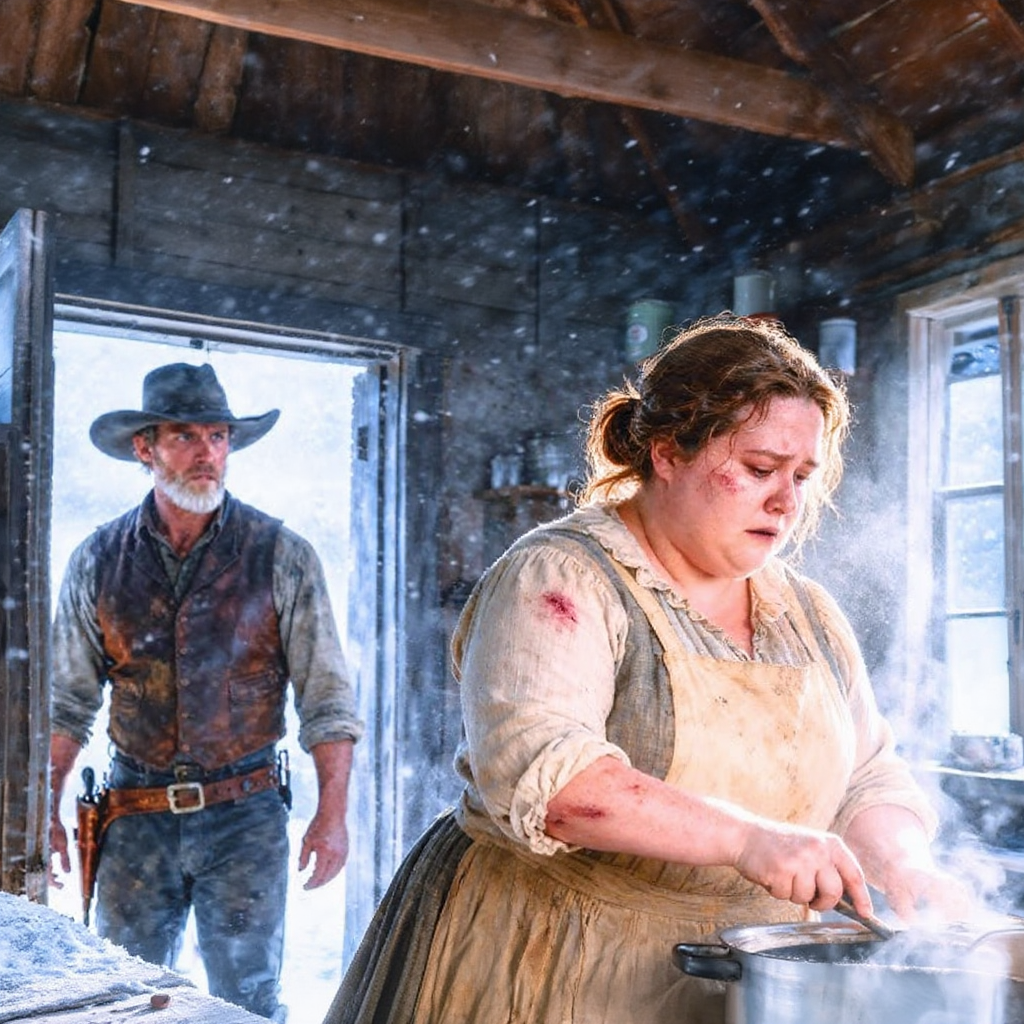
A pot steamed over the iron stove, sending up a thick ribbon of heat and the smell of onions, salt pork, and wild herbs. A woman stood in front of it, stirring slowly, deliberately, as though the rhythm alone kept her upright.
Clara Bennett’s light brown hair was pulled back into a loose knot, strands escaping and clinging to her damp temples. Her dress, once pale blue, was faded and worn thin at the elbows. An apron hung loosely over her frame, marked with flour, grease, and small streaks of dried blood.
There were fresh cuts on her arm.
A bruise darkened her jaw.
Another showed beneath her sleeve when she lifted the spoon.
She stirred anyway, focused, jaw set. The stew had to stretch. The men would be hungry. There were eight of them now, snowed in at the high ridge cattle camp, and supplies were running low.
She tasted the broth, added salt, then reached for a sack of dried beans on the shelf. Her fingers trembled slightly.
Behind her, the wind slammed against the door.
She didn’t turn.
Then the latch lifted.
The wooden door swung open with a heavy groan, and a blast of snow swept into the room, swirling in a pale cloud that shimmered in the lantern light. The cold air rushed across the floor, carrying the smell of pine and frost.
A man filled the doorway.
He seemed too large for the frame — broad shoulders wrapped in a worn brown leather vest, grey shirt darkened with melted snow, and a gun belt slung low across his hips. A dark cowboy hat shadowed his face, but his thick grey beard caught the light. Snow clung to his coat and boots.
Eli Mercer stepped inside.
He closed the door behind him with one heavy push. The wind faded, leaving only the quiet hiss of the stove.
Clara didn’t look back immediately. She stirred once more, then said softly, “Storm getting worse?”
“Yeah.”
His voice was deep, rough from cold air and long silence.
He removed his gloves slowly, setting them on the table. His eyes moved across the cabin — the shelves lined with jars, the stacked plates, the neatly chopped wood.
Then they stopped on Clara.
She reached for the ladle, lifted it, and poured broth into a tin bowl.
Her sleeve slipped.
The bruise showed.
Eli’s eyes narrowed.
He didn’t speak.
She turned slightly, finally aware of his presence, and forced a small smile.
“You’re back early.”
“Trail’s buried.”
She nodded, turning back to the stove.
“I’ll have this ready soon.”
He took a step forward. The floorboards creaked under his weight.
She reached for another bowl.
Her hand shook.
He noticed that too.
“What happened?” he asked.
She froze for half a second.
“Nothing.”
He walked closer.
Snow melted from his coat, dripping onto the wood floor. He stopped just behind her, tall enough that his shadow fell across the stove.
“That ain’t nothing,” he said quietly.
She kept stirring.
“I bumped into the woodpile.”
He didn’t respond.
His gaze moved to her arm — small cuts, some fresh, some older. One still red.
“And that?”
“Knife slipped.”
“You left-handed now?”
She swallowed.
“No.”
Silence stretched.
The stew bubbled softly.
She tried to move past him, but he shifted slightly, blocking her path without touching her.
“Clara.”
Her shoulders stiffened.
“I’m fine,” she said.
“You ain’t.”
She exhaled slowly, then turned to face him.
Up close, the bruising was clearer. Yellowed edges. A darker mark along her cheekbone.
“Just clumsy,” she said.
Eli studied her face.
He had seen injuries before — bar fights, cattle accidents, broken bones, knife cuts. These weren’t those.
These were shaped.
Placed.
He stepped aside, letting her pass.
She carried the bowls to the table, setting them down carefully.
He didn’t sit.
“Who did it?” he asked.
She didn’t answer.
The wind howled outside again.
She wiped her hands on her apron.
“It don’t matter.”
“It does.”
“No,” she said softly. “It doesn’t.”
He leaned one hand on the table.
“You working here. That makes it my concern.”
She shook her head.
“I’m just the cook.”
“You’re more than that.”
She almost laughed.
“No, I’m not.”
He watched her for a long moment.
Then he said, “You got someone in town?”
Her silence answered.
“Your husband?”
She nodded once.
“He drinks?”
Another nod.
“And he hits you.”
She didn’t speak.
Eli’s jaw tightened.
“He ain’t my problem,” she said quietly. “I come up here to work. That’s all.”
“You go back every week.”
“I have to.”
“No.”
She looked up.
“I don’t.”
“You live here now.”
She shook her head.
“I don’t belong here.”
He stared at her.
“You belong wherever you stand.”
She looked away.
“I appreciate the concern. But it’s not something you fix.”
Eli didn’t respond.
He sat down slowly, picked up the bowl, and took a bite. The stew was good. Warm. Filling.
He ate in silence.
Clara served the rest when the men returned. They stomped snow from boots, joked about the storm, praised the food. No one mentioned the bruises. No one looked closely enough.
Except Eli.
He watched her all evening.
When the men slept, he stepped outside.
The snow had eased. Moonlight reflected off the drifts, turning the valley silver.
He saddled his horse.
By morning, he was gone.
The town of Red Hollow woke slowly beneath a pale winter sun. Smoke rose from chimneys. The saloon doors creaked open. Wagons rolled through packed snow.
Clara’s husband sat outside the general store, bottle in hand.
Tom Bennett was a broad man gone soft from drink. His coat hung open despite the cold. A bruise marked his knuckles.
He laughed loudly at something no one else heard.
Then the street went quiet.
A horse approached.
Huge. Dark. Steam rising from its flanks.
Eli Mercer rode into town.
People noticed immediately. The giant cowboy rarely came down from the mountain unless something mattered.
He stopped in the middle of the street.
Tom squinted.
“Well, look at that,” he slurred. “Mountain man come to shop?”
Eli dismounted.
Boots hit snow.
He walked forward.
Tom smirked.
“You lost?”
Eli stopped in front of him.
“You hit Clara again,” he said calmly.
Tom laughed.
“That my wife.”
Eli’s expression didn’t change.
“Not anymore.”
Tom frowned.
“What?”
Eli pulled a folded paper from his coat.
He handed it to Tom.
Tom stared at it.
“What’s this?”
“Signed transfer,” Eli said. “Your debts. Paid. House bought.”
Tom blinked.
“You drunk?”
“You owe money to three men,” Eli continued. “And the bank. I bought it all.”
Tom’s face shifted.
“You can’t—”
“I can.”
Tom’s grip tightened on the paper.
“So what? You own the house?”
“Yes.”
Tom laughed again, but it sounded weaker.
“She still my wife.”
Eli’s voice stayed even.
“She filed this morning.”
He nodded toward the courthouse.
Tom looked up.
The sheriff stood on the porch, arms crossed.
“Divorce,” Eli said. “Signed. Witnessed.”
Tom’s mouth opened.
“You planned this?”
“Yes.”
The town watched in stunned silence.
“You think she’ll go with you?” Tom sneered.
Eli stepped closer.
“She already did.”
Tom swung suddenly.
Eli didn’t move.
Tom’s fist hit his chest — like punching a tree. Pain shot through Tom’s hand.
Before he could pull back, Eli caught his wrist.
Not violently.
Just firmly.
“You’re done,” Eli said.
He released him.
Tom stumbled back, humiliated.
Eli turned, mounted his horse, and rode away.
The town buzzed.
“Did you see that?”
“He bought the man’s debts…”
“For her?”
“Never seen anything like it.”
Two days later, Clara stood in the cabin doorway, watching the snow fall softly.
Eli approached from the barn.
She held the paper in her hands.
“You didn’t have to do that,” she said.
“Yes, I did.”
“You spent a fortune.”
He shrugged.
“Worth it.”
She looked at him, eyes bright.
“I don’t know what to say.”
“Stay,” he said simply.
She hesitated.
“You don’t owe me.”
“I know.”
Snow drifted between them.
She stepped forward.
“I don’t cook for free.”
He almost smiled.
“Good.”
She took another step.
“And I don’t stay out of pity.”
“I know that too.”
She stopped in front of him.
The wind softened.
“You shocked the whole town,” she said quietly.
He met her gaze.
“Only thing that matters… is you’re safe.”
For the first time, she reached for his hand.
It disappeared inside hers — small against his massive grip.
“I am,” she said.
Behind them, the cabin glowed warm against the cold mountains, steam rising from the chimney, shelves lined with jars, and a pot already simmering — no longer just a cook’s duty, but the beginning of a new life neither of them expected.