
My Dad and “Deadbeat” Brother Sold My Home While I Was in Okinawa — But That House Really Was…
I was standing on the edge of the training field in Okinawa when my phone buzzed in my pocket.
It was almost midnight. Rain hung heavy in the air, turning the ground beneath my boots into thick red mud. We had just finished a twelve-hour exercise, and my muscles screamed as if they were tearing apart.
I almost ignored the call.
Almost.
Something made me answer.
“Hello?”
Silence.
Then my father’s voice, strained and unfamiliar.
“Son… we need to talk.”
My stomach tightened. My dad never called this late. Not unless something was wrong.
“What’s going on?” I asked, already bracing myself.
He hesitated. I could hear the television murmuring in the background, the same old channel he watched every night back home in Ohio.
“We… your brother and I… we sold the house.”
The world tilted.
“What?” I said. “What house?”
There was another pause. Longer this time.
“Your house.”
The words didn’t register at first. My mind searched for logic, for a misunderstanding.
“My house?” I repeated. “The one on Maple Ridge?”
“Yes.”
I laughed once, short and sharp. “That’s not funny, Dad.”
“I’m not joking,” he said quietly.
My grip tightened around the phone. “You can’t sell my house. I’m deployed. I didn’t sign anything.”
“Well,” he cleared his throat, “your brother handled the paperwork.”
That was when anger flooded my chest like fire.
My brother, Kyle.
Thirty-four years old. No steady job. No savings. No sense of responsibility. Living on my couch before I shipped out, promising—again—that he’d get back on his feet.
The same brother my father had defended my entire life.
“He needed help,” Dad always said.
“He’s trying,” Dad always insisted.
And now this.
“Why?” I demanded. “Why would you do that?”
Dad’s voice cracked. “We thought you wouldn’t need it anymore.”
I felt my heart slam against my ribs.
“What do you mean, ‘need it anymore’?”
Another pause.
“Your brother said… he said you weren’t coming back.”
The rain started pouring harder around me, soaking my uniform, but I barely noticed.
“What?” My voice dropped to a whisper. “What did he tell you?”
“He showed me some documents,” Dad said. “Military stuff. Said you’d extended your deployment. Said it was dangerous.”
I closed my eyes.
Kyle had always been good at lying. Always knew how to wrap fear around truth until people couldn’t tell the difference.
“So you just believed him?” I asked. “You didn’t call me?”
“You were overseas,” Dad said defensively. “And Kyle said—”
“Kyle said,” I snapped. “Kyle always says.”
Silence stretched between us.
Finally, Dad spoke again. “The money’s gone.”
My breath caught. “Gone?”
“He had debts,” Dad admitted. “Gambling. Loans. People looking for him. I thought selling the house would protect you.”
Protect me.
I ended the call without saying goodbye.
That night, I lay on my bunk staring at the metal ceiling, listening to the rain and the distant hum of generators. My hands shook—not from fear, but from something colder.
That house wasn’t just a house.
It was my anchor.
I bought it at twenty-six, after my first deployment. Brick exterior. White porch railing. An oak tree out front that dropped leaves every fall like clockwork.
But more than that…
It was the last place my mother ever lived.
She died in that house.
Cancer took her fast. Too fast. I was stationed in Germany when it happened. By the time I got home, the rooms still smelled like her lavender soap. Her slippers sat by the couch, exactly where she left them.
I swore I’d never let that house go.
And now it was gone.
Or so they thought.
Three weeks later, I was back in the States.
I didn’t go home first.
I drove straight to Maple Ridge.
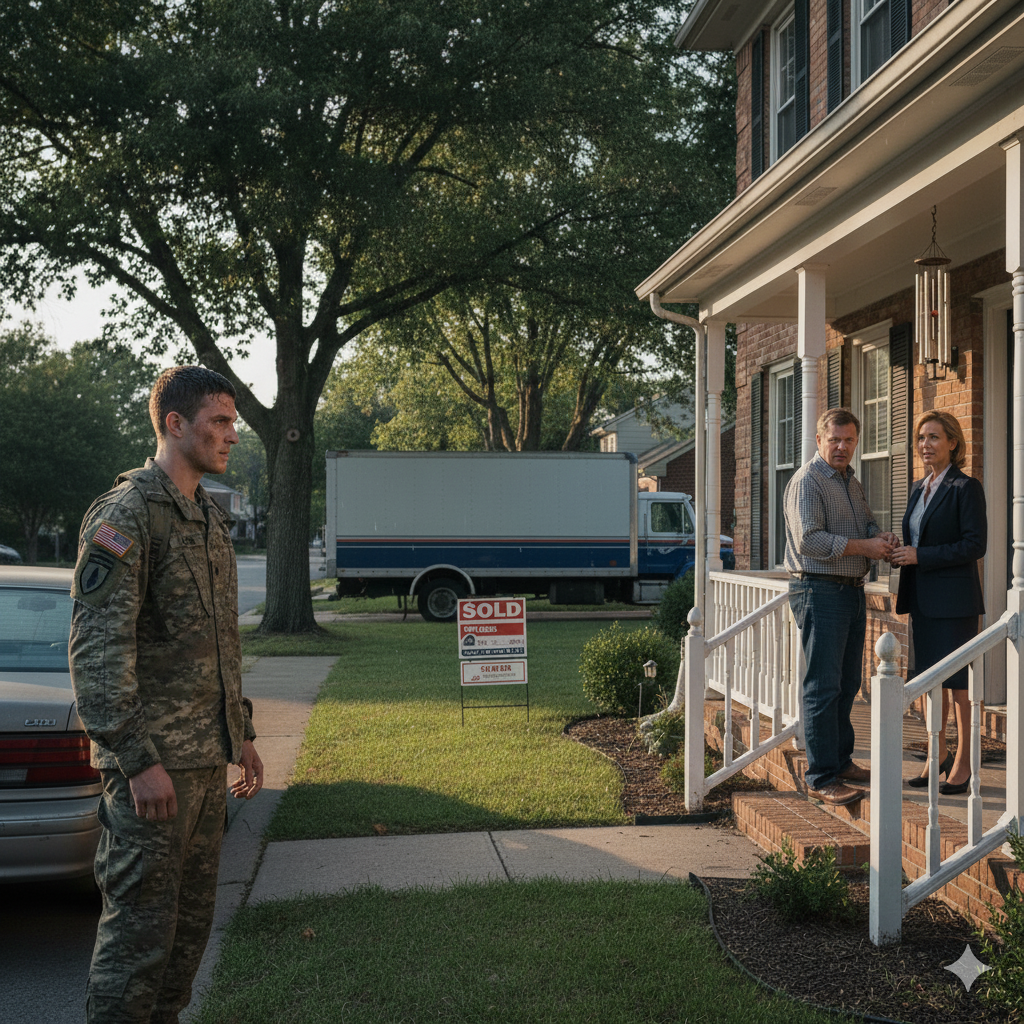
The house looked the same. Same porch. Same oak tree. Same wind chimes Mom loved, still hanging crooked near the front door.
But there was a “SOLD” sign in the yard.
And a moving truck parked out front.
A man in his fifties stood on the porch, keys in hand, laughing with a woman beside him.
I parked across the street and watched.
My chest felt hollow.
Then something strange happened.
The man tried to unlock the door.
It didn’t open.
He tried again. Jiggled the handle. Frowned.
He knocked.
Nothing.
Finally, he turned to the realtor. “You said this place was vacant.”
“It is,” she replied, confused. “The previous owner’s overseas.”
I stepped out of my car.
“That’s funny,” I said loudly. “Because I’m right here.”
They both turned.
The realtor’s smile froze. “Sir… can I help you?”
“I own this house,” I said. “And I didn’t sell it.”
The man’s face drained of color.
“I paid cash,” he said. “Two weeks ago.”
“Then you were scammed,” I replied.
The police arrived within minutes.
As officers examined the documents, one of them pulled me aside.
“Sir,” he said carefully, “the sale paperwork is fraudulent.”
I wasn’t surprised.
“The signature’s forged,” he continued. “And there’s another issue.”
“What?”
“This property isn’t legally transferable.”
I blinked. “What do you mean?”
He glanced at the house, then back at me.
“It’s listed under a protected trust.”
My knees nearly buckled.
“What trust?”
He flipped through his tablet. “Established by Margaret Hayes. Fifteen years ago.”
My mother.
I felt my throat tighten.
“She placed the home in an irrevocable trust,” the officer explained, “designating you as the sole beneficiary. No one else—no family member, no power of attorney—can sell it without your presence.”
I laughed. I cried. I did both at once.
Kyle and my father never owned the house.
They never could.
The sale was void.
The buyers were refunded.
And the investigation began.
Kyle was arrested three days later.
Turns out, he’d done more than sell my house.
He’d taken loans in my name. Opened credit cards. Claimed I was dead on one application.
Dead.
When Dad found out, he broke down in the interrogation room.
“I just wanted to help my son,” he kept saying.
But the truth was simpler—and harder.
He had helped the wrong one.
Weeks later, I sat alone in the living room, the same couch where my mother used to nap in the afternoons. Sunlight filtered through the curtains, dust dancing in the air.
The house was quiet.
Safe.
My dad came by once. He stood on the porch, hat in his hands.
“I’m sorry,” he said. “I should’ve trusted you.”
I nodded.
“I still love you,” I told him. “But trust… that’ll take time.”
As for Kyle?
He’s serving time now. Court documents list him as “convicted of fraud, identity theft, and falsification.”
Deadbeat brother.
Finally honest.
Sometimes, late at night, I walk through the house and run my fingers along the walls.
They tried to sell my home while I was half a world away.
But what they never understood was this:
That house wasn’t just mine.
It was protected by love, memory, and a mother who knew—long before I did—exactly who I could trust.
And who I couldn’t.