
“Get Someone Else,” the Marine Commander Demanded — Then the Nurse Showed the Unit Tattoo He Served Under
The shouting started before sunrise.
“Get someone else in here!”
The voice thundered through the surgical recovery wing at Walter Reed National Military Medical Center, rattling monitors and silencing conversations all down the hallway.
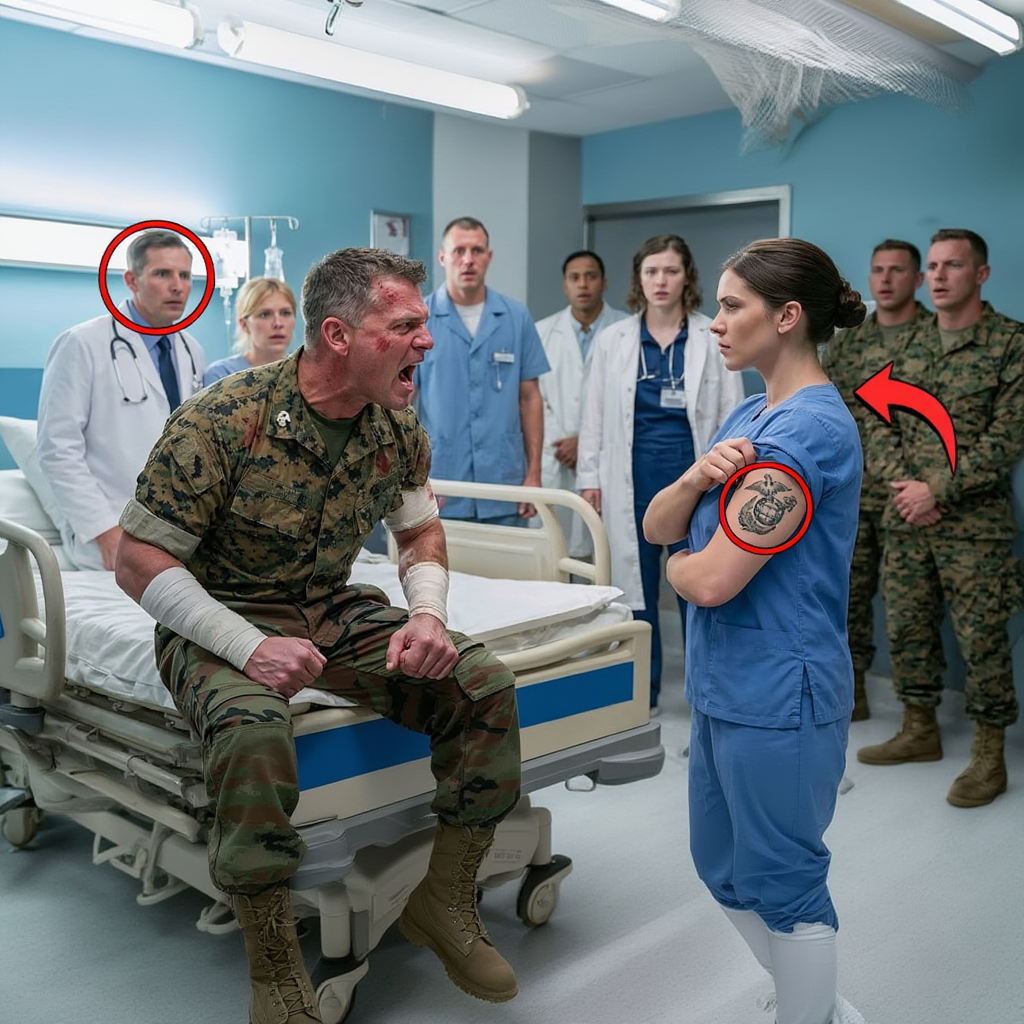
Captain Ethan Briggs sat upright on the hospital bed like a wounded bear ready to attack. His marine camouflage blouse was soaked dark with blood near the shoulder and ribs. Thick white bandages wrapped both forearms where shrapnel had torn through muscle only twelve hours earlier.
A heart monitor beeped wildly beside him.
Three doctors stood frozen near the foot of the bed.
Two young nurses exchanged nervous glances.
And in the doorway, two Marines from Briggs’s command unit stood rigidly at attention, pretending not to hear their commander lose control.
“I said OUT!” Briggs roared again, pointing toward the woman in blue scrubs standing beside the medicine cart. “I don’t want her touching me. Get another nurse.”
The room went dead silent.
The nurse didn’t move.
She was maybe thirty-two. Dark hair tied back tightly. Calm eyes. Slim build. Her badge read:
LIEUTENANT EMILY NAVARRO, RN
Unlike everyone else in the room, she didn’t flinch.
“Captain Briggs,” she said evenly, “your blood pressure is crashing. You need treatment now.”
“I said no.”
“You lost nearly two liters of blood.”
“Didn’t ask.”
One of the doctors stepped forward carefully. “Captain, Lieutenant Navarro is the best trauma nurse in this unit—”
“I don’t care if she’s the Surgeon General,” Briggs snapped. “Get. Someone. Else.”
Emily studied him quietly.
She had seen this before.
Combat trauma.
Shock.
Adrenaline overload.
Survivor’s guilt.
But this wasn’t fear.
This was anger. Deep, personal anger.
The kind that came from somewhere old.
Briggs glared at her with pure hostility.
Then his eyes dropped briefly to her left arm.
That was when she understood.
A faded scar ran along the inside of her wrist.
Marine Corps issue.
Not combat.
Training injury.
Recognition flashed across his face.
His jaw tightened.
“Oh hell no,” he muttered. “You were military.”
Emily answered calmly. “Yes.”
“Marine?”
“Yes.”
Briggs let out a bitter laugh.
“Unbelievable.”
The doctor beside him frowned. “Captain—”
“I buried Marines this week,” Briggs barked. “Good Marines. Kids barely old enough to shave. And now I wake up in a hospital with a former Marine pretending to play nurse?”
Emily’s face remained unreadable.
But one of the younger nurses looked offended.
“Sir,” she said carefully, “Lieutenant Navarro served two tours—”
“I didn’t ask for her résumé.”
Briggs swung his legs off the bed.
Pain immediately hit him like a truck.
His face went pale, but he refused to show weakness.
“I’ll sign whatever refusal form you want.”
“You’re not stable enough to leave,” Emily said.
“Watch me.”
He stood.
For exactly two seconds.
Then his knees buckled.
One of the Marines lunged forward instinctively, but Emily reached him first.
She caught Briggs under the arm before he hit the tile floor.
The room froze again.
Briggs stared at her hand gripping his arm.
Then slowly, dangerously, he looked up at her face.
“Don’t touch me.”
Emily released him immediately.
No anger.
No embarrassment.
Just calm professionalism.
“Captain,” she said quietly, “you’re bleeding through the dressing.”
Sure enough, fresh red stains spread through the bandages on his side.
The doctor exhaled sharply. “He needs the wound resealed.”
But Briggs ignored him.
His eyes remained locked on Emily.
“You were Corps?”
“Yes.”
“What unit?”
Emily hesitated.
Only briefly.
“Second Battalion. Seventh Marines.”
The entire room changed.
One of the Marines near the door actually looked stunned.
Briggs’s expression hardened instantly.
“No.”
Emily said nothing.
“That’s impossible.”
“It isn’t.”
“You weren’t infantry.”
“No.”
“Then how the hell were you with Two-Seven?”
Emily slowly rolled up the sleeve of her scrub top.
Gasps spread quietly around the room.
A large tattoo covered her shoulder.
The unmistakable Eagle, Globe, and Anchor.
Beneath it were the faded black numbers:
2/7 — RAKKASANS ATTACHED — SANGIN
Briggs stared at it like he’d seen a ghost.
The room disappeared around him.
Afghanistan.
Dust storms.
Gunfire.
Smoke.
Blood.
And a tiny combat aid station inside a ruined school building.
His voice came out quieter now.
“Where did you get that tattoo?”
Emily lowered her sleeve halfway.
“In Helmand Province.”
Briggs swallowed hard.
“No,” he whispered. “No way.”
One of the doctors looked confused. “Captain?”
But Briggs barely heard him.
His breathing changed.
Not rage anymore.
Shock.
“You were there,” he said slowly.
Emily nodded once.
“Yes.”
Briggs stared.
“You were Doc Navarro?”
For the first time all morning, emotion crossed her face.
Just a little.
“Yes.”
One of the Marines near the door suddenly whispered:
“Oh my God.”
The younger nurses looked between them in confusion.
Briggs sank slowly back onto the bed.
Like all the strength had drained out of him.
“No…” he muttered again.
He looked at her differently now.
Not as a nurse.
Not as a stranger.
As memory.
As war.
As survival.
“You died,” he said.
Emily blinked once.
“Apparently not.”
“You got hit during the extraction.”
“I did.”
“I saw the helicopter leave.”
“They pronounced me dead twice on the way to Germany.”
Nobody in the room spoke.
Briggs’s hands trembled slightly.
“You saved Morales.”
“Yes.”
“And Jenkins.”
“Yes.”
“You went back into the building for Collins.”
Emily looked down briefly.
“I tried.”
The room remained perfectly still.
One of the doctors quietly motioned for the others to leave.
Nobody argued.
Within seconds, only Briggs, Emily, and the two Marines remained.
Briggs leaned back slowly against the bed.
His eyes looked far away now.
“You were nineteen,” he said.
Emily gave a faint smile.
“Twenty.”
“Still insane.”
“You Marines kept getting shot.”
One of the men near the door actually laughed softly despite himself.
Briggs rubbed his face painfully.
“I thought you were dead.”
“Most people did.”
“What happened?”
Emily crossed her arms loosely.
“The building collapsed during the second mortar strike. They pulled me out six hours later.”
Briggs stared at the floor.
“I carried Collins outside.”
“I know.”
“He died before the bird landed.”
“I know.”
Silence filled the room again.
Heavy silence.
The kind veterans understood without explanation.
Finally Briggs looked back up.
“You know why I yelled at you?”
Emily nodded.
“You blame the Corps.”
His jaw tightened.
“I blame myself.”
That answer changed everything.
Emily saw it immediately.
This wasn’t hatred.
It was grief.
The ugly kind that lived too long inside someone.
Briggs stared at the ceiling lights.
“I sent them into that village,” he said quietly. “Intel said low resistance.”
Emily said nothing.
“There were kids there.”
His voice cracked slightly.
“Kids with rifles.”
One of the Marines near the door looked down.
Briggs continued.
“Morales lost both legs.”
“Jenkins can’t hear out of one ear.”
“Collins…” He stopped.
Emily walked slowly toward him.
Not as a nurse now.
As someone who had also survived the same hell.
“You know what Collins said before surgery?” she asked.
Briggs frowned weakly.
“He was conscious?”
“For a few minutes.”
Briggs swallowed.
“What did he say?”
Emily’s eyes softened.
“He said, ‘Tell Briggs it wasn’t his fault.’”
The room went silent again.
Briggs stared at her.
Then suddenly covered his face with one bandaged hand.
Years of pressure cracked all at once.
Not loudly.
Not dramatically.
Just a man finally too exhausted to keep holding everything inside.
Emily let him sit with it.
After a minute, Briggs looked up again.
His eyes were red now.
“I should’ve remembered your face.”
“You were busy bleeding.”
A faint laugh escaped him unexpectedly.
The first one all morning.
One of the Marines near the door smiled in relief.
Emily stepped beside the IV stand.
“Now,” she said gently, “are you finally going to let me treat your wounds?”
Briggs looked at her shoulder tattoo again.
Then nodded once.
“Yes, ma’am.”
“Good answer.”
She carefully removed the old dressing from his side.
The wound was ugly.
Fresh stitches had partially torn when he tried standing earlier.
Briggs winced but stayed quiet.
Emily worked with steady hands.
The same hands that once treated Marines under mortar fire.
“You still talk to Morales?” Briggs asked quietly.
“Every Christmas.”
“Jenkins?”
“He became a high school football coach.”
Briggs smiled faintly.
“That idiot hated running.”
“He still does.”
Briggs watched her work for a moment.
“You ever regret it?”
“The Corps?”
He nodded.
Emily considered the question seriously.
Then shook her head.
“No.”
“Even after Sangin?”
“Yes.”
“Why?”
She finished taping the clean dressing into place before answering.
“Because broken people still need somebody willing to walk into the fire with them.”
Briggs looked away immediately.
Like the words hit too close.
Emily checked the IV line.
“You know,” she added, “you were famous.”
He blinked.
“What?”
“Among the med staff.”
“For what?”
“You carried three wounded Marines two hundred yards under gunfire.”
Briggs scoffed weakly.
“Adrenaline.”
“You also punched a British contractor unconscious.”
One of the Marines near the door coughed to hide a laugh.
Briggs groaned.
“He deserved it.”
“That’s what the report said.”
For the first time since waking up, the tension in the room eased.
The storm was passing.
One of the doctors finally reentered carefully.
“How are we doing?”
Emily answered without looking up.
“Captain Briggs has decided not to fight the entire hospital anymore.”
“That’s encouraging.”
Briggs shook his head tiredly.
“I make no promises.”
The doctor smiled carefully.
“Well, your scans are clear. No spinal damage. You were lucky.”
Briggs muttered, “Doesn’t feel lucky.”
Emily adjusted the blanket near his legs.
“No,” she said softly. “It usually doesn’t.”
A long silence followed.
Then Briggs looked at her again.
“You stayed in medicine after discharge?”
“Yes.”
“Why emergency trauma?”
Emily smiled faintly.
“Because normal people panic too much.”
One of the younger nurses laughed quietly from outside the doorway.
Briggs studied Emily for a long moment.
Finally he asked the question that had clearly haunted him since recognizing her.
“Why didn’t you tell anyone who you were?”
Emily shrugged lightly.
“Most patients don’t care.”
“I would’ve.”
“You were busy yelling.”
He winced.
“Yeah… about that.”
“You called me ‘discount scrubs.’”
One Marine snorted loudly before regaining composure.
Briggs looked horrified.
“Oh God.”
“You also threatened to remove your IV with your teeth.”
“That sounds like me.”
“It absolutely sounded like you.”
For the first time, Emily laughed fully.
Warm.
Human.
Real.
And suddenly the room no longer felt like a battlefield.
Just tired survivors finding each other again after years apart.
Briggs leaned back carefully against the pillow.
“You know,” he said quietly, “after Sangin… I kept thinking maybe leadership just meant deciding who dies.”
Emily looked at him steadily.
“No.”
“Then what is it?”
She thought for a moment.
Then nodded toward the two Marines still standing near the door.
“Those men came because they refused to leave you alone.”
Briggs looked at them.
Both immediately straightened.
Emily continued softly.
“That means somewhere along the line, you gave them something worth following.”
The captain stared silently at the floor.
Emotion tightened his throat again.
But this time it wasn’t guilt alone.
It was relief.
The kind a man feels when someone finally hands back a piece of himself he thought was gone forever.
Emily finished checking his bandages.
“All done.”
Briggs looked up at her.
“Lieutenant?”
“Yes?”
“Thank you.”
She smiled gently.
“For the medical care?”
He shook his head slowly.
“For coming back from the dead.”
Emily laughed softly.
Then tapped the Marine Corps tattoo beneath her sleeve.
“Marines are hard to get rid of, Captain.”
One of the men at the door grinned.
“Semper Fi.”
Briggs looked at Emily one last time.
Then answered quietly:
“Semper Fi.”