
She Only Had 3 Skinny Chickens and a Ruined Ranch… But No One Knew What Her Hands Could Do
When Emily Harper stepped off the rusted pickup, the wind nearly knocked her backward.
It carried dust, dry grass, and the hollow scent of abandonment. The ranch stretched before her—two hundred acres of cracked earth, leaning fences, and a house that looked like it had been holding its breath for years.
She tightened her grip on the cage in her hands.
Inside, three scrawny chickens shifted nervously.
“That’s all we’ve got, girls,” she murmured softly.
The bank had taken everything else.
Her husband’s medical bills. The equipment. The cattle. Even the tractor. When the dust settled, the only thing left was the land—too dry, too neglected, too “worthless” for anyone to bother with.
And the chickens.
Someone in town had laughed when she loaded them into the truck.
“You planning to rebuild a ranch with those?” the man joked.
Emily hadn’t answered.
Because she didn’t know yet.
But she did know one thing—she wasn’t leaving.
She walked toward the house. The porch sagged under her weight. The door creaked open. Dust coated every surface. Cobwebs stretched across the corners. The kitchen smelled faintly of mildew.
Still, the structure held.
She set the cage down gently.
“You’ll have a yard soon,” she promised.
—
The first night was cold.
Emily lit a small fire in the old cast-iron stove. She ate a can of beans and slept wrapped in two coats. The wind howled through gaps in the boards, but exhaustion pulled her under anyway.
At dawn, she woke before the sun.
Work began immediately.
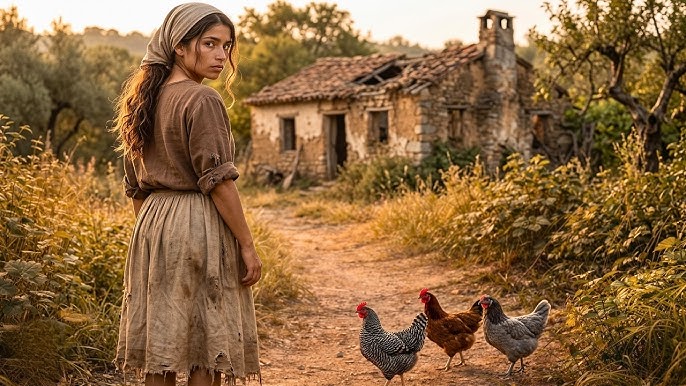
She cleared a patch of weeds near the house and hammered together a small chicken run using leftover fence wire. The birds stepped out cautiously, pecking at the ground like they weren’t sure it would hold.
“You’re tougher than you look,” she told them.
She wasn’t talking only to the chickens.
By midday, a truck rolled slowly past the ranch.
Two men inside glanced at her.
One shook his head.
“She won’t last a month,” he muttered.
Emily heard it.
She kept working.
—
The land was worse than she remembered.
Hard soil. No irrigation. The well pump groaned and coughed before producing a thin trickle. The barn roof had partially collapsed. The pasture looked more like desert.
But Emily didn’t panic.
She studied.
Her father had taught her things most people forgot—how to read soil by color, how to trap moisture, how to coax life from neglected land. She hadn’t used those skills in years, but her hands remembered.
She started small.
She dug shallow trenches in curved patterns across the slope behind the house. She hauled broken boards and old metal sheets, placing them strategically to block wind and hold shade. She collected rainwater from the roof using barrels she patched with tar.
The neighbors watched from a distance.
“She’s digging lines in the dirt,” one said.
“Grief makes people strange,” another replied.
Emily ignored them.
At night, she mixed compost from kitchen scraps, dry grass, and chicken manure. She worked quietly, methodically, like she was following a map only she could see.
The three chickens began laying eggs.
Small at first.
Then steadier.
She sold half in town.
Used the money for seeds.
—
Weeks passed.
Green appeared.
Not much—just tiny shoots hugging the soil—but they held. Emily shaded them with scrap cloth and watered carefully. She planted in clusters, not rows, letting plants protect each other.
The wind still blew.
But now, it slowed where she had built low barriers.
Moisture lingered.
Roots dug deeper.
One afternoon, the same truck drove past again.
The men slowed.
“You see that?” one said.
“Looks like… something’s growing.”
Emily wiped sweat from her brow and kept working.
—
By the second month, the chickens had doubled.
She traded eggs for two more hens from a farmer who felt sorry for her.
“You’re gonna need more than luck,” he said.
“I don’t use luck,” Emily replied.
He laughed.
But he came back the next week.
—
The ruined barn became her next project.
She couldn’t rebuild it entirely, so she repaired one corner. Reinforced beams. Patched holes. Used salvaged tin for roofing. It wasn’t pretty—but it stood.
She moved the chickens inside at night.
Predators circled, but none got in.
The flock grew stronger.
Emily hatched chicks using a homemade incubator built from a cooler, a bulb, and a thermometer she bought secondhand.
Neighbors began talking.
“She’s raising birds now.”
“She’ll run out of feed.”
But she didn’t.
Emily planted sorghum near the trenches. It grew tall and hardy. She used it for feed. Then she added sunflowers. Then beans that climbed the stalks.
The land slowly changed.
Color returned.
Texture softened.
Life spread.
—
By late summer, people noticed.
The dusty patch near the house had become a green island. Chickens roamed in rotating pens she moved daily. The soil beneath them darkened and richened.
A man stopped one morning.
“You selling eggs?”
“Yes.”
“How much?”
He blinked at the price.
“Those better be good.”
“They are.”
He came back two days later.
“Got more?”
Emily smiled.
—
The first real rain came in September.
Water flowed into the curved trenches she had carved months earlier. Instead of washing away, it pooled, soaked, and stayed.
The next week, grass sprouted where nothing had grown in years.
Even the skeptics fell silent.
The three skinny chickens had become twenty-seven.
Emily built a small roadside stand.
HARPER RANCH EGGS — FRESH DAILY
Cars began stopping.
Then more.
—
One evening, a rancher named Tom Walker pulled in.
He studied the fields, the birds, the green patches spreading outward.
“You did all this?” he asked.
“Yes.”
“With what?”
Emily held up her hands.
“These.”
He nodded slowly.
“Never seen land turn around this fast.”
“It was waiting,” she said.
“For what?”
“For someone to listen.”
Tom bought two dozen eggs.
Then asked if she’d consult on his dry pasture.
Emily hesitated.
Then agreed.
—
By winter, the ranch looked different.
Not perfect.
But alive.
Chickens filled the barn. Compost piles steamed gently in the cold. Windbreaks of planted shrubs began forming along the property line.
Emily worked every day.
Her hands cracked from cold.
But she kept going.
The town stopped laughing.
They started asking.
“How’d you do it?”
“What did you plant?”
“Can you look at my land?”
Emily didn’t boast.
She just showed them.
—
Spring arrived again.
The pasture turned green.
Not just near the house—but across the lower fields where moisture had spread underground. Wildflowers appeared. Insects returned. Birds nested in the shrubs she planted.
The ranch that had once been dismissed as ruined began producing.
Eggs.
Vegetables.
Feed crops.
And hope.
One morning, the man who had laughed at her months ago stepped out of his truck.
“I was wrong,” he said quietly.
Emily nodded.
He looked at the chickens wandering the yard.
“You started with three?”
“Yes.”
He shook his head in disbelief.
“Guess nobody knew what your hands could do.”
Emily smiled softly, watching the wind ripple across green fields that once held only dust.
Neither had she.
Until she tried.
She Only Had 3 Skinny Chickens and a Ruined Ranch… But No One Knew What Her Hands Could Do
Part 2
By the second spring, Harper Ranch no longer looked abandoned.
The earth had changed color.
What used to be pale and cracked had deepened into soft brown. Grass spread in uneven but determined patches. The wind no longer swept dust across the yard—instead, it brushed through low shrubs Emily had planted as windbreaks.
The chickens were everywhere.
Not three.
Not twenty.
Nearly eighty.
They moved in rotating paddocks she shifted each morning. The soil behind them turned dark and crumbly, alive again. People in town began calling it “Emily’s moving garden,” because wherever the birds went, green followed.
Emily didn’t correct them.
She just kept working.
—
Her days started before sunrise.
She carried feed buckets, checked water lines, and collected eggs while the sky was still gray. The chickens clucked softly as she moved among them. She spoke to them quietly, the same way she had when there were only three.
“You girls did good,” she murmured one morning, lifting a basket already half full.
She walked back toward the house—and stopped.
A pickup truck sat near the gate.
A man leaned against it, arms crossed, studying the land.
Emily recognized him.
Frank Delaney.
He owned one of the largest ranches in the county—and one of the driest. He had been among those who laughed the loudest when she first arrived.
He tipped his hat.
“Morning.”
“Morning,” Emily replied cautiously.
He glanced around again. “Didn’t think I’d see this.”
“Neither did I,” she said.
Frank stepped closer, boots crunching over gravel. “I got two hundred acres just like this used to be. Dead. Windblown. Nothing holds.”
Emily waited.
“I want you to look at it,” he continued. “Tell me what you did.”
She hesitated. “I didn’t do anything special.”
Frank shook his head. “Don’t sell yourself short. Land doesn’t wake up like this on its own.”
Emily studied his face. He wasn’t mocking her now. He looked… hopeful.
“I’ll come by tomorrow,” she said finally.
Frank nodded, relief flickering across his expression.
“Appreciate it.”
—
Frank’s ranch looked familiar.
Cracked soil.
Leaning fence posts.
Dry creek bed.
Emily walked slowly, crouching to touch the ground, picking up handfuls of dust, studying slopes and shadows.
Frank followed silently.
“You don’t need water first,” she said after a while.
He blinked. “I don’t?”
“You need to slow the wind. Then hold the rain when it comes.”
He frowned. “That’s it?”
“It’s where you start.”
Emily sketched lines in the dirt with a stick—curved trenches, windbreak rows, rotation paddocks.
Frank stared at the pattern.
“That looks like what you did at your place.”
“Yes.”
He looked across his land again.
“You think it’ll work?”
Emily shrugged gently. “If you work.”
He nodded once. “I’ll start today.”
—
Word spread quickly.
Frank Delaney asking Emily Harper for advice turned heads.
Soon, others came too.
A widow with five acres.
A young couple who had bought dry land cheap.
Even a retired farmer who thought his soil was beyond saving.
Emily helped them all.
Not for money at first—just eggs, seeds, or tools in exchange. But slowly, people began insisting on paying.
“You’re saving us years,” one man said, pressing bills into her hand.
Emily used the money carefully.
She repaired the well.
Bought better fencing.
Expanded the barn.
And added something new.
Goats.
Three of them.
They cleared brush fast, fertilized the ground, and gave milk. The ranch diversified, becoming more resilient.
The land responded.
—
By summer, Harper Ranch became a quiet example.
People drove out just to see it.
Not flashy.
Not huge.
But alive.
A group from the county agriculture office visited one morning. They walked through the paddocks, took notes, and photographed the trenches.
“This is regenerative grazing,” one woman said.
Emily shrugged. “It’s just common sense.”
The woman smiled. “You turned three chickens into a working ecosystem.”
Emily laughed softly. “They did most of the work.”
—
One afternoon, a dusty sedan rolled into the yard.
Emily stepped outside.
A young woman climbed out, holding a folder.
“Ms. Harper?” she asked.
“Yes.”
“I’m from the state conservation program. We’d like to feature your ranch. Maybe offer a grant to expand.”
Emily blinked. “A grant?”
“Yes. To help restore more land.”
Emily looked out across the fields.
She remembered the day she arrived—three skinny chickens, a ruined ranch, and nothing else.
“I don’t need much,” she said.
The woman smiled. “That’s exactly why we want to help.”
—
Fall brought the biggest change yet.
Frank Delaney’s ranch began turning green.
Not everywhere—but patches appeared. Then strips. Then whole sections. His neighbors noticed. The method spread.
They started calling it “Harper style.”
Emily didn’t like the name—but she couldn’t stop it.
One evening, Frank pulled into her yard again.
He handed her a small wooden box.
“What’s this?” she asked.
“Open it.”
Inside lay a metal sign.
HARPER RANCH — EST. REBORN
Emily swallowed.
“You didn’t have to—”
Frank shook his head. “You gave this county hope.”
She looked at the sign quietly.
“Started with three chickens,” he added.
Emily smiled faintly.
“They weren’t much to look at.”
Frank chuckled. “Neither was this land.”
—
Winter came gently that year.
The soil held moisture. Grass remained longer. The chickens huddled safely in the barn she had rebuilt.
One cold morning, Emily stood on the porch, watching frost shimmer across green fields that once held only dust.
Her hands rested on the railing.
Rough.
Scarred.
Strong.
She remembered the laughter when she arrived. The doubts. The empty land. The three skinny chickens.
No one had believed she could rebuild anything.
But they hadn’t known what her hands could do.
Emily stepped down from the porch and walked toward the flock.
The chickens scattered happily around her boots.
She bent, picked up one gently, and smiled.
“You started it all,” she whispered.
The wind moved softly across the ranch—no longer harsh, no longer empty.
Just quiet.
And alive.