
Father Cut His Daughter’s Hair Over the Shame of Her Pregnancy — Until a Rancher Took the Blame and Changed Everything
The first thing they took from her… was her hair.
Not her dignity. Not yet.
That would come later.
The morning air in the small frontier town was sharp with whispers. They passed from porch to porch, from store to stable, like dry wind carrying sparks.
“Did you hear about Mary Whitaker?”
“Pregnant.”
“Unmarried.”
“Shameful.”
By the time the sun climbed over the wooden rooftops, the entire town knew.
And her father—Thomas Whitaker—had already decided what to do.
Mary stood in the yard behind their small house, her hands trembling at her sides. Her long chestnut hair—once her pride—fell past her waist in soft waves, catching the morning light.
Her father stood in front of her, jaw tight, eyes cold with something deeper than anger.
Disappointment.
“You’ve brought disgrace into this house,” he said.
Mary swallowed hard. “Pa, please—”
“Don’t,” he snapped. “Don’t you dare beg now.”
From the porch, neighbors watched.
No one stepped in.
No one ever did.
Thomas reached into his pocket and pulled out a knife.
Mary’s breath caught.
“You don’t get to walk around like nothing happened,” he said. “Not with that belly growing. Not with people talking.”
Her voice cracked. “It wasn’t—”
“Enough!”
The word echoed.
Then—
With one swift motion—
He grabbed her hair.
And cut.
The sound was soft.
But the meaning was deafening.
Strands fell to the dirt like something dead.
Mary didn’t scream.
Didn’t cry.
Not then.
Because something inside her had already gone quiet.
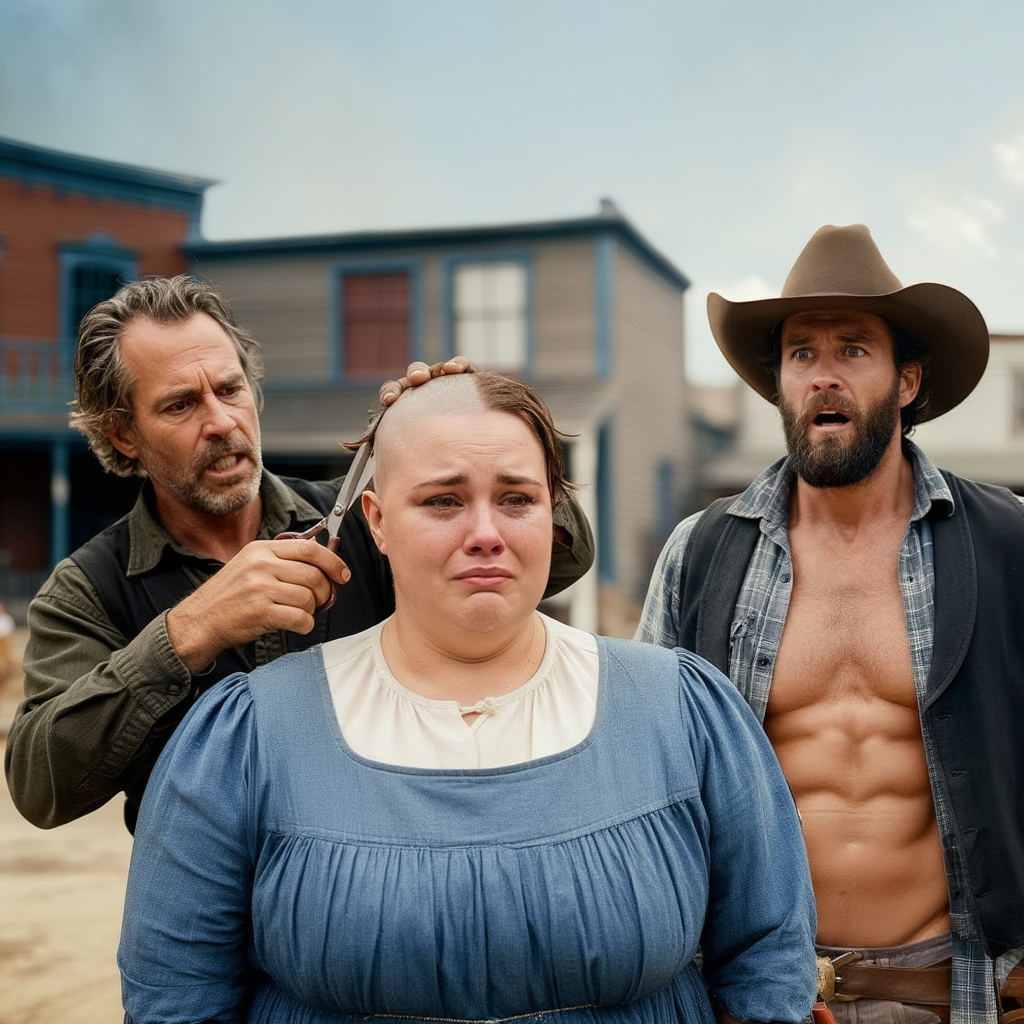
By afternoon, she was gone.
Driven out.
No bag. No food. No place to go.
Just the dress on her back—and the weight of a child no one wanted to claim.
The road stretched endlessly ahead, dust rising beneath her bare steps.
She walked until her legs gave out.
And then she kept walking.
Miles away, beyond the edges of town, beyond where the gossip lost its voice, there was a ranch.
Simple.
Weathered.
Steady.
It belonged to a man named Caleb Hayes.
He wasn’t known for much.
Didn’t talk more than needed.
Didn’t visit town often.
Didn’t involve himself in other people’s business.
But he noticed things.
And that evening, as he rode along the outer fence line, he saw her.
A figure collapsed near the road.
Still.
Too still.
Caleb pulled his horse to a stop.
For a moment, he just looked.
Then he dismounted and approached carefully.
“Miss?”
No response.
He crouched beside her.
Her face was pale. Lips dry. Hair uneven—cut jagged and short, like it had been taken in anger.
And her hand—
Rested protectively over her stomach.
Caleb’s expression shifted.
He understood.
Not everything.
But enough.
He stood, lifted her gently, and carried her to his horse.
“You’re not dying out here,” he muttered.
When Mary woke, it was to warmth.
A blanket.
The smell of wood smoke.
She blinked slowly, disoriented.
A ceiling above her—not sky.
A roof.
Safe.
Her body tensed instantly.
She sat up too fast, panic flooding in.
“Easy,” a voice said.
She turned.
A man stood across the room—tall, broad-shouldered, his expression calm but unreadable.
“You’re alright,” he added.
Mary pulled the blanket tighter around herself.
“Where am I?”
“My place,” he said. “Found you by the road.”
Her heart raced.
“Why?”
Caleb tilted his head slightly. “Why what?”
“Why didn’t you just… leave me?”
He didn’t answer right away.
Instead, he walked over to the stove, poured a cup of water, and handed it to her.
“Drink.”
She hesitated.
Then took it.
Her hands shook as she sipped.
“You looked like you needed help,” he said simply.
Mary laughed—soft, bitter.
“People don’t help girls like me.”
Caleb met her eyes.
“Guess I’m not people.”
Days passed.
Mary stayed.
At first, because she had nowhere else.
Then—
Because she wasn’t asked to leave.
Caleb didn’t pry.
Didn’t ask who the father was.
Didn’t ask what happened.
He just gave her space.
Food.
A bed.
Work, when she was strong enough.
And something unfamiliar—
Respect.
But the world doesn’t forget.
And it doesn’t forgive easily.
Word reached town.
Then spread.
Then grew.
Until one morning, a group of riders appeared at the edge of Caleb’s land.
Mary saw them first.
Her breath caught.
“Caleb,” she whispered.
He stepped outside, wiping his hands on a cloth.
His eyes narrowed slightly.
“Stay inside,” he said.
But Mary didn’t move.
She couldn’t.
Because leading the group—
Was her father.
Thomas Whitaker dismounted slowly, his expression hard as stone.
“You’ve got something that belongs to me,” he said.
Caleb leaned against the post, unbothered.
“She’s not a thing.”
Thomas’s eyes flashed. “She’s my daughter.”
Mary stepped into the doorway.
“I was,” she said.
Silence fell.
Thomas’s gaze snapped to her.
For a moment—just a moment—something flickered.
Then it vanished.
“You’ll come home,” he said.
“No.”
The word surprised even her.
“No?” His voice rose. “After what you’ve done?”
Mary’s hands trembled.
But she didn’t back down.
“You made your choice,” she said. “So did I.”
The men behind Thomas shifted, uncomfortable.
This wasn’t going how they expected.
Thomas stepped forward.
“Do you even know who the father is?” he demanded.
Mary’s silence answered him.
His lip curled.
“Thought so.”
Then he turned to Caleb.
“You think you’re doing something noble?” he sneered. “Taking in someone else’s mistake?”
Caleb straightened.
His voice, when it came, was quiet.
But it carried.
“It’s not a mistake.”
Thomas scoffed. “Then what is it?”
Caleb paused.
Then—
He said something no one expected.
“It’s mine.”
The world seemed to stop.
Mary’s head snapped toward him.
“What—?”
Thomas blinked. “Yours?”
Caleb nodded once.
“I’m the father.”
The lie settled heavy in the air.
Thomas stared, searching his face.
For doubt.
For hesitation.
He found none.
“You expect me to believe that?” he said slowly.
Caleb shrugged. “Believe what you want. Doesn’t change it.”
Mary’s heart pounded.
Why was he doing this?
Why would he—
Thomas looked between them.
Then laughed.
A harsh, disbelieving sound.
“Well,” he said, “ain’t that convenient.”
He shook his head.
“Fine.”
He turned back to his horse.
“Then she’s your problem now.”
And just like that—
He left.
No apology.
No regret.
Just dust and distance.
The riders followed.
The land grew quiet again.
Mary stood frozen.
Then—
She turned to Caleb.
“Why did you do that?”
He didn’t answer right away.
Instead, he walked past her, back toward the house.
She followed.
“Caleb,” she pressed. “You lied.”
“Yes.”
“Why?”
He stopped.
Turned.
Looked at her—not as a burden, not as a problem.
But as a person.
“Because sometimes,” he said, “the truth doesn’t protect people.”
Mary’s eyes filled.
“I didn’t ask you to—”
“I know.”
“Then why?”
Caleb exhaled slowly.
“Because you needed someone to stand in front of you,” he said. “Not behind.”
The words hit harder than anything her father had said.
Because they didn’t hurt.
They healed.
Weeks turned into months.
The town adjusted.
People whispered, yes.
But now the story was different.
Not a fallen girl.
But a quiet rancher and the woman he stood by.
And slowly—
The whispers softened.
When the baby came, it was during a storm.
Rain pounded the roof.
Wind howled through the night.
Mary screamed.
Cried.
Fought.
And Caleb—
Stayed.
Not outside.
Not distant.
Right there.
Holding her hand.
Telling her to breathe.
Telling her she wasn’t alone.
And when the child finally cried—
A strong, defiant sound—
Mary broke.
Not from pain.
But from something deeper.
Relief.
Love.
Hope.
Caleb looked down at the child in his arms.
Then at Mary.
“What’s her name?” he asked.
Mary smiled through tears.
“Hope.”
Years later, people would still talk.
About the girl who was cast out.
About the father who chose pride over love.
But more than that—
They talked about the man who stepped forward.
Who took a burden that wasn’t his.
And made it something beautiful.
One evening, as the sun dipped low and painted the fields gold, Mary sat on the porch, Hope playing at her feet.
Caleb leaned against the railing beside her.
“You know,” Mary said softly, “you never told me why.”
Caleb glanced at her. “Why what?”
“Why you really did it.”
He thought for a moment.
Then said—
“Because no one did it for my mother.”
Mary looked at him.
And understood.
Some wounds didn’t close.
They just taught you how to keep others from bleeding.
She reached for his hand.
He didn’t pull away.
And for the first time—
What started as a lie…
Felt like the truest thing in the world.
Father Cut His Daughter’s Hair Over the Shame of Her Pregnancy — Part 2: The Truth He Couldn’t Silence
The lie should have ended everything.
Instead—
It began something neither of them expected.
The seasons turned, steady and patient.
Little Hope grew strong, her laughter echoing across the ranch like something sacred. She had Caleb’s quiet calm—or so people said—and Mary’s eyes, full of depth that came from surviving more than most ever would.
And the town?
It watched.
At first from a distance.
Then closer.
Then, slowly… with something that almost resembled respect.
But peace, on the frontier, never lasted forever.
It came back on a cold morning.
Not with shouting.
Not with threats.
But with a single rider.
Mary saw him from the porch, her breath catching before her mind even caught up.
She knew that posture.
That rigid back.
That refusal to bend.
“Caleb,” she said quietly.
He stepped out beside her, one glance enough to understand.
Thomas Whitaker had returned.
This time, he came alone.
No men.
No noise.
Just him.
That made it worse.
He dismounted slowly, his eyes never leaving Mary.
“I hear you’ve built yourself a life,” he said.
Mary didn’t answer.
Hope clutched her skirt, peeking out with curious eyes.
Thomas noticed.
His gaze lingered.
“That the child?” he asked.
Mary’s voice was firm. “Yes.”
A long pause.
Then—
“She looks healthy.”
It wasn’t kindness.
But it wasn’t cruelty either.
And somehow, that unsettled Mary more.
Caleb stepped forward slightly.
“You’ve said what you came to say?”
Thomas ignored him.
Instead, he reached into his coat.
Mary tensed.
But he didn’t pull a weapon.
He pulled paper.
Folded.
Worn.
“I went to town,” he said. “Did some asking.”
Caleb’s expression didn’t change.
“You lied,” Thomas said flatly.
The words hung in the air.
Mary’s heart dropped.
Hope looked between them, confused.
“You’re not the father,” Thomas continued, eyes locked on Caleb. “No record. No witness. Nothing tying you to her before that day.”
Silence.
Heavy.
Unavoidable.
Mary stepped forward.
“It doesn’t matter—”
“It matters to me,” Thomas snapped.
His voice cracked—not loud, but sharp enough to cut.
For the first time—
There was something else there.
Not anger.
Not pride.
Something closer to… fracture.
Caleb exhaled slowly.
“You’re right,” he said.
Mary turned to him, stunned.
“Caleb—”
“It’s not mine,” he repeated.
The truth, once spoken, didn’t explode.
It settled.
Like dust.
Like something inevitable.
Thomas let out a humorless laugh.
“So that’s it,” he said. “All this… built on a lie.”
Mary’s chest tightened.
But Caleb didn’t move.
Didn’t retreat.
“It was never about the lie,” he said.
Thomas scoffed. “Then what was it about?”
Caleb looked at Mary.
Then at Hope.
Then back at Thomas.
“It was about giving them something you didn’t.”
The words landed harder than any accusation.
Thomas flinched.
Just slightly.
“You think you’re better than me?” he demanded.
“No,” Caleb said calmly. “I think I made a different choice.”
Silence.
Wind moved through the dry grass.
Hope squeezed Mary’s hand.
“Why is he mad?” she whispered.
Mary swallowed.
“Because he doesn’t understand,” she said softly.
Thomas stared at the child.
Then at Mary.
His voice dropped.
“You could’ve come back,” he said.
Mary blinked.
“What?”
“You could’ve come back,” he repeated. “After… after the baby.”
The words felt wrong.
Out of place.
Like they didn’t belong to the man who had cut her hair and sent her away.
Mary’s voice trembled.
“You threw me out.”
“I was angry.”
“You were ashamed.”
Thomas didn’t deny it.
“I was trying to protect this family.”
Mary laughed, the sound breaking halfway through.
“By destroying it?”
The truth sat between them now.
Raw.
Unavoidable.
Thomas looked older than she remembered.
Not weaker.
Just… worn.
“I thought,” he said slowly, “if I made an example… if I showed the town I wouldn’t tolerate it…”
His voice faltered.
“They’d respect us.”
Mary shook her head.
“They feared you,” she said. “That’s not the same.”
Caleb stayed silent.
This wasn’t his moment.
It never was.
Thomas looked at Hope again.
Something shifted in his expression.
Not fully.
But enough.
“She’s got your eyes,” he said quietly.
Mary nodded.
A long pause followed.
Then—
“I can’t undo what I did,” Thomas said.
No one spoke.
Because that much was obvious.
“But I came here to…” He stopped.
Struggled.
Tried again.
“I came here to see if there was anything left.”
Mary felt her chest tighten.
Years of pain.
Of silence.
Of survival.
All leading to this moment.
“Why now?” she asked.
Thomas looked away.
“For a long time, I told myself I did the right thing,” he said. “That I had to.”
His hands clenched slightly.
“But the house got quieter,” he continued. “People stopped visiting. Your mother… she stopped talking about you.”
Mary’s breath caught.
“She still keeps your room the same,” he added.
The words landed gently.
But they cut deep.
Hope tugged at Mary’s hand.
“Who is he?” she asked.
Mary looked down at her daughter.
Then back at the man standing in front of her.
A stranger.
And not.
“He’s…” Mary hesitated.
Then said it.
“He’s my father.”
Hope’s eyes widened.
She studied him.
Then waved.
A small, uncertain gesture.
Thomas froze.
As if he didn’t know what to do with something so simple.
So undeserved.
Slowly—
He raised his hand back.
The moment passed quietly.
But it changed something.
“I’m not asking to take her,” Thomas said suddenly.
Mary’s shoulders relaxed slightly.
“I’m not asking you to come back,” he added.
A pause.
“I just… didn’t want to die with this the way it is.”
The honesty in his voice was unfamiliar.
Uncomfortable.
Real.
Mary looked at Caleb.
He didn’t tell her what to do.
Didn’t guide her.
Didn’t protect her from this choice.
Because this—
Was hers.
She stepped forward slowly.
Close enough to see the lines in her father’s face.
The regret he didn’t quite know how to carry.
“You don’t get to fix everything,” she said.
“I know.”
“You don’t get to pretend it didn’t happen.”
“I won’t.”
Her voice softened.
“But… you showed up.”
Thomas nodded.
It wasn’t forgiveness.
Not yet.
But it was something.
“Can I…” he hesitated, then nodded toward Hope. “Can I know her name?”
Mary looked down.
Then smiled faintly.
“Hope.”
Thomas repeated it under his breath.
As if testing something fragile.
“Hope.”
The wind moved through the fields again.
But this time—
It didn’t feel so cold.
As the sun began to set, Thomas stepped back toward his horse.
“I won’t come again unless you want me to,” he said.
Mary nodded.
“That’s fair.”
He hesitated.
Then looked at Caleb.
“You didn’t have to do what you did.”
Caleb shrugged slightly.
“I know.”
A long pause.
Then Thomas said—
“Thank you.”
It was quiet.
Almost lost in the air.
But it mattered.
When he rode away, it felt different than before.
Not like something unfinished.
But like something… opened.
That night, Mary sat on the porch again.
Hope asleep beside her.
Caleb leaned against the railing.
“You alright?” he asked.
Mary nodded slowly.
“I don’t know what this becomes,” she admitted.
“You don’t have to,” Caleb said.
She looked at him.
“You told the truth today.”
“Yeah.”
“Does that change anything?”
Caleb thought for a moment.
Then shook his head.
“No,” he said. “Because I meant what I did. Lie or not.”
Mary smiled softly.
Then reached for his hand.
And this time—
There was no question.
No uncertainty.
No shame.
Because sometimes, the truth doesn’t break what was built on a lie.
Sometimes—
It proves that what was built…
Was real all along.