
“They Left Her Alone Before Winter” — She Built a Hill Shelter… Then Saved Every Cow at -22°
They left before the first real frost.
The trucks rolled down the long dirt road in a slow, deliberate line, their tires crunching over the early ice that clung to the ruts. A wind came off the plains and tugged at loose tarps, rattling the empty feed buckets that hung beside the barn. The sky was a pale iron gray — the kind that meant winter wasn’t coming. It was already here.
Emma Carter stood alone beside the fence, her gloved hands gripping the cold wood.
She didn’t wave.
No one waved back.
Her older brother, Luke, had been the last to climb into the pickup. He leaned out the window only once.
“You can still come with us,” he said, not meeting her eyes. “This place isn’t survivable. Not alone.”
Emma looked past him — past the cattle moving slowly in the far pasture, past the barn that needed patching, past the low hill behind the house.
“I’m staying,” she said.
Luke exhaled sharply. “You’ve got forty-two head out there. Water freezes. Feed runs low. Roads close. You know what -20 does to livestock.”
“I know,” she said.
He waited.
She didn’t change her mind.
Finally, he nodded once, like a man signing a paper he didn’t agree with. Then the truck door shut, the convoy pulled away, and the sound of engines faded into the open country.
Emma was alone.
The ranch had never been meant for one person.
Two hundred acres of rolling pasture, a weather-beaten barn, a small farmhouse, and a shallow creek that iced over every winter. Their father had run it for thirty years. After he died, the siblings tried to hold it together — but the last two winters had been brutal.
Too much snow.
Too many calves lost.
Too many frozen pipes.
So they sold their shares. Luke found work in Colorado. The others scattered.
Emma bought what she could with borrowed money.
And stayed.
The first snow came early.
Not deep — just a powder that dusted the grass and froze into a thin crust overnight. The cattle moved slower, bunching together near the windbreak. Emma checked them twice a day, breaking ice in the troughs, hauling hay, listening to the wind.
At night, she studied the land.
Not the house. Not the barn.
The hill.
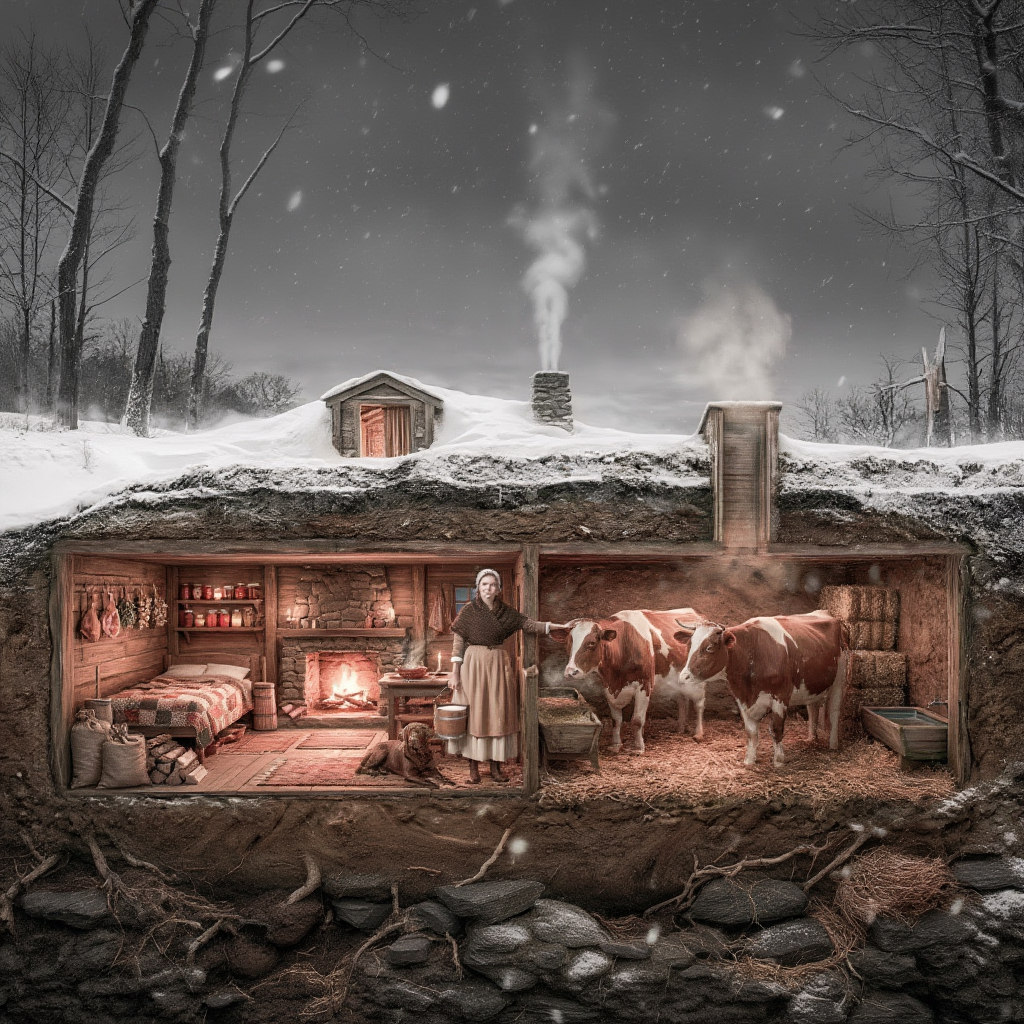
It rose gently behind the property — nothing dramatic, just a long slope of packed earth and stubborn grass. But halfway up, the ground curved inward slightly, creating a shallow natural shelf.
Her father had once mentioned it.
“Wind slides over that hill,” he’d said. “Temperature’s warmer on the backside. Snow drifts there too. Natural insulation.”
Emma remembered.
Three days later, she started digging.
The first shovel strike bounced off frozen ground.
She switched to a pickaxe.
The soil beneath the crust was dense clay mixed with gravel — hard work, slow progress. She marked a rectangle about twelve feet wide and eight feet deep, carving into the slope just below the natural shelf.
Her hands blistered.
Her shoulders burned.
The wind cut through her coat.
But she kept digging.
By the end of day three, she had a shallow cavity. By day six, a pit large enough to stand in. By day nine, a rough chamber carved into the hill itself.
She reinforced the roof with salvaged fence posts and old beams from a collapsed shed. Over those, she laid plywood. Then plastic sheeting. Then shoveled earth back over the top.
From a distance, it looked like nothing.
Just a bump in the hill.
Inside, the air felt different — still, muted, insulated from the wind. She installed a simple vent pipe using an old stovepipe and left a narrow entrance angled downward to block gusts.
She spread straw across the floor.
Then she stood in the middle and exhaled.
It was warmer.
Not warm.
But warmer.
She nodded once.
“This’ll do,” she murmured.
The first real storm hit two weeks later.
It came fast — a wall of white sweeping across the plains. By sunset, visibility dropped to yards. By midnight, the wind howled like a freight train, slamming snow against the barn walls.
Emma woke at 3:10 a.m. to the sound of something banging.
She pulled on boots, grabbed her flashlight, and stepped outside.
The cold hit like a punch.
The thermometer by the porch read -9°F… and dropping.
The cattle were restless — clustered tight, shifting, lowing nervously. Snow piled against the windbreak, leaving gaps where the wind cut straight through.
Emma’s jaw tightened.
They wouldn’t last long in the open.
She opened the gate and began driving them — slow, steady — toward the hill.
The animals resisted at first, confused by the storm. But Emma kept moving, her voice calm, her flashlight guiding them.
Step by step.
Minute by minute.
Forty-two cattle climbed the slope.
At the top, she turned them toward the dugout shelter.
The first cow hesitated at the entrance.
Emma stepped inside, waving gently.
“Come on, girl. It’s alright.”
The animal lowered its head, sniffed, then stepped in.
The rest followed.
One by one.
They packed tightly inside and around the recessed shelter, using the hill as a windbreak. Snow drifted over the roof, sealing heat inside. The animals’ body warmth filled the space, raising the temperature further.
Emma stayed until dawn.
When the storm passed, she checked the thermometer again.
Outside: -18°F.
Inside the hill shelter: 9°F.
She stared.
Nearly thirty degrees difference.
Every cow was alive.
Word didn’t spread immediately.
Winter deepened.
Emma expanded the shelter — widening the entrance, carving a secondary alcove. She stacked hay along the outer wall to add insulation. Snowstorms came and went. Temperatures dropped further.
Then came January.
The coldest front in years.
Weather radio crackled warnings: Arctic air. Dangerous exposure. Wind chills below -30°F.
Emma filled troughs early, hauled extra hay, and moved the cattle before sunset.
The sky cleared overnight — a bad sign.
By morning, the thermometer read -22°F.
The world was silent.
Even the wind had stopped.
Emma trudged up the hill, breath freezing in the air. She pushed through the snow drift blocking the entrance and stepped inside.
Steam rose from the cattle.
They shifted slowly, calm, alive.
She checked her pocket thermometer.
Inside: 11°F.
Her shoulders dropped in relief.
Every single animal stood breathing.
Forty-two heartbeats.
Forty-two lives.
Saved by dirt, straw, and stubbornness.
Three days later, Luke called.
“I heard you stayed,” he said.
“I did.”
“You lose many?”
Emma looked out at the hill, where cattle grazed lightly in weak sunlight.
“No,” she said quietly. “Didn’t lose one.”
Silence.
“That’s not possible,” he muttered.
“I built a hill shelter.”
“A what?”
She explained.
He didn’t speak for a long time.
Finally, he said, “I… might come see that.”
“You’re welcome anytime.”
He arrived two weeks later.
The road was still rough, snow piled along both sides. He stepped out of the truck, scanning the property like a man expecting damage.
Instead, he saw calm cattle.
Full hay stacks.
No carcasses.
Emma led him up the hill.
He frowned.
“That’s it?”
“That’s it.”
He stepped inside — and stopped.
The warmth surprised him.
He touched the roof beam, the packed earth, the straw.
“You did this… alone?”
Emma nodded.
Luke shook his head slowly.
“Dad would’ve loved this,” he murmured.
Emma smiled faintly.
“Yeah,” she said. “I think he would’ve.”
Spring thaw came late.
But when it did, every cow walked out healthy. Calving season arrived strong. The herd grew.
Neighbors began asking questions.
Emma showed them the hill.
Some copied her design.
The next winter, more shelters dotted the plains — low, quiet shapes built into slopes and ridges.
And when temperatures plunged again, losses were fewer.
Emma never bragged.
She just kept working — patching fences, hauling hay, watching the horizon.
But sometimes, on cold mornings, she climbed the hill and looked at the land stretching white and endless around her.
They had left her alone before winter.
They thought she wouldn’t make it.
Instead, she built a shelter out of the earth itself…
…and saved every cow at -22°.
Spring didn’t bring relief.
It brought mud.
The snow melted too fast, turning the pasture into a slick gray field. Water pooled along the low ground, and the shallow creek swelled beyond its banks. Emma spent mornings hauling boards to keep the cattle from bogging down and afternoons clearing drainage channels with a shovel.
But the hill held firm.
The earth-packed shelter stayed dry inside, the straw still usable. When the calves started arriving in late March, Emma moved the weakest pairs into the dugout during cold nights. The difference was obvious — calves that might’ve chilled in open wind stayed steady, nursing and sleeping against the insulated walls.
By mid-April, she counted six new calves.
All alive.
Luke called again.
“You’re going to hate this,” he said.
“What?”
“I told a guy about your hill thing.”
Emma leaned against the fence. “A guy?”
“Neighbor down from where I’m working. Lost eight head this winter. He wants to see yours.”
Emma hesitated.
“This isn’t some secret,” she said finally. “He can come.”
He arrived three days later in a dusty green pickup. Middle-aged, weathered, quiet. He introduced himself as Mark Jensen and walked the property without speaking much.
When he stepped into the hill shelter, he crouched low, touching the walls.
“You didn’t pour concrete,” he said.
“No.”
“Just clay and timber?”
“And snow insulation.”
He nodded slowly.
“I lost calves every year,” he muttered. “Wind just cuts right through them.”
Emma shrugged lightly. “Wind’s the real killer. Not just cold.”
He studied her for a long moment.
“You mind if I build one?”
“Go ahead.”
By summer, two more ranches within ten miles had hillside shelters.
By fall, five.
The second winter came earlier than expected.
October frost hardened the ground overnight. The grass thinned faster than usual. Emma cut extra hay from the far pasture, stacking bales along the outer wall of the shelter to create a thicker wind barrier.
She also extended the roof.
Using salvaged tin sheets and fence posts, she built a shallow overhang above the entrance, angled downward so snow would drift and seal the gap naturally. It wasn’t pretty — but it worked.
Luke arrived in November.
This time, he stayed longer.
They worked side by side, reinforcing the back wall and digging a narrow secondary exit — just in case snow blocked the main entrance. Emma hadn’t mentioned it before, but the idea of being trapped had bothered her all summer.
Luke wiped sweat from his brow despite the cold.
“You really thought this through,” he said.
“I had all winter,” she replied.
He looked across the pasture.
“You know… I almost sold Dad’s saddle last year.”
Emma paused.
“Did you?”
He shook his head. “Couldn’t do it.”
She smiled faintly. “Good.”
The storm hit in December.
Not like the year before.
This one was worse.
Wind screamed across the plains at forty miles per hour, driving snow sideways in thick sheets. The temperature dropped hour by hour, plunging below zero before sunset.
Emma moved the herd early.
The cattle filed into the hill shelter more easily now — they remembered. The older cows led the way, calves following close.
By midnight, the world outside disappeared.
Snow piled waist-high. The barn doors groaned. Ice coated the fence wires.
Emma and Luke took turns checking the shelter every two hours.
Inside, the cattle pressed together, their breath fogging the air. The straw floor stayed dry. Heat built slowly, trapped by earth and drifting snow.
At 4 a.m., Luke checked the thermometer.
Outside: -17°F and falling.
Inside: 14°F.
He let out a low whistle.
“This thing’s a lifesaver.”
Emma didn’t answer. She just watched the animals — steady, calm, alive.
Morning brought worse news.
The radio crackled: Arctic front intensifying. Wind chill below -40°F. Travel not advised.
Luke looked at Emma.
“You ever see it this bad?”
She shook her head.
“No.”
They stayed close to the hill all day.
By afternoon, the temperature bottomed out at -22°F again — but this time with brutal wind. Snow sealed the shelter deeper, creating a thick insulating layer over the roof.
Inside, it held at 12°F.
The cattle never panicked.
They simply stood, breathing warmth into the space.
When the storm finally eased two days later, Emma counted them carefully.
Forty-eight.
All alive.
Including the new calves.
Luke laughed in disbelief.
“You didn’t just save them,” he said. “You beat winter.”
Emma looked at the hill, half-buried in snow.
“No,” she said quietly. “The hill did.”
Word spread faster this time.
By February, ranchers from thirty miles away came to see the shelter. Some took notes. Others just stood silently inside, feeling the still air.
One older rancher removed his hat.
“My granddad used to talk about dugouts,” he said. “Said they kept people alive back in the day.”
Emma nodded. “Same idea. Just… for cows.”
That spring, more hills were carved across the county.
Low, quiet shelters shaped by necessity.
Luke didn’t leave right away.
One evening in March, he stood beside Emma watching the herd graze.
“You ever think about expanding?” he asked.
She raised an eyebrow. “Expanding?”
“More cattle. Maybe another pasture. You’ve got a system now.”
Emma considered it.
For a long moment, she didn’t answer.
Then she looked at the hill — the simple mound of earth that had changed everything.
“Maybe,” she said. “But only if I can protect them.”
Luke smiled.
“You already know how.”
The wind moved gently across the plains, no longer a threat — just a reminder.
They had left her alone before winter.
She built a shelter into the hill.
And when the cold came again…
she saved every cow.