
Widow and Her Mother Built a Sandstone Wall — Then Fresh Food Grew in Deep Snow
Snow came early that year.
By the first week of October, the high desert valleys of southern Utah had already turned silver under frost, and the mesas beyond Cedar Wash glowed crimson in the late afternoon sun. Most families in the territory looked at the early storms and prayed their root cellars would hold.
But for thirty-two-year-old Evelyn Harper, prayer had become a quieter thing.
Not absent.
Just quieter.
Ever since her husband, Thomas, had died beneath a runaway timber sled the previous winter, Evelyn no longer asked Heaven for miracles.
She asked for enough.
Enough wood.
Enough flour.
Enough warmth.
Enough strength to get through one more morning.
And enough courage to keep her mother alive.
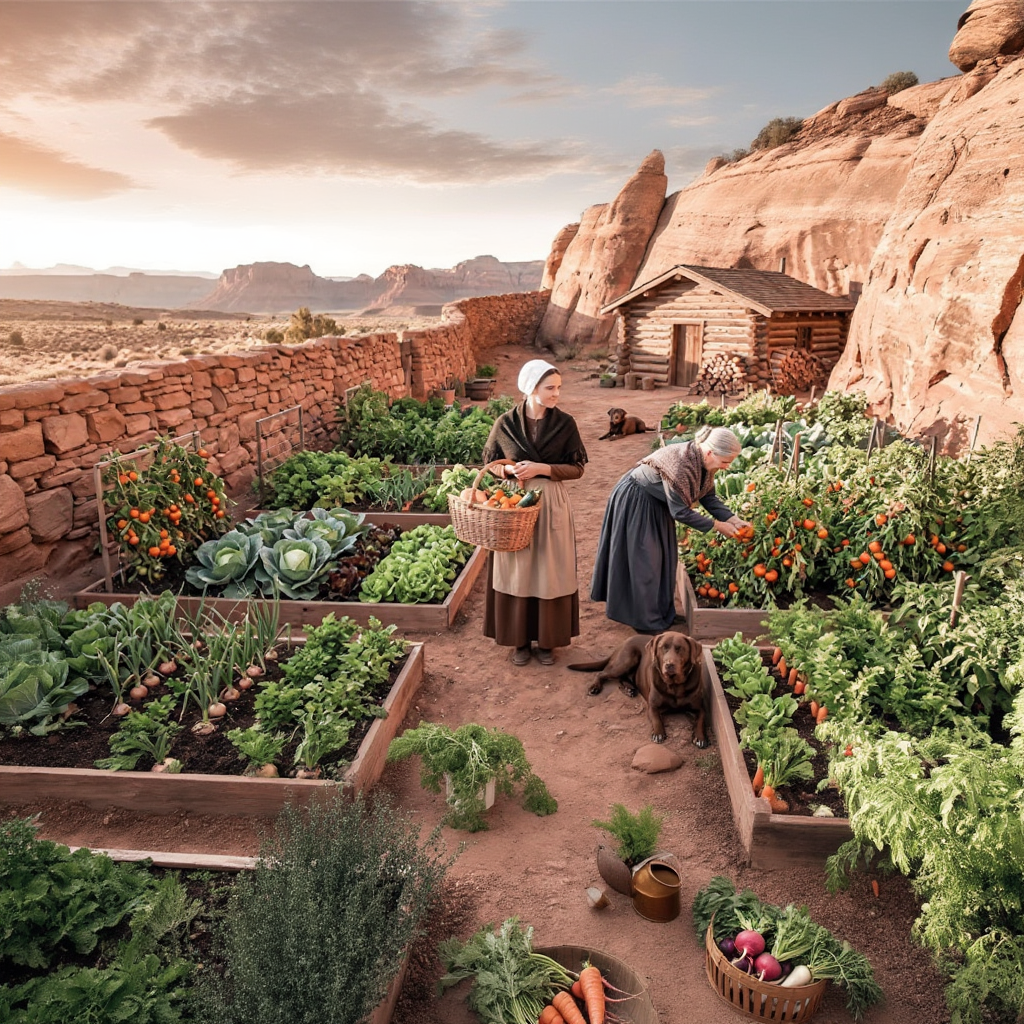
Their cabin sat alone beneath towering sandstone cliffs, miles from the nearest settlement. It was little more than a hand-hewn log structure with a sod roof, two windows, and a stone chimney that smoked day and night.
To strangers, it looked forgotten.
To Evelyn and her mother, Margaret, it was all they had left.
Thomas had built it with his own hands.
And after his death, many assumed the women would leave before spring.
Many assumed wrong.
Evelyn stood at the edge of their small garden, boots crunching on frozen dirt.
Her breath floated in the dawn air.
Beyond the cabin, snow dusted the red cliffs in thin white ribbons, and two brown dogs—Rusty and Belle—trotted between the raised beds, sniffing the frozen cabbage leaves.
Margaret Harper emerged from the cabin wrapped in a dark wool shawl, her white bonnet tied tightly beneath her chin.
At sixty-three, Margaret moved slower than she once had, but there was still iron in her bones.
She studied the frozen ground.
Then she sighed.
“We’ve got maybe two weeks before the soil locks.”
Evelyn nodded.
“Less.”
Margaret folded her arms.
“Then if we’re going to try your foolish idea…”
She looked toward the sandstone ridge.
“…we’d best start today.”
Evelyn smiled.
Her mother only called something foolish when she secretly believed it might work.
The idea had come from Thomas.
Or rather…
From something Thomas had once said.
The year before he died, he’d noticed warm patches of ground near the cliff walls, even after the first snow.
“The stone holds the sun,” he’d said.
“Like an oven.”
At the time, Evelyn had barely listened.
Now those words refused to leave her.
So one cold morning, she walked the base of the red cliffs and pressed her gloved hand against the rock.
Warm.
Not hot.
But warm.
Warmer than frozen air had any right to allow.
And suddenly…
She had an idea.
“Again.”
Margaret grunted as she lowered another sandstone block.
Evelyn adjusted it carefully.
“No gaps.”
Rusty barked.
Belle dug happily in the dirt nearby.
The women had spent four straight days hauling red sandstone from the slope behind the cabin.
Block by block.
Stone by stone.
Their hands blistered.
Their backs screamed.
Their fingers bled through wool gloves.
But slowly…
A wall began to rise.
Not tall.
Only waist high.
A curved enclosure facing south, pressed close against the cliffside.
Margaret wiped sweat from her brow.
“In all my years…”
She shook her head.
“…I never thought widowhood would involve masonry.”
Evelyn laughed for the first time in months.
Real laughter.
The kind that startled birds from cedar branches.
By the seventh day, snow began falling.
Soft.
Silent.
Relentless.
The valley disappeared under white.
Neighbors in distant cabins shuttered windows and prepared for winter.
But Evelyn and Margaret kept working.
Even as snow gathered on their bonnets.
Even as their skirts froze stiff around their ankles.
Even as their hands turned numb.
Stone after stone.
Until finally…
The wall was finished.
A low crescent of red sandstone enclosing six raised beds packed with dark soil, manure, and composted leaves.
Margaret stood back, breathing hard.
She stared.
Then frowned.
“It still looks foolish.”
Evelyn grinned.
“Then we’ve done it right.”
The next morning…
The snow was knee-deep.
White stretched across the valley in every direction.
The garden beyond the wall should have been dead.
Frozen.
Hopeless.
Instead…
Steam rose from the soil.
Margaret stopped walking.
Her basket slipped from her hands.
Evelyn smiled softly.
“Told you.”
The old woman walked closer.
Then knelt.
She touched the earth.
Warm.
Not summer warm.
But alive.
Warm enough to grow.
Margaret looked up.
And for a long moment…
Neither woman spoke.
Because some miracles arrive so quietly…
You almost miss them.
They planted everything they had left.
Tomatoes.
Carrots.
Onions.
Lettuce.
Cabbage.
Radishes.
Herbs.
Even the last precious bean seeds Thomas had saved in a glass jar.
Margaret hesitated over those.
“Are you sure?”
Evelyn held the seeds in her palm.
Thomas’s handwriting still marked the lid.
For hard years.
She smiled sadly.
“This qualifies.”
And they planted them.
Every last one.
Days passed.
Then weeks.
Snow deepened.
The valley vanished beneath white drifts.
Ice formed on the cabin windows.
Coyotes howled at night.
Wood grew scarce.
Flour ran low.
And still…
Every morning…
Evelyn walked to the sandstone wall.
And every morning…
Something green waited.
First tiny lettuce leaves.
Then onion shoots.
Then tomato vines.
Margaret stared at them as though they’d risen from graves.
Rusty and Belle lay between the beds, soaking in the trapped warmth.
And little by little…
Hope returned.
Word spread.
It always does.
By December, neighbors began arriving on horseback through snow-covered trails.
Men in fur hats.
Women wrapped in blankets.
Children with wide eyes.
They came expecting to see rumors.
Instead…
They saw life.
A lush garden growing in deep snow.
Bright green lettuce.
Thick cabbages.
Carrots.
Tomatoes hanging like rubies.
Steam rising from dark soil.
One rancher removed his hat.
“Good Lord.”
Margaret crossed her arms proudly.
“Told her it wouldn’t work.”
Evelyn raised an eyebrow.
“You did?”
Margaret smirked.
“I was preserving my dignity.”
Soon everyone wanted to know.
How?
Why?
Would it work elsewhere?
Evelyn showed them everything.
The south-facing wall.
The thermal stone.
The compost heat.
The wind barrier.
The raised beds.
Nothing magical.
Just observation.
Patience.
And refusal.
Refusal to freeze.
Refusal to starve.
Refusal to leave.
And somehow…
That inspired people even more.
By January, families from across the territory were building their own stone gardens.
Some failed.
Some succeeded.
Most improved.
And all of them remembered where it began.
At a lonely cabin beneath red cliffs.
With a widow.
Her mother.
And two stubborn dogs.
One bitter morning in late February…
Evelyn found Margaret standing alone beside the garden.
Snow drifted around her boots.
She wasn’t moving.
Just staring.
Evelyn walked closer.
“What is it?”
Margaret’s voice trembled.
“Come here.”
Evelyn stepped beside her.
And froze.
In the center bed…
The bean vines had climbed higher than either expected.
And hanging there…
Covered in frost crystals…
Were dozens of green pods.
Thomas’s beans.
Alive.
Margaret reached out.
Touched one.
Then whispered—
“He knew.”
Evelyn swallowed hard.
“Knew what?”
Margaret smiled through tears.
“That hard years come.”
She squeezed Evelyn’s hand.
“And that you’d survive them.”
For the first time since Thomas died…
Evelyn cried.
Not from grief.
Not from fear.
Not from hunger.
But from something she hadn’t allowed herself to feel.
Future.
Spring finally came in April.
Snow melted from the mesas.
Rivers swelled.
Birdsong returned.
Wildflowers pushed through thawing soil.
And where neighbors once expected to find a grieving widow preparing to leave…
They found something else entirely.
A thriving homestead.
Stone gardens overflowing with food.
Dogs sleeping in warm dirt.
A mother laughing.
A daughter standing tall.
And behind them…
A cabin no longer haunted by loss.
But built again…
By love.
Years later, travelers crossing southern Utah would stop at Cedar Wash and marvel at the strange gardens growing against red stone walls.
Some called them winter gardens.
Others called them Harper walls.
But those who knew the truth called them something simpler.
Proof.
Proof that grief can build.
Proof that love can feed.
And proof…
That sometimes…
When a widow and her mother build a wall of sandstone…
Fresh food really can grow…
In deep snow.