
I Married a 78-Year-Old Man and Pretended to Sleep in Terror — What He Did While I “Slept” Still Haunts Me
I married Henry Whitmore on a rainy Thursday afternoon.
No flowers.
No music.
No white dress.
Just a courthouse, two witnesses, and a silence so heavy it pressed against my chest like guilt.
People thought I married him for money.
They weren’t completely wrong.
Henry was seventy-eight. I was twenty-four.
He walked with a cane, spoke slowly, and looked at me with eyes that had already seen too much life. When he held my hand in front of the judge, his palm was dry and warm, nothing like the cold grip I had imagined.
Still, fear crawled up my spine.
That night would be our first night as husband and wife.
And I was terrified.
Henry’s house sat at the edge of a quiet New England town—white siding, dark shutters, a place that smelled of old books and lemon polish. The guest room had been prepared for me, but after the wedding, he paused at the top of the stairs.
“You can take the master bedroom,” he said gently. “I’ll sleep downstairs.”
I forced a smile. “We’re married now. It would be strange.”
He studied me for a moment, as if weighing something heavy.
“As you wish,” he said.
That was the first moment I should have paid attention.
The bedroom was enormous, the bed perfectly made, the lamps already on. I changed in the bathroom with shaking hands. My heart wouldn’t slow.
I kept thinking about what everyone had warned me about.
An old man is still a man.
Be careful what you agree to.
You owe him now.
When I came out, Henry was already in bed—fully dressed, glasses on, reading a thick leather-bound journal.
He looked up. “You don’t have to be nervous.”
“I’m not,” I lied.
He smiled faintly and turned off his lamp.
The room went dark except for moonlight spilling through the curtains.
I lay beside him, stiff as stone.
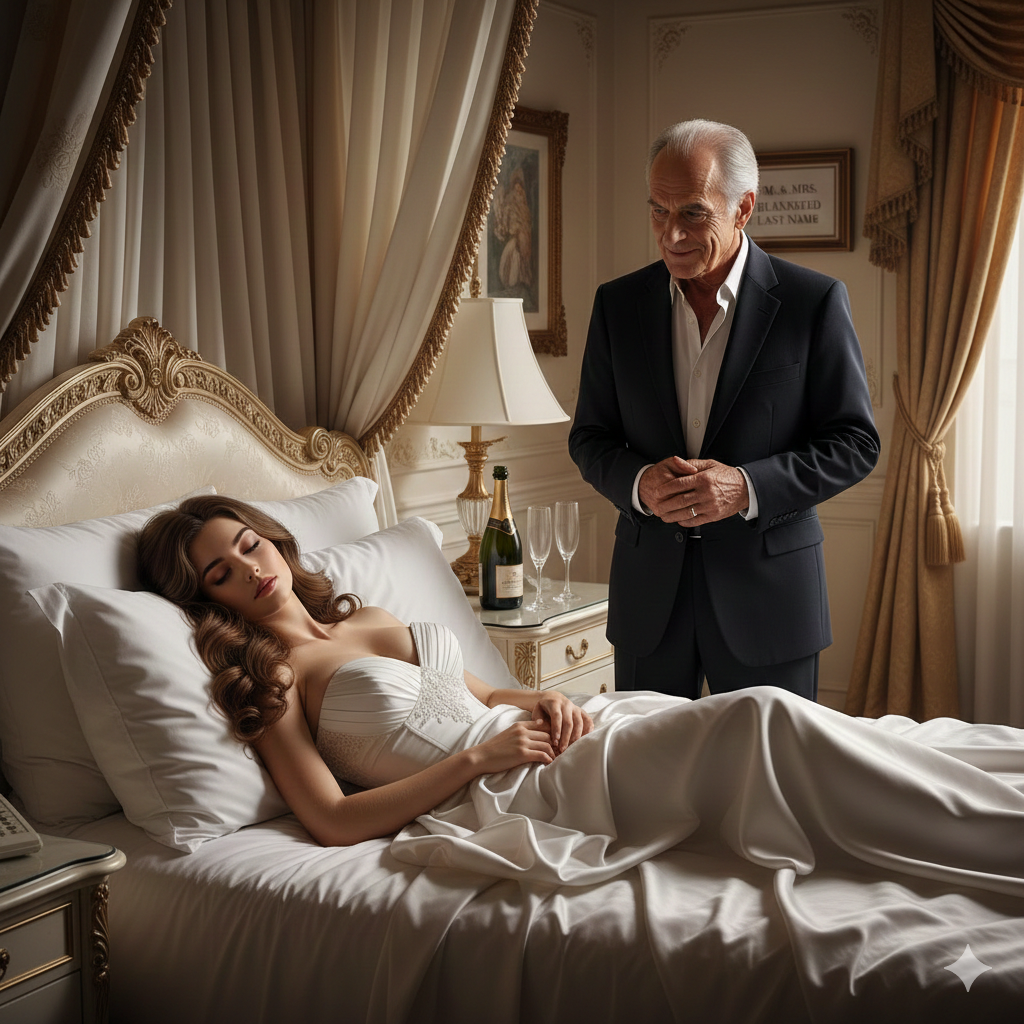
Minutes passed. Then more.
I listened to his breathing, slow and steady.
My fear grew louder than the silence.
Finally, I did the only thing I could think of.
I pretended to fall asleep.
I slowed my breath. Relaxed my face. Let my body go still.
Inside, my mind screamed.
Time stretched.
Then I felt him move.
The mattress dipped slightly as Henry sat up.
My pulse thundered in my ears.
I told myself not to react. Not to flinch.
I heard the faint sound of a drawer opening. Something soft brushed the bed near my feet. Paper, maybe.
Then footsteps—slow, careful—as he crossed the room.
The door opened.
Closed.
Locked.
Locked.
My chest tightened.
Why would he lock the door?
I lay there for what felt like hours, muscles aching, mind racing through every terrible possibility.
Eventually, exhaustion pulled me into real sleep.
When morning light touched my face, my eyes flew open.
Henry wasn’t beside me.
But the bed was changed.
New sheets. Freshly made.
I sat up sharply.
On the nightstand lay a manila envelope with my name written on it.
My stomach dropped.
I opened it with trembling fingers.
Inside were documents.
Legal documents.
A notarized will.
A trust.
Property deeds.
Bank statements.
And a handwritten letter.
I read it twice before the words made sense.
Emily,
If you are reading this, then you are awake—and I am relieved.
Last night, while you slept, I made a decision I should have made long before.
I know you married me out of fear as much as necessity. I saw it in your eyes. I never intended to take anything from you—your youth, your safety, or your future.
That is why I changed my will.
As of midnight, everything I own now belongs to you. The house. The savings. The trust I created for medical research in my daughter’s name. You are the sole executor.
I locked the door not to trap you—but to protect you.
Because there are people who would not hesitate to hurt you if they knew what you now possess.
I will explain when you are ready.
—Henry
My hands were shaking so badly I dropped the letter.
Everything?
Why would he do this?
And who was he afraid of?
I rushed downstairs.
Henry sat at the kitchen table, sipping tea like it was any other morning.
He looked up calmly. “You read it.”
“You gave me everything,” I said, voice breaking. “Why?”
He folded his hands. “Because I’m dying.”
The word hit me like a slap.
“I have months. Maybe less.”
I sank into the chair across from him.
“And because,” he continued, “my first daughter died because I trusted the wrong people.”
The story spilled out slowly.
Years ago, Henry had been a pharmaceutical executive. His company had funded experimental treatments—some ethical, some dangerously close to criminal. When his daughter, Laura, became sick, he pulled strings to get her into a trial.
She never came home.
The company buried the truth.
Henry buried his grief.
But he spent decades collecting evidence.
“Those men still exist,” he said quietly. “They still erase people.”
I stared at him. “And me?”
“You needed money. A way out. I needed someone I could trust with the truth.”
“You barely know me.”
He smiled sadly. “That’s why I trust you.”
I remembered the locked door.
The changed sheets.
“You were protecting me,” I whispered.
“Yes.”
Tears burned my eyes.
Everyone had told me I should be ashamed.
But no one had told me I might be brave.
Weeks later, Henry was hospitalized.
Men came asking questions.
Lawyers. Strangers. Smiles that never reached their eyes.
But they couldn’t touch me.
Everything was legal.
When Henry passed, the truth came out.
Investigations reopened. Names surfaced. Arrests followed.
I testified.
The headlines didn’t call me a gold-digger anymore.
They called me a whistleblower.
Sometimes I still think about that first night.
About the fear.
About pretending to sleep.
And how the thing I feared most…
…turned out to be the moment my life was saved.