
He Settled in an Abandoned Steamboat Instead of Building a Cabin — Sealed Oak Held Heat All Winter
By the time Elias Boone first saw the steamboat, he had already buried two horses, burned through the last of his dried venison, and come within a single frozen night of dying beside a river nobody bothered to name.
The maps called it the northern fork of the Missouri.
The trappers called it God’s forgotten ditch.
Elias simply called it home.
At thirty-four, he had the face of a man older than his years—deep lines around the eyes, a thick beard streaked with frost, and hands that looked carved from old walnut. He had fought in wars he no longer spoke about, buried a wife before he turned thirty, and left behind a Kentucky farm that no longer felt like his.
When people asked why he was heading north into country that wolves themselves abandoned in winter, Elias always gave the same answer:
“Because nobody else wants it.”
By November of 1872, he stood alone on a ridge overlooking the river valley, snow blowing sideways across his face, his fur hat crusted white.
And below him—
Half buried in ice.
Leaning slightly toward shore.
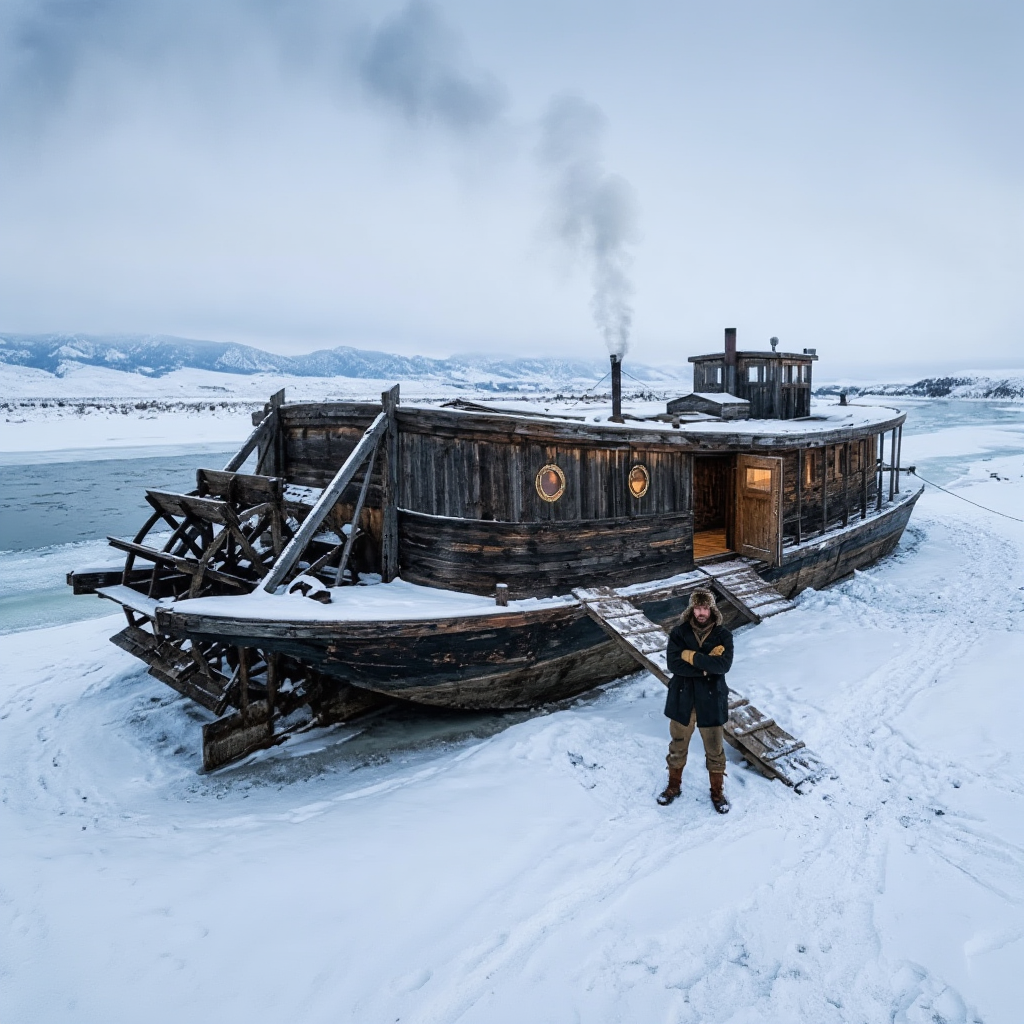
A weathered paddlewheel steamboat.
Abandoned.
Silent.
Impossible.
Elias narrowed his eyes.
Smoke stains still marked the stack.
The hull, though worn gray with age, remained intact.
And the oak—
Even from that distance—
Looked solid.
He grinned for the first time in months.
“Well,” he muttered.
“Looks like somebody already built me a cabin.”
The descent nearly killed him.
Ice cracked beneath his boots.
Twice he slid on frozen mud.
Once he nearly disappeared through river crust into black water.
But by dusk, he stood before the vessel.
Its faded name was barely visible beneath snow and age.
MARY ELLEN.
Elias brushed away ice with his glove.
Built in St. Louis.
Twenty-one years old.
Not dead.
Just forgotten.
The hull rested partly in frozen mud, locked against the riverbank where spring floods must’ve stranded her years ago.
He circled slowly.
No rot.
No split planks.
No major damage.
And when he struck the oak side with his knuckles—
Thunk.
Solid.
He climbed the frozen ramp.
Each step creaked.
Snow blew through the open deck.
Broken rope swung lazily in the wind.
Inside—
Darkness.
Dust.
Silence.
And something else.
Dryness.
He lit a lantern.
Its glow spread across old oak walls.
Cabins.
Storage compartments.
Iron stove.
Coal bins.
Shelving.
Bunks.
His breath caught.
It wasn’t a wreck.
It was a house.
A damned good one.
And the oak walls—
Nearly four inches thick in places.
Sealed tight.
Built to hold steam.
Built to trap heat.
Built to survive.
Elias laughed aloud.
The sound echoed through empty corridors.
“You beautiful old girl.”
He moved in that same night.
No tent.
No cabin.
No axe work.
No log hauling.
Instead, Elias built a fire in the old iron stove.
At first the chimney groaned.
Dust fell.
Soot exploded upward.
But then—
Warmth.
Real warmth.
The kind he hadn’t felt in months.
By midnight, the boat glowed like a lantern against the frozen river.
And for the first time in nearly a year—
Elias slept without his boots on.
Word spread.
It always did.
By December, passing trappers began talking about the madman who lived inside a ghost ship.
At a trading post sixty miles south, men laughed.
“Boone’s finally froze his brain.”
“He’s living in a damn coffin.”
“That boat’ll split before Christmas.”
Elias heard every rumor.
And ignored every one.
Because while they chopped frozen pine until their hands bled—
He was warm.
While they patched drafty cabins—
He sat beside thick oak walls that held heat like a bank vault.
Every evening, he fed the stove.
Every morning—
The boat still breathed warmth.
The oak absorbed the heat.
Held it.
Released it slowly through the night.
Even when outside temperatures dropped below twenty below—
Inside the Mary Ellen—
Water stayed liquid.
Bread stayed soft.
And Elias Boone stayed alive.
By January, the real winter came.
Not snow.
Not wind.
Death.
A storm rolled down from Canada like judgment itself.
The sky turned black at noon.
The temperature fell thirty degrees in four hours.
Trees exploded from cold.
Wolves disappeared.
Even ravens stopped flying.
And Elias—
Standing on the deck, arms crossed—
Watched the storm come.
“Come on then,” he whispered.
“Let’s see what you got.”
By sunset—
He could no longer see the river.
By dark—
He could no longer see his ramps.
By midnight—
The boat had disappeared beneath snow.
Only the smokestack remained visible.
And inside—
Elias fed oak logs into the stove.
The thick hull groaned.
Wind screamed.
Ice cracked against the sides.
But the Mary Ellen held.
Hour after hour.
Night after night.
For six straight days—
The storm tried to kill him.
And failed.
On the seventh morning—
Someone knocked.
Elias froze.
Three knocks.
Weak.
Desperate.
He grabbed his rifle.
Opened the cabin door.
And found—
A woman.
Half buried in snow.
Barely conscious.
Wrapped in torn blankets.
A little girl clinging to her side.
And a boy no older than seven.
Blue-lipped.
Shaking.
The woman looked up.
Her lips trembled.
“Please…”
Then she collapsed.
Elias didn’t ask questions.
He dragged all three inside.
Barred the door.
Fed the fire.
Boiled water.
Stripped frozen clothes.
Wrapped them in blankets.
And waited.
Hours passed.
The little girl woke first.
Brown eyes.
Dark curls.
Terrified.
She stared at Elias.
“Are… are we dead?”
Elias smiled gently.
“Not today.”
The woman’s name was Sarah Whitmore.
Widowed.
Heading west with her children.
Her wagon had broken three days earlier.
Her horse died the next morning.
Her supplies froze the next.
And by the time she saw smoke—
She’d already accepted death.
When she woke, she stared around the warm oak cabin in disbelief.
“Where…?”
Elias handed her soup.
“Steamboat.”
She blinked.
“What?”
He shrugged.
“Mine now.”
For the first time in weeks—
Sarah laughed.
They stayed.
At first because they had no choice.
Then—
Because they didn’t want to leave.
Sarah cooked.
The children played in old passenger cabins.
Elias hunted.
Fixed windows.
Patched leaks.
Repaired the paddlewheel just because he could.
And every night—
They gathered by the stove.
Listening to wind batter the hull.
Feeling the oak radiate warmth.
Protected.
Safe.
Alive.
One evening, Sarah ran her hand across the wall.
“It’s warm.”
Elias nodded.
“Sealed oak.”
She looked at him.
“What does that mean?”
He smiled.
“Means whoever built this old girl knew winter.”
She leaned against the wall.
“It feels alive.”
Elias looked around.
At the lantern glow.
At the children sleeping.
At the stove humming.
At the thick oak walls that had held heat through every storm.
And for the first time in years—
He didn’t feel alone.
“No,” he said softly.
“It feels like home.”
Spring came slowly.
Ice broke.
River water moved again.
Birds returned.
And word spread farther than before.
Only now—
The stories changed.
No longer about the madman on a ghost ship.
Now—
People spoke of the man who survived the worst winter in twenty years.
The man who saved a widow and two children.
The man who turned a wreck into a fortress.
By May—
Travelers came just to see it.
Standing on the bank.
Staring in disbelief.
One man shook his head.
“You really lived here all winter?”
Elias leaned against the rail.
“Sure did.”
The man frowned.
“Why didn’t you build a cabin?”
Elias looked down at the oak beneath his boots.
Ran a hand along the warm wood.
And smiled.
“Because somebody smarter than me built this one first.”
Years later—
Children born in that valley would point toward the river and tell visitors about the strange old paddlewheeler that never moved.
About the smoke that rose from its stack every winter.
About the man who chose a ghost ship over a cabin.
And about the oak walls—
So thick.
So tight.
So perfectly sealed—
That they held heat all winter long.
And in a land where most men fought the wilderness—
Elias Boone had done something rarer.
He had found shelter…
Already waiting for him.