
They Called It the Coward’s Cabin — Until His Children Slept Barefoot in -40° Winter
They called it the Coward’s Cabin before it even had a roof.
The name started as a joke.
Then it stuck.
“Too close to the trees,” one man said, squinting from his saddle as he looked down into the shallow valley.
“Too far from town,” another added.
“And too small,” a third finished with a laugh. “Man’s building himself a box, not a home.”
They rode on, boots creaking in their stirrups, voices fading into the cold air. The wind carried the laughter a little longer than it should have.
Elias Turner heard it all.
He kept hammering anyway.
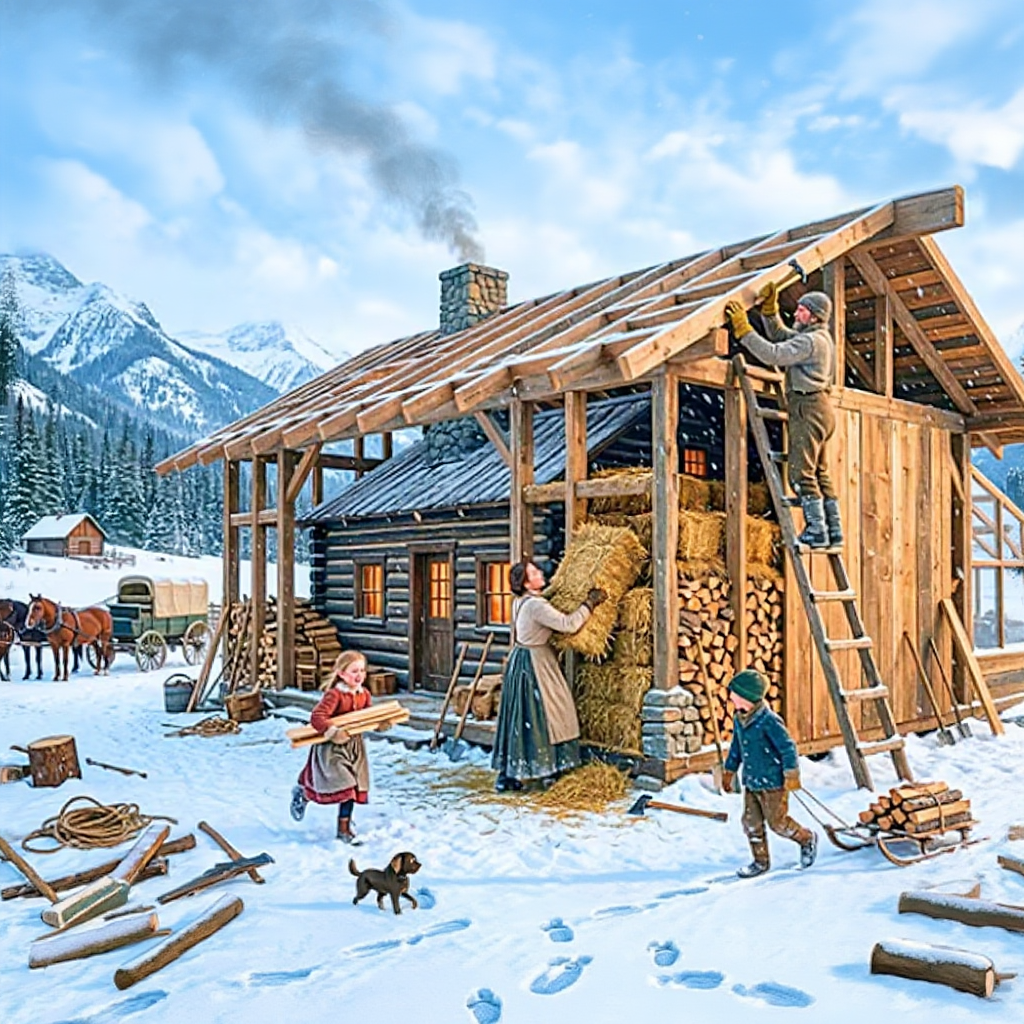
The cabin stood half-finished in a clearing carved out of dense pine forest. Snow blanketed everything in white silence, broken only by the steady rhythm of work—the thunk of an axe, the scrape of wood against wood, the low crackle of a fire struggling against the cold.
Elias stood high on a wooden ladder, his hands rough and reddened, shaping the roof frame piece by piece. His breath came in slow clouds, each one vanishing into the air before it could linger.
Below him, life moved in smaller, quieter ways.
Mara carried a bale of hay across the yard, her boots sinking deep into the snow. Her dress brushed the surface, already stiff with frost at the hem, but she didn’t slow.
“Careful up there,” she called, not looking up.
“I’m always careful,” Elias replied.
She snorted softly.
“That’s what they say about cowards.”
He paused just long enough to glance down.
There was no anger in her tone.
Just truth.
“Better a careful man than a dead one,” he said.
Mara didn’t answer.
She didn’t need to.
Across the clearing, their daughter Lucy darted through the snow, her red dress a bright streak against the white. She clutched two wooden planks in her arms, boots slipping as she ran, laughter breaking through the cold like something stubborn and alive.
“Got ‘em!” she shouted.
“Set them by the wall,” Elias called back.
Nearby, their son Caleb dragged a small sled loaded with firewood, his blue jacket dusted white at the shoulders. He leaned forward with determination, boots digging deep, teeth clenched in effort.
“I can take more!” he insisted.
“You’ll take what you’ve got,” Mara said firmly, adjusting the hay near the half-built wall.
The dog—small, scruffy, and endlessly loyal—bounded between them, chasing invisible things only it understood.
From a distance, it might have looked like a painting.
A family building something from nothing.
A moment of quiet perseverance.
But closer—
You could see the cracks.
Because the cabin was smaller than it should have been.
The logs were thinner.
The walls, closer together.
The design… deliberate.
Elias knew what they said.
That he was afraid.
That he didn’t trust the open land like the others.
That he hid behind trees instead of facing the horizon like a “proper man.”
They weren’t wrong.
Not entirely.
Three winters ago, Elias had buried a family.
Not this one.
Another.
A wife.
A son.
A daughter.
All taken by a storm that came too fast and stayed too long.
Back then, he had built wide.
Open.
Proud.
A cabin that stood tall against the plains, exposed to every wind that came roaring down from the mountains.
He had believed strength meant facing the storm head-on.
He had been wrong.
The wind had found every gap.
The cold had seeped through every seam.
The fire had failed.
And by the time the storm passed—
There was nothing left to fight.
After that, Elias disappeared.
For a time, no one knew where he went.
Until one spring morning, he returned with Mara and two children who clung to him like roots to soil.
No one asked too many questions.
Not out here.
But they watched.
And when Elias chose his land—
Tucked low among the trees, shielded from the worst of the wind—
They laughed.
“Coward’s Cabin,” they called it.
Elias never argued.
Because this time—
He wasn’t building for pride.
He was building for survival.
The first snowfall came early that year.
Thick.
Heavy.
Relentless.
By then, the cabin had walls.
A roof.
A stone chimney that breathed thin trails of smoke into the pale sky.
Inside, it was tight.
Crowded.
But warm.
“Too small,” someone had said once, peering inside.
“You’ll suffocate before winter ends.”
Elias had just shrugged.
“Better close than cold.”
The real winter came in January.
The kind that made the air hurt.
The kind that froze breath before it could settle.
Forty below.
The world outside turned brittle.
Silent.
Dead.
The snow piled high against the cabin walls, pressing in like the weight of the sky itself. The trees groaned under the burden, their branches cracking in the distance like gunshots.
Inside—
Life held on.
The fire burned low but steady.
The walls trapped heat, just as Elias had planned.
The space, small as it was, kept warmth from escaping.
Lucy and Caleb slept side by side, wrapped in blankets.
Barefoot.
Not because they had nothing.
But because they didn’t need more.
Mara sat near the fire, mending a coat.
Elias fed another piece of wood into the flames.
They spoke little.
They didn’t have to.
Outside, the storm raged.
Inside, it couldn’t reach them.
Three days passed.
Then five.
Then seven.
The storm didn’t break.
It tightened.
On the eighth day, there was a knock.
Elias froze.
No one came out in weather like this.
The knock came again.
Weaker.
Mara looked at him.
He moved without a word.
The door resisted as he pushed it open, snow packed tight against it.
Wind howled in, sharp and vicious.
And there—
Half-buried in the drift—
A man.
One of the ones who had laughed.
Elias dragged him inside.
The man was barely conscious, his face pale, lips blue.
“Cabin…” he muttered weakly. “Couldn’t make it… mine’s too far…”
Elias didn’t respond.
He didn’t need to.
They stripped the frozen clothes.
Wrapped him in blankets.
Gave him water.
Sat him near the fire.
The man’s eyes flickered open slowly.
He looked around.
At the close walls.
The low ceiling.
The heat.
At the children—
Sleeping.
Barefoot.
Unshivering.
“You…” he rasped.
Elias met his gaze.
“Yeah,” he said.
The man swallowed hard.
“Coward,” he whispered.
A pause.
“Smart one,” he corrected.
Elias didn’t smile.
But something in his expression softened.
Outside, the storm began to ease.
Not all at once.
But enough.
By the tenth day, the wind had died down to a whisper.
The sky cleared.
The world emerged again—white, endless, quiet.
People began to dig themselves out.
Cabins uncovered.
Paths carved.
Lives counted.
Some hadn’t made it.
Others barely had.
When they reached Elias’s clearing, they found smoke rising steady from the chimney.
Footprints pressed deep into the snow.
Signs of life.
Inside, it was warm.
Crowded.
Alive.
The man who had knocked on the door sat by the fire, color returned to his face.
Lucy laughed at something Caleb said.
The dog barked lazily.
Mara stirred a pot.
And Elias—
He stood by the wall, watching.
No one called it the Coward’s Cabin anymore.
Not after that winter.
Not after they saw the children—
Sleeping barefoot—
While the world outside froze solid.
They called it something else.
Something quieter.
Something earned.
The cabin that endured.
But Elias didn’t care what they called it.
Because he hadn’t built it for them.
He built it for the ones who would wake up in the morning.
Warm.
Alive.
And this time—
That was enough.