
They Burned Her Books and Threw Her Out — She Built an Underground Bakery That Fed Three Villages
The villagers said Eleanor Hartwell was dangerous.
Not because she stole.
Not because she lied.
Not because she harmed anyone.
They feared her because she read.
In the remote mountain settlements of the northern frontier, knowledge was treated with suspicion. Most people worked from sunrise to sunset, surviving harsh winters and poor harvests. Books were rare treasures, and many believed that too much learning only filled a person’s head with foolish dreams.
Eleanor, however, loved books more than anything.
By the age of twenty-three, she had collected dozens of worn volumes. Some taught mathematics. Others explained farming, engineering, medicine, and baking techniques from distant lands. Whenever she earned a few coins, she traded for another book from traveling merchants.
Her tiny cottage had shelves lining every wall.
People laughed behind her back.
“There goes Eleanor and her strange ideas.”
“Books can’t keep you warm.”
“Books can’t feed hungry families.”
Eleanor simply smiled and kept reading.
What nobody knew was that every page she studied planted a seed.
And one day, those seeds would save hundreds of lives.
The disaster began during the worst winter anyone could remember.
Snow arrived early.
Then came freezing rain.
Then another storm.
Within weeks, roads disappeared beneath towering drifts.
Supply wagons stopped coming.
Food became scarce.
Families rationed flour and grain.
The village baker announced that he would soon run out of ingredients entirely.
Fear spread faster than the cold.
People gathered nightly in the town hall to discuss solutions.
Yet every suggestion seemed impossible.
One evening Eleanor stood and cleared her throat.
“I’ve been studying old mountain settlements,” she said. “Many survived severe winters by building underground food storage systems and earth-insulated ovens.”
Several villagers rolled their eyes.
She continued.
“The ground stays warmer than the air. If we build below the frost line, we can bake efficiently year-round while protecting supplies from storms.”
The mayor frowned.
“You learned this from your books?”
“Yes.”
A few people laughed.
The mayor shook his head.
“We need practical answers, not fairy tales.”
Murmurs of agreement filled the room.
Eleanor sat down quietly.
No one listened.
Weeks later conditions grew worse.
Several families ran out of bread.
Children went to bed hungry.
Yet instead of reconsidering Eleanor’s ideas, many villagers blamed her.
Rumors spread.
They claimed she wasted time reading instead of helping.
They said her strange books had filled her mind with arrogance.
One bitter night a crowd gathered outside her cottage.
Eleanor woke to shouting.
She rushed outside.
Dozens of villagers stood in the snow.
Someone carried a torch.
Someone else held a sack.
“What are you doing?” Eleanor asked.
A man stepped forward.
“We’re tired of your nonsense.”
Another villager entered her cottage.
Then another.
Moments later they emerged carrying books.
Her books.
Years of collecting.
Years of learning.
Years of dreams.
“No!” Eleanor screamed.
She ran forward.
Someone grabbed her arms.
The books were piled into the snow.
A torch touched the pages.
Flames erupted.
The fire crackled against the freezing wind.
Eleanor watched helplessly as hundreds of pages curled into ash.
Mathematics.
Medicine.
Engineering.
History.
Baking.
Gone.
Tears froze on her cheeks.
Then came the final cruelty.
The mayor pointed toward the mountains.
“Leave.”
The crowd fell silent.
“You don’t belong here anymore.”
Eleanor stared at him.
“I’ve lived here my entire life.”
“Not anymore.”
Nobody defended her.
Nobody stepped forward.
Nobody spoke.
So before dawn, carrying only a small pack, she walked away from the village she had once called home.
The mountain wilderness stretched endlessly before her.
For days Eleanor wandered through snow-covered forests.
She survived on dried food and melted snow.
At night she sheltered beneath rocky overhangs.
Eventually she discovered a hidden valley surrounded by steep cliffs.
A narrow crevice led into a vast cave system.
Warm air drifted from within.
Curious, she entered.
The cave expanded into an enormous chamber.
The ceiling arched high overhead.
Natural stone columns rose from the ground.
Underground springs trickled through the rock.
Most importantly, the temperature remained stable despite the blizzard outside.
Eleanor stood silently.
Then she remembered something from one of her lost books.
Earth insulation.
Natural heat retention.
Underground architecture.
A smile slowly appeared.
“If nobody will build it,” she whispered, “I will.”
The work consumed months.
She carved living spaces into the cave walls.
She constructed wooden platforms and storage rooms.
She built ventilation shafts using natural cracks in the stone.
She created drainage channels for spring water.
Most difficult of all, she designed ovens.
The knowledge survived in her memory.
Every diagram.
Every lesson.
Every page she had once studied.
Stone by stone she assembled massive arched ovens.
Their thick walls captured heat and released it slowly.
Fuel consumption dropped dramatically.
Soon the first oven stood ready.
Eleanor mixed flour from wild grains she had gathered and cultivated.
She kneaded dough.
Waited.
Then slid loaves into the glowing chamber.
The scent of fresh bread filled the cave.
Warm.
Rich.
Comforting.
For the first time in many months, she laughed.
The underground bakery was alive.
Years passed.
The bakery grew.
Eleanor cultivated underground mushroom gardens.
She planted hardy grains in sheltered valley fields.
She traded with travelers.
She hired wandering workers seeking opportunity.
Together they expanded the cave.
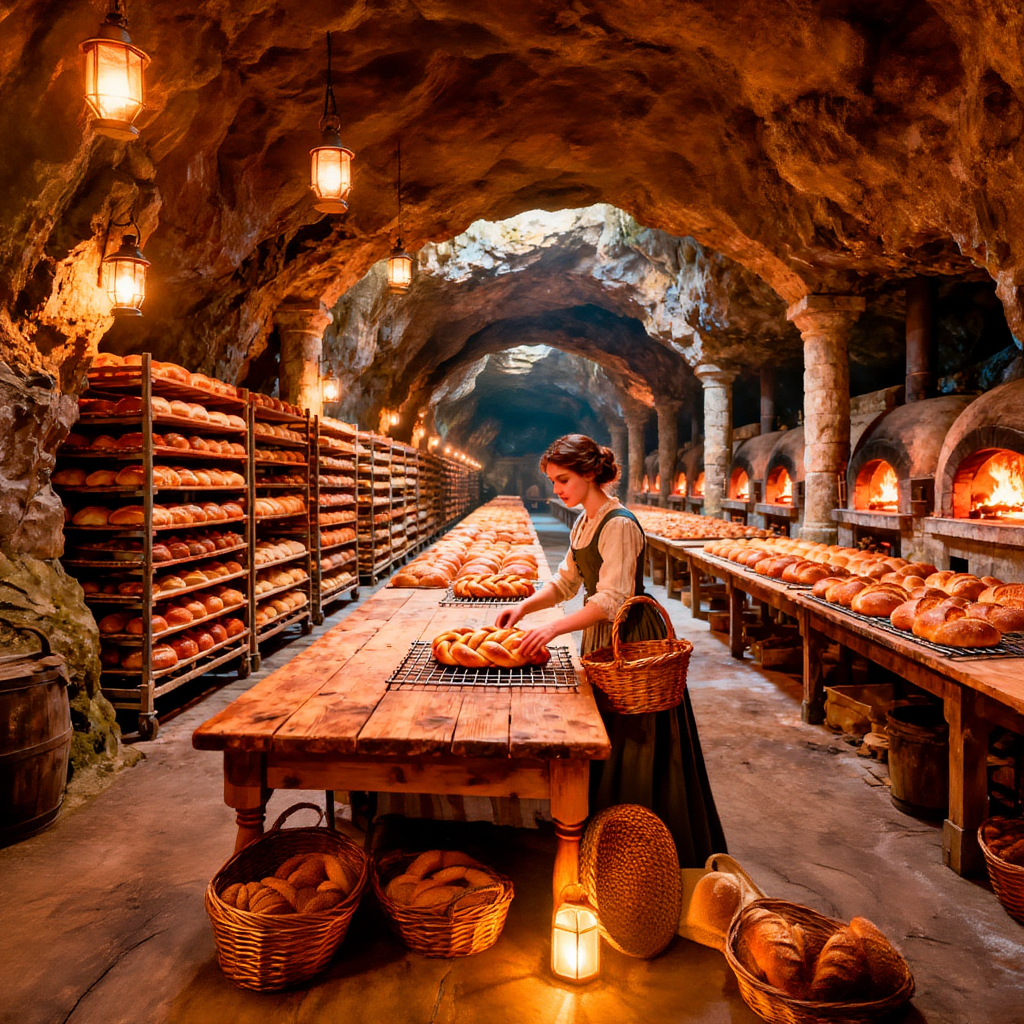
Wooden racks stretched across entire chambers.
Lanterns illuminated pathways.
Dozens of ovens glowed day and night.
Soon bread production exceeded anything Eleanor had imagined.
Round loaves.
Braided loaves.
Honey bread.
Seed bread.
Her recipes combined knowledge gathered from many traditions she had studied.
Travelers carried stories across the mountains.
“There is a bakery beneath the earth.”
“They never run out of bread.”
“The woman who runs it knows impossible things.”
People laughed at first.
Then they tasted the bread.
And they believed.
The nearby settlements soon depended upon her bakery.
Three villages purchased bread regularly.
Even during severe storms, Eleanor’s underground ovens continued operating.
The earth protected them.
The cave remained warm.
Food remained secure.
While surface farms struggled, her storage systems preserved grain for months.
Nobody went hungry.
Children grew stronger.
Families survived winters that once would have devastated them.
Eleanor never sought wealth.
She simply remembered what hunger felt like.
Remembered standing helplessly before burning books.
Remembered being abandoned.
So she charged fair prices.
Sometimes no price at all.
Especially for widows, elderly villagers, and struggling families.
Word spread farther.
Her reputation became legendary.
Yet she rarely spoke about her past.
One autumn evening, nearly seven years after her exile, strangers appeared at the bakery entrance.
Eleanor was placing freshly baked braided loaves onto a long wooden table.
Lantern light danced across the cave ceiling.
Workers moved between towering racks stacked with bread.
The aroma of baking filled the air.
A young employee approached.
“Visitors.”
Eleanor nodded.
“I’ll meet them.”
As she walked toward the entrance chamber, she froze.
Standing there were three familiar faces.
The former mayor.
The village baker.
And an elderly woman she recognized from her old neighborhood.
Time had aged them all.
The mayor looked smaller than she remembered.
Older.
Wearier.
For several moments nobody spoke.
Finally he removed his hat.
“Eleanor.”
She waited.
The old man swallowed.
“Our village is struggling.”
She remained silent.
“The harvest failed.”
The baker stepped forward.
“Our ovens collapsed during a storm.”
The elderly woman wiped tears from her eyes.
“We need help.”
The irony hung heavily in the air.
Years earlier they had destroyed her books.
Now they stood inside a thriving underground bakery built from the knowledge those books had provided.
The mayor lowered his gaze.
“We were wrong.”
The words seemed painful for him to say.
“Terribly wrong.”
Eleanor looked around.
Workers loaded bread into baskets.
Lanterns glowed warmly.
Children laughed nearby.
Life flourished.
Everything they had mocked stood before them.
At last she asked quietly:
“Why did you come?”
The old woman answered first.
“Because our children are hungry.”
The chamber fell silent.
Many workers knew Eleanor’s history.
Several looked angry.
One muttered,
“Send them away.”
Another nodded.
“They don’t deserve help.”
Perhaps they were right.
Perhaps justice demanded refusal.
After all, those villagers had taken everything from her.
Her home.
Her community.
Her treasured books.
Her future.
Yet Eleanor remembered another lesson from those lost pages.
Knowledge had taught her many things.
But the greatest lesson was this:
Bitterness feeds no one.
Compassion does.
She took a deep breath.
Then smiled gently.
“How much bread do you need?”
The mayor stared at her.
“You’ll help us?”
“Yes.”
His eyes filled with tears.
“We don’t deserve that.”
“No,” Eleanor said softly. “Maybe not.”
The old man lowered his head.
“Then why?”
Eleanor glanced toward the glowing ovens.
“Because hungry children should never pay for the mistakes of adults.”
The bakery worked through the night.
Workers prepared hundreds of loaves.
Wagons were loaded before dawn.
Additional grain shipments followed.
Then more.
For months Eleanor supported the struggling village.
Not once did she mention the past.
Not once did she demand repayment.
Instead she shared knowledge.
She taught them how to build insulated storage rooms.
She showed them improved baking methods.
She explained underground preservation systems.
Everything she had once tried to teach.
This time they listened.
Carefully.
Respectfully.
Gratefully.
The village slowly recovered.
Then prospered.
Years later travelers crossing the mountains often heard a remarkable story.
They spoke of a woman whose books had been burned.
A woman cast into the wilderness.
A woman who transformed a forgotten cave into the greatest bakery in the region.
They described endless racks of bread.
Glowing stone ovens.
Lanterns shining against ancient rock.
And a baker whose kindness proved stronger than cruelty.
Many visitors expected to find someone bitter.
Someone seeking revenge.
Instead they found Eleanor.
Smiling.
Working.
Teaching.
Feeding people.
The underground bakery continued serving three villages and eventually many more.
Generations grew up nourished by bread baked beneath the mountain.
And above the main entrance, carved into a stone archway, stood a simple inscription Eleanor had written herself:
“They burned the books.
But they could not burn what the books had already taught.”
For as long as the ovens glowed and the scent of fresh bread drifted through the cave, her story remained alive.
A reminder that knowledge can survive fire.
That kindness can outlive cruelty.
And that sometimes the people cast out by the world become the very people who save it.