
Can You Talk to a Child Who Has Never Answered? The Cowboy Begged—And the Obese Woman Stayed Until He Did
No one in Dry Creek believed the boy would ever speak.
Not after four years.
Not after doctors from three towns had come and gone, each leaving behind the same quiet conclusion wrapped in polite words and heavy sighs.
“He may never talk.”
Caleb Dawson stopped listening after the second one.
The ranch had gone silent long before the boy did.
Once, it had been a place of laughter—boots stomping across the porch, cattle lowing in the fields, a woman’s voice drifting through the open windows as she sang off-key just to make him smile.
Her name was Martha.
And when she died, something inside Caleb’s son went with her.
The boy’s name was Eli.
He was six years old now.
Big brown eyes. Thin frame. Always watching.
Always listening.
Never speaking.
Not a word. Not a sound.
Not even when Caleb begged.
“Say anything,” Caleb whispered one night, kneeling beside the small bed. “You can yell. You can cry. You can tell me you hate me—I don’t care. Just… say something.”
Eli lay there, staring at the ceiling.
Unmoving.
Silent.
The townsfolk tried, in their own ways.
Mrs. Granger brought sweets.
The preacher came with soft prayers and softer voices.
Even the blacksmith carved a small wooden horse and left it on the porch.
Nothing worked.
Eli never reacted.
Not really.
“They say children like him… they close off,” one woman murmured in the general store. “Like a door that just won’t open.”
Caleb heard it.
He heard everything.
And every word felt like another nail sealing that door shut.
The day Marlene showed up, no one thought she’d last a week.
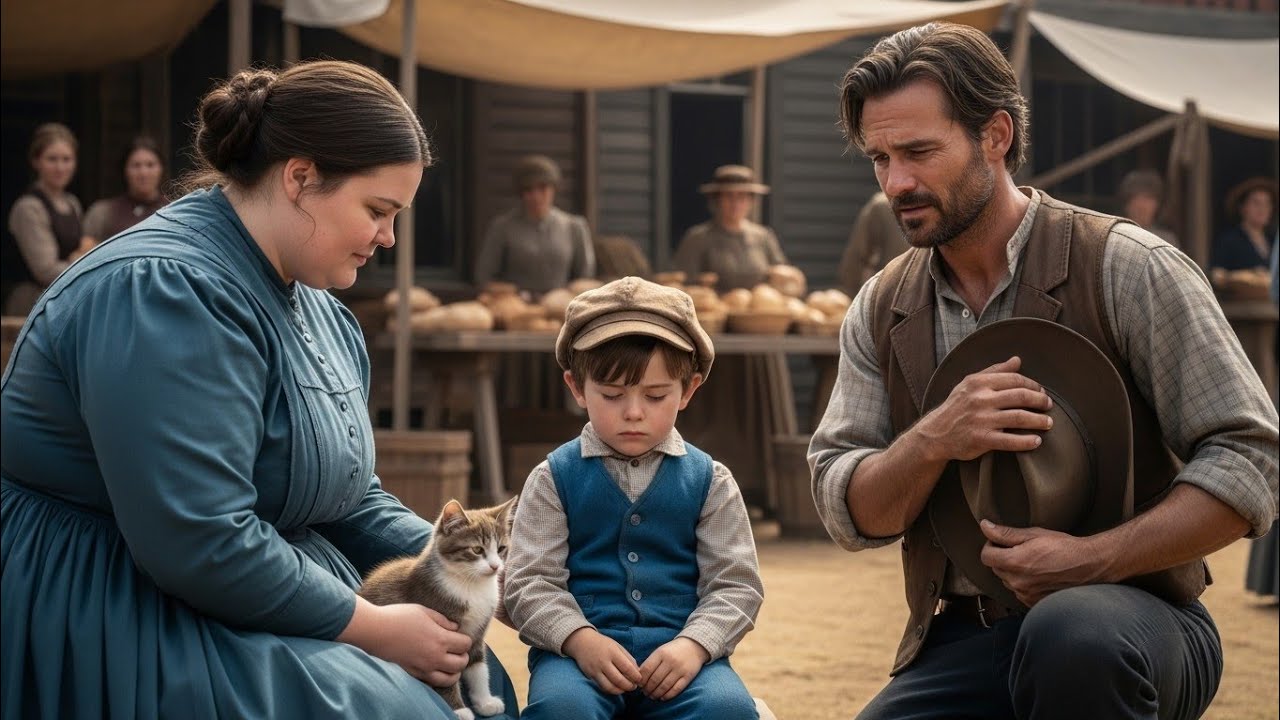
She came in on a wagon that looked like it had seen too many roads and not enough repairs. Dust clung to everything she owned, including her.
She stepped down slowly, her weight shifting the wood beneath her boots.
She was large.
Not just heavy—but broad, solid, built like someone who had learned to carry more than most.
People stared.
Some whispered.
Others didn’t bother hiding it.
“She ain’t built for ranch work,” someone muttered.
“Won’t last three days,” another added.
Caleb didn’t say anything.
He didn’t care.
He hadn’t hired her.
“I heard you needed help,” she said, standing in front of him with a calm, steady gaze.
Her voice wasn’t timid.
It wasn’t defensive either.
Just… certain.
Caleb crossed his arms. “I didn’t put out a call.”
She shrugged lightly. “Word travels anyway.”
He studied her.
“You ever worked a ranch?”
“Yes.”
“You look like you don’t move much.”
A few people nearby chuckled.
Marlene didn’t react.
“I move when it matters,” she said.
That made Caleb pause.
“I can cook,” she added. “Fix things. Keep a place running.”
Caleb exhaled slowly. “Got no money to waste.”
“Then don’t pay me,” she said. “Let me stay. I’ll earn my keep.”
“Why?”
That question lingered.
People usually had reasons.
Bad ones.
Selfish ones.
Desperate ones.
Marlene looked past him.
Toward the house.
Toward the small window where a boy sat watching the world without speaking.
“That’s why,” she said.
Caleb turned sharply. “You don’t know anything about him.”
“No,” she admitted. “But I know silence.”
That shut him up.
She stayed.
The first few days were awkward.
Marlene didn’t try to take over.
Didn’t push.
Didn’t ask questions.
She just… worked.
Slowly, steadily.
She cooked meals that smelled like something more than survival. Fixed broken hinges. Swept dust from corners no one had looked at in months.
The house changed.
Not dramatically.
But enough.
Eli noticed.
Of course he did.
He noticed everything.
The first time Marlene sat near him, she didn’t speak.
She didn’t ask questions.
Didn’t wave her hands or try to force eye contact.
She just sat on the floor, a few feet away, mending a torn shirt.
Quiet.
Patient.
Present.
Minutes passed.
Then an hour.
Eli watched her.
She didn’t look back.
The next day, she did the same thing.
And the day after.
Caleb grew restless.
“What are you doing?” he asked one evening.
Marlene didn’t look up from her work. “Waiting.”
“For what?”
She finally met his eyes.
“For him.”
“That’s not how this works,” Caleb snapped. “You don’t just sit around and expect—”
“Neither does begging,” she said gently.
That hit harder than it should have.
Caleb turned away, jaw tight.
“You don’t understand.”
“You’re right,” she said softly. “But I’m trying.”
Weeks passed.
Still no words.
But something changed.
Eli started sitting closer.
Not much.
Just a few inches at a time.
But it was something.
One afternoon, Marlene brought out a small wooden bowl filled with flour.
She placed it on the table.
Then she dipped her finger in and drew a simple shape.
A circle.
She didn’t say anything.
Just waited.
Eli watched.
Then slowly—
He reached out.
His small finger hovered above the flour.
Then pressed down.
He drew a line.
Crooked.
Uneven.
But intentional.
Marlene smiled faintly.
Not big.
Not overwhelming.
Just enough.
Caleb saw it from the doorway.
And for the first time in months—
He felt something shift.
“Say something,” Caleb whispered that night again.
But this time—
There was less desperation in his voice.
More hope.
Days turned into months.
The flour became drawings.
The drawings became small gestures.
Nods.
Looks.
Tiny pieces of communication that weren’t words—but weren’t silence either.
Caleb watched it all with a mix of awe and frustration.
“Why her?” he asked one night. “Why does he respond to you?”
Marlene sat quietly for a moment.
Then she said—
“Because I’m not asking him to be different.”
That answer stayed with him.
Winter came.
Cold. Sharp. Unforgiving.
But inside the ranch house—
There was warmth.
More than just from the fire.
One night, a storm rolled in fast.
Wind howled against the walls.
The kind of storm that made everything feel smaller.
More fragile.
Eli sat near the window, watching the snow.
Marlene sat nearby, knitting.
Caleb paced.
Then—
A loud crack echoed outside.
A branch snapped, hitting the side of the house.
Eli flinched.
Hard.
His breathing quickened.
Caleb froze.
“Eli?”
The boy’s hands clenched.
His chest rising faster.
Panic.
Caleb stepped closer. “It’s alright, son. Just the wind—”
But Eli shook his head violently.
Stepping back.
Eyes wide.
Marlene stood slowly.
She didn’t rush.
Didn’t panic.
She walked over and knelt beside him.
“It’s loud,” she said softly.
No response.
“But it’s not hurting you.”
Eli’s breathing didn’t slow.
She placed a hand on the floor.
Tapped it gently.
Once.
Twice.
Steady.
Eli’s eyes flicked to her hand.
The tapping continued.
Slow.
Rhythmic.
Safe.
After a moment—
Eli copied it.
Small taps.
Unsteady.
But there.
Marlene nodded slightly.
“Good,” she whispered.
The storm raged outside.
But inside—
Something held.
Then—
It happened.
A sound.
Soft.
Broken.
But unmistakable.
“…Pa.”
Caleb froze.
His heart stopped.
Eli’s lips trembled.
His voice barely there.
But real.
“Pa.”
Caleb dropped to his knees.
Tears hitting the floor before he even realized they’d fallen.
“Say it again,” he whispered.
“Please… just say it again.”
Eli looked at him.
Really looked.
And this time—
He didn’t look away.
“Pa.”
Caleb pulled him into his arms, holding him like he might disappear.
Like the moment might vanish if he let go.
Across the room, Marlene sat quietly.
Watching.
A small smile on her face.
“You did it,” Caleb said later, his voice still shaking. “You got him to talk.”
Marlene shook her head.
“No,” she said softly.
“He was always going to.”
“Then why now?”
She looked toward Eli, who was asleep by the fire.
“Because someone finally waited long enough.”
The storm passed.
The winter softened.
And the ranch—once silent—began to find its voice again.
Eli didn’t talk much at first.
Just small words.
Careful ones.
But each one mattered.
Each one was a step.
And Marlene?
She stayed.
Not because she had to.
But because she wanted to.
Sometimes, healing doesn’t come from force.
Or from begging.
Or from trying to break down a door.
Sometimes—
It comes from sitting quietly beside it.
And waiting for it to open on its own.
Can You Talk to a Child Who Has Never Answered? The Cowboy Begged—And the Obese Woman Stayed Until He Did (Part 2)
The first word didn’t change everything.
Not right away.
For Caleb Dawson, it felt like the sky had split open and poured light straight into his chest. He replayed it over and over—Pa. Soft, trembling, real.
But for Eli?
It was just the beginning of something fragile.
Something that could still disappear if pushed too hard.
The next morning, Caleb woke before sunrise, heart pounding with quiet excitement.
He moved carefully through the house, as if any sudden sound might break the moment from the night before.
Eli was already awake.
Sitting by the window.
Watching the pale light crawl across the snow.
Caleb knelt beside him.
“Morning,” he said gently.
Eli didn’t respond.
Didn’t turn.
Didn’t speak.
Caleb’s chest tightened.
The fear came rushing back—fast, sharp, merciless.
What if it was just a moment?
What if it was all they would ever get?
He swallowed hard.
“It’s me,” he added softly. “Pa.”
Eli blinked.
Slowly.
Then looked at him.
For a second—
Just a second—
His lips parted.
Caleb leaned forward, hope rising again.
But the word didn’t come.
Instead, Eli reached out.
Placed his small hand on Caleb’s sleeve.
Held it there.
Caleb exhaled shakily.
“Okay,” he whispered. “That’s okay.”
Across the room, Marlene watched quietly.
She didn’t intervene.
Didn’t encourage.
Didn’t correct.
She just observed.
The way she always had.
Later that day, Caleb found her outside, splitting kindling with slow, steady swings.
“He didn’t say anything today,” Caleb said.
Marlene nodded. “I know.”
“You don’t seem worried.”
“I’m not.”
Caleb frowned. “You should be.”
She set the axe down and looked at him.
“Why?”
“Because what if that was it? What if we lose it again?”
Marlene wiped her hands on her apron.
“Then we don’t lose anything,” she said calmly.
Caleb stared at her. “That doesn’t make sense.”
“It does,” she replied. “You heard him once. That means it’s there. It doesn’t disappear just because it’s quiet again.”
Caleb ran a hand through his hair.
“I don’t know how to do this.”
Marlene’s expression softened.
“You don’t have to ‘do’ anything,” she said. “That’s the hard part.”
The days that followed tested him.
Eli didn’t speak again.
Not immediately.
Not clearly.
Not like Caleb wanted.
Instead, the boy moved in small, careful steps.
He stayed closer.
Watched more intently.
Responded in ways that didn’t require words.
One afternoon, Caleb dropped a metal cup by accident. It clattered loudly against the floor.
Eli flinched—but not as hard as before.
Not as afraid.
Caleb crouched down.
“Sorry,” he said.
Eli stared at the cup.
Then at Caleb.
Then—
He tapped twice on the table.
The same rhythm Marlene had used during the storm.
Caleb blinked.
“You’re… telling me it’s okay?”
Eli didn’t answer.
But he didn’t look away either.
That night, Caleb sat by the fire longer than usual.
Thinking.
“You’re learning his language,” Marlene said quietly from her chair.
Caleb looked up. “I thought I was waiting for him to learn mine.”
Marlene smiled faintly.
“Maybe you were waiting for the wrong thing.”
Winter settled deeper over the ranch, but it didn’t feel as heavy as before.
The silence wasn’t empty anymore.
It was… filled.
With small things.
Important things.
A glance.
A gesture.
A shared moment.
And slowly—
The words came back.
Not all at once.
Not in a flood.
But one at a time.
“Pa.”
Again.
A week after the first.
Then—
“Cold.”
Murmured softly one morning as Eli stood near the door.
Caleb nearly dropped the bucket he was holding.
“You’re cold?” he asked quickly.
Eli nodded.
It was such a simple thing.
Such a small word.
But it meant everything.
“You see?” Marlene said later. “He talks when it matters.”
Caleb leaned against the wall, arms crossed.
“I spent four years trying to make it matter.”
Marlene tilted her head.
“Or maybe you were trying to make it happen on your time.”
That stung.
But Caleb didn’t argue.
Because deep down—
He knew she was right.
The real change came one quiet evening.
The three of them sat together after dinner.
Fire crackling.
Wind whispering outside.
Eli sat on the floor, tracing patterns in the dust with his finger.
Marlene hummed softly as she worked on a piece of cloth.
Caleb watched them both.
It felt… steady.
Safe.
Then Eli stopped moving.
He looked up.
At Marlene.
For a long moment, he just stared.
Like he was building something inside his mind.
Marlene noticed.
She set her work aside slowly.
“Yes?” she asked gently.
Eli’s lips moved.
No sound at first.
Just the shape of something forming.
Caleb held his breath.
Then—
“Stay.”
The word was soft.
Barely there.
But clear.
Marlene froze.
Her eyes widened just slightly.
Eli swallowed.
Then said it again.
A little stronger.
“Stay.”
The room went still.
Caleb looked between them, his chest tightening.
Marlene’s expression changed—something deeper, something more fragile than anything Caleb had seen before.
“You want me to stay?” she asked quietly.
Eli nodded.
That was all.
No explanation.
No extra words.
But it was enough.
Marlene blinked quickly, turning her head just slightly as if to hide the emotion rising in her eyes.
“I was planning to,” she said softly.
Eli looked relieved.
Not dramatic.
Not obvious.
But there.
And Caleb?
He understood something in that moment that he hadn’t before.
Eli hadn’t just been learning to speak.
He had been choosing who to speak for.
That night, after Eli had gone to bed, Caleb stepped outside.
The cold air hit his face, sharp and grounding.
Marlene joined him a few minutes later.
Neither spoke at first.
Then Caleb said—
“He didn’t ask me to stay.”
Marlene glanced at him.
“No,” she said gently. “He didn’t.”
Caleb let out a slow breath.
“I think… I was always going to.”
Marlene nodded.
“Exactly.”
Silence settled between them again.
But this time—
It wasn’t heavy.
After a while, Caleb looked at her.
“You’re not leaving, are you?”
Marlene met his gaze.
“No.”
Caleb gave a small nod.
“Good.”
Because some people arrive when you’re not looking.
Not because they have to.
Not because they’re expected.
But because something in them recognizes what’s missing.
And sometimes—
They stay long enough to help you find it again.
Inside the ranch house, Eli slept peacefully.
No longer locked behind silence.
No longer alone in his own world.
And in the quiet warmth of that small, weathered home—
Three lives, once broken in different ways—
Had found something stronger than words.
They had found each other.