
They Laughed at Her Scars — Until a Decorated Veteran Stood Up and Revealed the Truth That Silenced the Entire Room
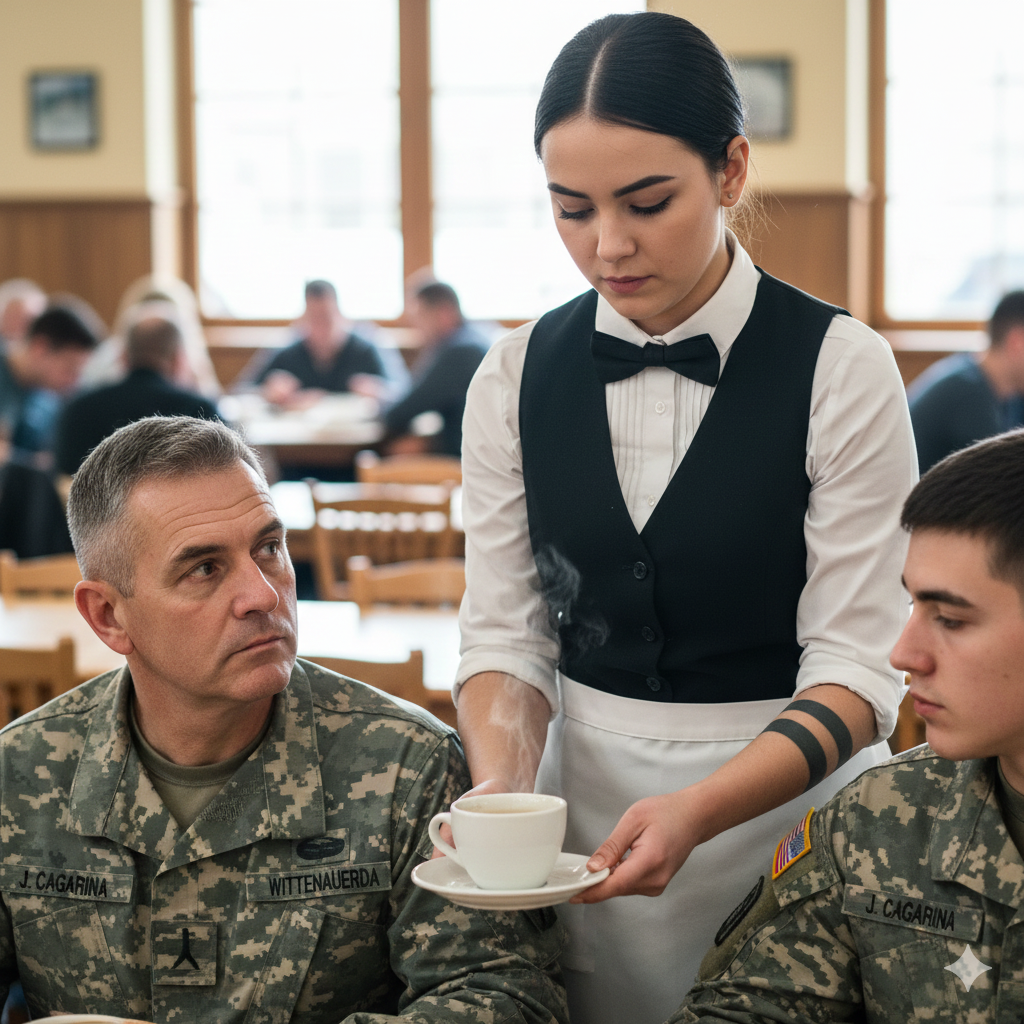
The cafeteria at Ridgeview High School buzzed the way it always did on the first day of the fall semester—loud, chaotic, unforgiving. But that morning, something was different. Something sharper hung in the air, like tension waiting to snap.
It began when Harper Malone, seventeen, walked through the double doors.
She wore a loose gray sweatshirt, sleeves pushed up to her elbows. On her left forearm, a long scar ran from wrist to elbow—uneven, raised, pale. It wasn’t new, but for many students, it was the first time they’d seen it. Harper had spent the previous school year homeschooling while recovering from an explosion that changed her life.
She had hoped coming back would feel like a step toward normal.
Instead, silence swept across the room as she walked in.
Then came the snickers.
Then the whispers.
Then the comments not even whispered.
“Yikes, what happened to her arm?”
“She looks like she fought a chainsaw and lost.”
“Oh my God, that scar is disgusting.”
Harper kept walking, jaw tight. She found a seat near the windows, unpacked her lunch, and tried to pretend she didn’t hear any of it.
But she did.
Every word.
A group of seniors—football players—sat two tables away, laughing loud enough for her to hear every syllable.
“Maybe she tried to cut her arm off on purpose,” one said.
“Or maybe she’s radioactive,” another joked. “Don’t sit too close or you’ll mutate.”
Their laughter felt like needles.
Harper tried breathing exercises her therapist taught her, but they weren’t working. Memories flashed—sirens, flames, the heat of the blast, the sound of metal twisting, her father screaming her name.
She blinked hard.
Not now. Please not now.
Her fingers shook as she picked at her food.
Across the cafeteria, Ms. Graham, the guidance counselor, noticed but didn’t intervene—not yet. Harper knew the look: Should I step in? Or let her handle it? Adults always hesitated.
But it wasn’t an adult who stepped in.
Not yet.
THE SCHOOL ASSEMBLY
Later that week, the entire school gathered in the auditorium for the annual “Community Heroes” assembly—an event mostly ignored by students. Speakers were usually local firefighters, nurses, or business owners who gave long talks about responsibility and leadership.
Today’s speaker, though, was different.
The flyer read:
“Guest Speaker: Master Sergeant Luke Carter, U.S. Army (Ret.) — Recipient of the Silver Star, Bronze Star, and Purple Heart.”
The room hummed with boredom as kids filed in. Harper sat alone in the third row from the back, hoodie sleeves pulled down to hide her scars.
The principal introduced him.
“Please welcome a true American hero, Master Sergeant Luke Carter.”
Polite applause.
From the side door, a man in his late forties stepped onto the stage. He walked with a cane but stood tall—broad shoulders, sharp jaw, hair peppered with gray. His uniform jacket gleamed with medals.
Students perked up a little. He had presence. The kind that fills a room without even trying.
“Good morning,” he said, voice steady and warm. “I’m Luke.”
The auditorium quieted.
“I’m here to talk to you about courage,” he began. “Real courage. Not what you see in movies. The kind that shows up when everything goes wrong.”
He paced slowly.
“And to do that, I want to share a story about someone in this room.”
Every head lifted.
Harper froze.
No. It can’t be. He doesn’t even know me.
But when his eyes scanned the audience, they landed on her. Softly. Knowingly.
Her breath caught.
THE CRUEL INTERRUPTION
Before he could continue, one of the football players—Dylan Brooks—leaned toward his friend and whispered loudly, “Maybe he’s talking about the chainsaw girl.”
Harper’s chest tightened.
More snickers.
Master Sergeant Carter paused onstage.
His expression didn’t change—but something in the room did. The air grew still, electric.
He stepped forward, gripping the microphone.
“Son,” he said calmly, “would you mind standing up?”
Dylan’s smirk faltered. “Uh… why?”
“Because if you’re bold enough to speak while I’m speaking, you’re bold enough to stand for your words.”
A wave of ooohs rippled across the auditorium.
Dylan rose slowly, face flushing.
The veteran nodded. “Thank you. Now, repeat what you said.”
Dylan swallowed. “I… I don’t want to.”
“I didn’t ask what you wanted,” the veteran replied. “I asked for you to repeat it.”
The room went silent.
Dylan looked around helplessly. Then mumbled, “I said, uh… maybe you were talking about the chainsaw girl.”
A gasp ran through the audience.
Harper shrank into her seat.
The veteran remained still. “And who, exactly, is that?”
Dylan pointed reluctantly toward Harper. “Her. The girl with the scar.”
Every head turned toward her.
Her skin burned.
The veteran followed Dylan’s gesture. His eyes softened when they found Harper again.
“I see,” he said quietly.
Then he looked back at Dylan.
“Thank you for your honesty. You can sit.”
Dylan sagged into his seat.
THE TRUTH COMES OUT
Master Sergeant Carter faced the audience again.
“Let me tell you something about scars.”
His voice deepened, resonating.
“Every scar is a badge of survival. A chapter of a story someone had the courage to live through.”
He looked down for a moment, then unbuttoned his uniform jacket, revealing a faded burn scar climbing across his collarbone.
Students leaned forward.
“This one,” he said, touching it, “came from shielding my squad when our convoy was hit outside Kandahar. We lost two vehicles. I should’ve died. I didn’t.”
He paused.
“Not because I’m strong—but because someone else was braver than me that day.”
His gaze slid to Harper.
“And today, I want to tell you about someone in this room who showed that same bravery.”
Whispers swept the auditorium.
He walked slowly off the stage, cane tapping the floor, and approached Harper’s row.
Students parted like the Red Sea as he reached her seat.
“Harper,” he said gently, “may I share your story with them?”
She felt every eye on her. Her hands trembled.
She nodded.
He turned back to the crowd.
“Last year, Harper Malone was at the Lakeside County Fair. She and her father were near the food stalls when a propane tank malfunctioned.”
Students murmured—they’d heard about the explosion on the news.
“Most people ran,” he continued. “But Harper didn’t. She didn’t freeze. She didn’t think about herself. She rushed to help two children who were trapped between metal barriers.”
Gasps.
“She shielded them with her own body when the tank blew. And that scar you think is funny?” He gestured to her arm. “That scar exists because she saved lives.”
Silence.
Heavy, loaded silence.
The veteran’s voice thickened. “Her father was the paramedic who arrived on scene. He told me she kept telling the kids, ‘You’re okay. I’ve got you.’ Even though she was in pain herself.”
A few students wiped their eyes.
“She spent months in recovery. Physical therapy. Nightmares. But she returned to school anyway, even knowing some of you might stare or whisper.”
He faced Harper, eyes shining.
“That is courage.”
Then he turned sharply back to the audience.
“Not the kind you get from lifting weights or winning games. The kind that comes from the soul.”
THE MOMENT THAT SILENCED THEM
He climbed back onstage, breathing hard but steady.
“Before anyone mocks a scar—or a limp, or a difference—they should ask themselves: Would I have survived what that person survived?”
The room was pin-drop silent.
Then he added:
“And Harper… those children you saved? They wrote you a letter.”
He handed her a sealed envelope.
Harper stared at it, throat tight. She didn’t open it—not yet. But just knowing it existed made something inside her loosen, like a knot coming undone.
He turned to the students one last time.
“You don’t have to be soldiers to show respect. You just have to be human.”
The auditorium erupted into applause. Not polite. Not forced. Real.
Some stood.
Some cried.
Even Dylan clapped, face burning with shame.
But Harper didn’t see any of that.
She saw Master Sergeant Carter giving her a small nod—as if saying, You’re not alone anymore.
AFTER THE ASSEMBLY
Students crowded her after dismissal.
“I’m so sorry, Harper.”
“I didn’t know.”
“You’re amazing.”
“Are you okay?”
For the first time in months, she didn’t feel like disappearing. She felt… seen. Respected. Believed.
Ms. Graham approached with soft eyes. “If you ever want a place to talk, my door’s open.”
Harper nodded, grateful.
When the room thinned, the veteran found her.
“I knew your father,” he said quietly.
Harper blinked. “You… you did?”
“He served as a medic attached to my unit years ago. Best man I ever worked with.”
Her chest tightened. “He never told me.”
“He wouldn’t. Humble as they come.”
He smiled softly.
“When he saw you rush toward those kids instead of away, he told me he’d never been prouder.”
Harper swallowed hard. “He… he really said that?”
“Every word.”
She wiped her eyes.
He motioned to her arm. “Don’t hide that scar. Wear it. It’s a testament to your heart.”
“I’ll try,” she whispered.
“That’s all anyone can ask.”
EPILOGUE
Two months later, Harper didn’t wear long sleeves anymore.
She joined the school’s volunteer program. Became a mentor for younger students. Helped the guidance office create a “Courage Week” honoring community heroes.
And during the spring assembly, when she stepped onstage to receive the Ridgeview Humanitarian Award, the loudest applause came from the back row—where Master Sergeant Carter stood proudly.
The same students who once mocked her scars now admired her strength.
Because one man stood up.
Told the truth.
And reminded everyone:
Some scars aren’t ugly.
Some scars are heroic.
And some people carry them like worn medals—quiet but unstoppable.