
Obese Sisters Sold Like Cattle — The Mountain Man Who Bought Them Said, “I’ll Give You a Home”
The first thing people noticed about the Caldwell sisters was their size.
The second thing they noticed was how quietly they carried it.
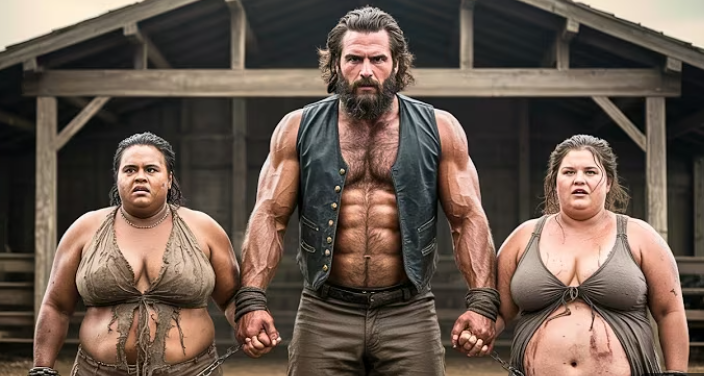
Abigail and Ruth Caldwell stood side by side at the edge of the dusty auction yard, their hands clasped together so tightly their knuckles had gone pale. Around them, men shouted, laughed, and haggled over livestock—horses, cattle, mules—and, on that terrible day, two human lives.
The war had ended years ago, but in the broken territories of the West, law still lagged behind desperation. Their father had died the previous winter, leaving debts he could never repay. The land was gone. The house was gone. And now, in a cruel twist of fate dressed up as “settlement,” the sisters themselves had become collateral.
“Keep your head down,” Abigail whispered.
Ruth nodded, though her eyes shimmered with tears she refused to let fall. She was the younger one, softer in spirit, though not weaker. Life had hardened them both in different ways.
“Next lot!” the auctioneer barked.
A few men chuckled before they even stepped forward.
“Well, would you look at that,” one muttered. “Didn’t know they were selling two for the price of one.”
Laughter rippled through the crowd.
Abigail straightened slightly. She had heard it all before. Fat. Useless. Burden. Words thrown like stones since childhood. But today, they cut deeper, because today, there was no walking away.
“Healthy girls,” the auctioneer announced, as if describing livestock. “Strong backs. Used to hard work.”
“Used to eating, you mean,” someone shouted.
More laughter.
Ruth’s grip tightened painfully around Abigail’s hand.
“Don’t listen,” Abigail murmured. “Just breathe.”
The bidding started low.
Too low.
A dollar.
Two.
Someone snorted. “What would I even do with them?”
“Feed them, for starters,” another replied, earning another round of laughter.
The numbers stalled.
For a moment—just a moment—Abigail thought no one would bid again. That they might be turned away, left with nothing but humiliation and nowhere to go.
And then a voice cut through the noise.
“Ten dollars.”
The yard fell quiet.
Heads turned.
At the edge of the crowd stood a man unlike the others. He wasn’t dressed for town—his clothes were rough, worn, patched in places. A thick beard covered most of his face, and his broad shoulders spoke of years spent in labor, not leisure.
“Ain’t seen you around,” the auctioneer said cautiously.
“Don’t come to town often,” the man replied.
There was something steady in his voice. Not loud. Not forceful. Just… certain.
“You offering ten for both?”
“That’s right.”
A murmur swept through the crowd. It was more than anyone expected. More than the sisters were “worth,” as the men liked to say.
“Anyone else?” the auctioneer called.
Silence.
No one cared enough to challenge it.
“Sold.”
The gavel struck.
And just like that, their lives changed.
—
The man introduced himself as Caleb Turner once they were away from the crowd.
He didn’t touch them, didn’t rush them. Just walked beside them, leading two sturdy horses by the reins.
“My place is a ways out,” he said. “Up in the mountains.”
Ruth glanced at Abigail, fear flickering in her eyes.
Mountains meant isolation.
Isolation meant no escape.
Abigail met her sister’s gaze, silently reassuring her. Whatever happened, they would face it together.
“Why?” Abigail asked finally.
Caleb stopped walking.
He looked at them—not at their size, not with judgment or curiosity, but as if he were trying to understand something deeper.
“Because you needed a chance,” he said simply.
Abigail frowned. “That’s not a reason.”
“It is to me.”
There was no arrogance in his tone. No hidden meaning. Just a quiet truth.
After a moment, he added, “You won’t be treated like property. Not in my home.”
Ruth’s voice was barely a whisper. “Then why buy us?”
Caleb hesitated.
“Because if I hadn’t, someone else might have.”
That was answer enough.
—
The journey took two days.
The land changed as they traveled—flat plains giving way to rolling hills, then to rugged slopes and towering pines. The air grew cooler, cleaner.
By the time they reached Caleb’s cabin, Ruth was exhausted, but something in her chest felt lighter.
It wasn’t grand. Just a small wooden cabin nestled against the mountainside, with a fenced garden and a creek running nearby.
“It’s not much,” Caleb said.
Abigail looked around.
It was more than they’d had in months.
“It’s enough,” she replied.
Inside, the cabin was simple but clean. A fire crackled in the hearth. Two extra beds had been set up, as if he had prepared for them long before they arrived.
“You can stay as long as you like,” Caleb said. “Help out if you want. Leave if you want. No one’s keeping you.”
Ruth blinked. “Just like that?”
“Just like that.”
Abigail studied him carefully. “You expect nothing in return?”
A faint smile tugged at his beard. “I expect honesty. And maybe some help with the chickens. They’re meaner than they look.”
For the first time in days, Ruth let out a small, surprised laugh.
—
Life in the mountains was hard.
But it was honest.
The sisters worked alongside Caleb—tending the garden, hauling water, gathering firewood. Their bodies, once mocked, proved strong and capable.
Weeks passed.
Then months.
Something began to change.
Not in their size—that remained—but in the way they carried themselves.
Ruth started humming while she worked.
Abigail found herself speaking more, her sharp edges softening.
And Caleb… Caleb never once made them feel less than.
He didn’t stare. Didn’t comment. Didn’t compare.
He simply treated them as people.
One evening, as the sun dipped behind the mountains, Ruth sat by the creek, her feet in the cool water.
“Do you think he regrets it?” she asked.
“Buying us?” Abigail said.
Ruth nodded.
Abigail watched Caleb in the distance, splitting wood with steady, practiced movements.
“No,” she said after a moment. “I think he knew exactly what he was doing.”
Ruth tilted her head. “Why us, though?”
Abigail hesitated.
“Maybe,” she said slowly, “he saw something no one else bothered to look for.”
—
Winter came early that year.
Snow blanketed the mountains, turning the world silent and still.
Food grew scarce.
The work grew harder.
One night, a storm rolled in—fierce and unrelenting. The wind howled like a living thing, rattling the cabin walls.
The fire burned low.
Ruth shivered under her blankets. “What if it doesn’t stop?”
“It will,” Abigail said, though she wasn’t entirely sure.
A sudden crash echoed outside.
The door burst open.
Caleb stumbled in, covered in snow.
“The roof of the shed collapsed,” he said, breathless. “We’re going to lose the animals if we don’t move them.”
Abigail was on her feet instantly. “We’ll help.”
“No,” Caleb said firmly. “It’s too dangerous.”
“We’re not sitting here while you freeze,” she shot back.
For a moment, their eyes locked.
Then Caleb nodded.
“Stay close,” he said.
The storm hit them like a wall.
Wind clawed at their clothes. Snow blinded them.
But they pushed forward.
Together.
Ruth guided the frightened animals while Abigail and Caleb cleared a path.
It took hours.
By the time they returned to the cabin, they were exhausted, soaked, and trembling.
But they had done it.
All of them.
Inside, as the fire roared back to life, Caleb looked at the sisters—really looked at them.
“I couldn’t have done that alone,” he said quietly.
Abigail shrugged, though her cheeks flushed slightly. “Good thing you didn’t have to.”
Ruth smiled softly.
For the first time in her life, she didn’t feel like a burden.
She felt… needed.
—
Spring came slowly, but when it did, it brought warmth—and something else.
Change.
Ruth noticed it first.
The way Caleb lingered a little longer when Abigail spoke.
The way Abigail’s voice softened when she said his name.
One afternoon, Ruth found them standing by the fence, talking quietly.
She didn’t hear the words.
But she saw the look in Abigail’s eyes.
And she smiled.
That night, as they lay in their beds, Ruth turned to her sister.
“You love him,” she said simply.
Abigail froze.
“That’s ridiculous.”
“Is it?”
Abigail stared at the ceiling.
For so long, she had believed love wasn’t meant for someone like her.
Not with her body.
Not with her past.
But Caleb had never seen her that way.
He had seen her strength. Her stubbornness. Her heart.
“I don’t know,” she admitted.
Ruth reached over and squeezed her hand.
“I think he does.”
—
It happened a few days later.
Nothing dramatic.
No grand gestures.
Just a quiet moment.
Caleb was fixing the fence when Abigail approached.
“You’re doing it wrong,” she said.
He glanced up, amused. “Oh?”
She stepped closer, showing him the proper way to secure the wire.
Their hands brushed.
Both of them paused.
For a moment, the world seemed to hold its breath.
“I’m glad I found you,” Caleb said softly.
Abigail’s heart skipped.
“You didn’t find us,” she said. “You bought us.”
Caleb shook his head.
“No,” he said. “I gave you a choice.”
Abigail swallowed.
“And if I choose to stay?”
A small, hopeful smile appeared beneath his beard.
“Then I’d be the luckiest man in these mountains.”
She hesitated.
Then, slowly, she reached for his hand.
“I think,” she said, “I already have.”
—
Years later, people would still talk about the day the Caldwell sisters were sold.
But the story had changed.
Now, it wasn’t about shame.
It was about survival.
About kindness.
About a mountain man who saw worth where others saw none.
Ruth would eventually leave the mountains, finding a life of her own in a nearby town—one where she was valued, respected, and, for the first time, truly seen.
And Abigail?
She stayed.
Because sometimes, the place you’re taken against your will becomes the place you finally belong.
And sometimes, the person who “buys” you… is the one who sets you free.
Obese Sisters Sold Like Cattle — Part 2: A Place Worth Staying
Spring did more than melt the snow—it revealed everything that had been buried beneath it.
Not just the earth, but hearts.
Abigail woke before sunrise most mornings now. The habit had formed during winter, when every extra hour of daylight meant survival. She stepped outside the cabin, wrapping a shawl around her shoulders as the cool mountain air greeted her.
For a moment, she simply stood there.
Listening.
The creek trickled again, freed from ice. Birds had returned, their songs tentative but growing stronger each day. The mountains, once harsh and silent, now felt alive.
And for the first time in her life, Abigail didn’t feel out of place in the world.
Behind her, the cabin door creaked open.
“You’re up early.”
She turned to see Caleb, rubbing sleep from his eyes, his hair tousled and beard unkempt in a way that would’ve looked wild on another man—but on him, it just looked right.
“Couldn’t sleep,” she said.
He stepped beside her, following her gaze toward the rising sun.
“Storm’s passed,” he murmured.
Abigail smiled faintly. “You mean winter.”
Caleb glanced at her.
“No,” he said quietly. “I meant more than that.”
Their eyes met.
For a moment, neither of them spoke.
Then Abigail looked away first, her cheeks warming.
“There’s work to do,” she said, almost too quickly.
“There always is,” Caleb replied—but there was a softness in his voice that hadn’t been there months ago.
—
Ruth noticed everything.
She always had.
By late spring, the distance between Abigail and Caleb had changed—not vanished, but softened, like ice turning to water. They moved around each other differently now. More aware. More careful.
And yet, somehow, more natural.
Ruth leaned against the fence one afternoon, watching them argue over how to plant the new row of crops.
“You’re spacing them too close,” Abigail insisted.
“They’ll grow fine,” Caleb countered.
“They’ll choke each other out.”
“They’re plants, not people.”
Ruth snorted.
Abigail shot her a look. “You’re not helping.”
“I’m observing,” Ruth said innocently.
Caleb chuckled under his breath.
Abigail crossed her arms. “You’re both impossible.”
But there was no bite in her words.
Only warmth.
Ruth smiled to herself.
They were getting there.
—
That evening, Ruth made a decision.
“I’m leaving,” she announced over dinner.
The words hung in the air.
Abigail’s fork froze halfway to her mouth. “What?”
Caleb looked up, surprised but calm. “You found a place?”
Ruth nodded.
“There’s a town about a day’s ride from here. I heard from a trader passing through. They need help at a boarding house.”
Abigail set her fork down slowly. “You’ve been planning this.”
“For a while,” Ruth admitted. “I didn’t want to say anything until I was sure.”
Silence settled over the table.
“You don’t have to go,” Abigail said quietly.
Ruth smiled gently. “I know. That’s why I can.”
That hit deeper than anything else.
For the first time in their lives, they weren’t trapped.
They had choices.
And Ruth was choosing something of her own.
“I’ll miss you,” Abigail said, her voice unsteady.
Ruth reached across the table, taking her hand.
“I’m not disappearing,” she said. “I’m just… starting something.”
Caleb nodded. “You’ll always have a place here.”
Ruth met his gaze, gratitude shining in her eyes.
“I know.”
—
The morning Ruth left, the mountains felt different.
Quieter.
Abigail stood by the path as her sister mounted the horse Caleb had saddled for her.
“You’ll write?” Abigail asked.
“As often as I can,” Ruth promised.
They hugged tightly, holding on longer than either of them expected.
“Be happy,” Ruth whispered.
Abigail pulled back, frowning slightly. “That’s a strange thing to say.”
Ruth just smiled.
“You’ll understand.”
Then she was gone.
Just like that.
Abigail stood there long after the sound of hooves had faded.
For the first time since their father died… since the auction… since everything…
She was alone.
Not abandoned.
Just… on her own path.
—
The days that followed were quieter.
Not lonely—but different.
Abigail threw herself into work, filling the silence with purpose.
Caleb gave her space.
He didn’t push. Didn’t pry.
But he was there.
Always there.
One evening, as the sky turned gold and purple, Abigail found herself sitting by the creek again—the same place Ruth had once sat.
“You’ve been avoiding me,” Caleb said, stepping into view.
She didn’t look up. “I’ve been busy.”
“You’ve been busy before.”
That made her glance at him.
He sat beside her, not too close, not too far.
“Ruth leaving changed things,” he said.
Abigail nodded slowly.
“It made everything… clearer.”
“In what way?”
She hesitated.
Then, before she could stop herself, the words slipped out.
“I don’t know who I am without her.”
Caleb was quiet for a moment.
Then he said, “You’re Abigail.”
She let out a small, humorless laugh. “That doesn’t mean much.”
“It does to me.”
She looked at him then.
Really looked.
“Why?” she asked.
The question carried more weight than just curiosity.
Why her?
Why had he chosen them?
Why had he stayed?
Why did he look at her the way he did now?
Caleb met her gaze steadily.
“Because you’re strong,” he said. “Because you don’t quit, even when the world gives you every reason to. Because you care more than you let on.”
Abigail’s throat tightened.
“You don’t see what others see,” she said softly.
“No,” Caleb agreed. “I see more.”
That broke something open inside her.
All the years of being judged, dismissed, reduced to her body—
And here was a man who saw beyond it.
Who always had.
“I’m afraid,” she admitted.
“Of what?”
She swallowed.
“Of wanting something I was never meant to have.”
Caleb’s voice was gentle.
“And what is that?”
She didn’t answer.
She didn’t have to.
The silence said everything.
—
He moved closer, slowly, giving her time to pull away.
She didn’t.
“Abigail,” he said, her name softer than she’d ever heard it.
His hand found hers.
Warm. Steady.
Real.
“You were never meant to be anything less than what you are,” he said. “And what you are… is more than enough.”
Tears slipped down her cheeks before she could stop them.
“I don’t know how to do this,” she whispered.
“You don’t have to know,” Caleb replied. “You just have to try.”
She let out a shaky breath.
Then, for the first time in her life, she allowed herself to lean into someone.
Not out of desperation.
Not out of fear.
But because she wanted to.
Caleb wrapped his arms around her, holding her as if she were something precious.
Not fragile.
Not temporary.
But real.
And worth keeping.
—
The mountains witnessed it all.
The slow, quiet unfolding of something neither of them had expected—but both of them needed.
It wasn’t perfect.
They argued.
They struggled.
There were days when Abigail’s old doubts crept back in, whispering lies she had believed for too long.
But Caleb never wavered.
And slowly… she didn’t either.
—
Months later, a letter arrived.
Abigail recognized Ruth’s handwriting immediately.
Her hands trembled slightly as she opened it.
I found my place, it read. Not because someone gave it to me—but because I chose it. I think you understand that now.
Abigail smiled.
She did.
Tell Caleb I said thank you—for everything. And tell yourself the same.
At the bottom, Ruth had added one more line:
You deserve to be loved, Abby. Don’t forget that.
Abigail folded the letter carefully.
Then she stepped outside, where Caleb was waiting.
“Good news?” he asked.
She nodded.
“Ruth’s happy.”
He smiled. “I figured she would be.”
Abigail looked at him, her heart full in a way that once felt impossible.
“So am I,” she said.
And this time, she didn’t hesitate.
Because she knew exactly who she was.
Not the girl in the auction yard.
Not the burden people once saw.
But someone who had survived.
Who had chosen.
Who had found a home—not just in the mountains, but in herself.
And in the man who had once said, “I’ll give you a home”…
…and meant far more than just a place to stay.