
STORY
By the time Clara Whitmore understood that the men meant to leave her behind, the snow had already swallowed the road.
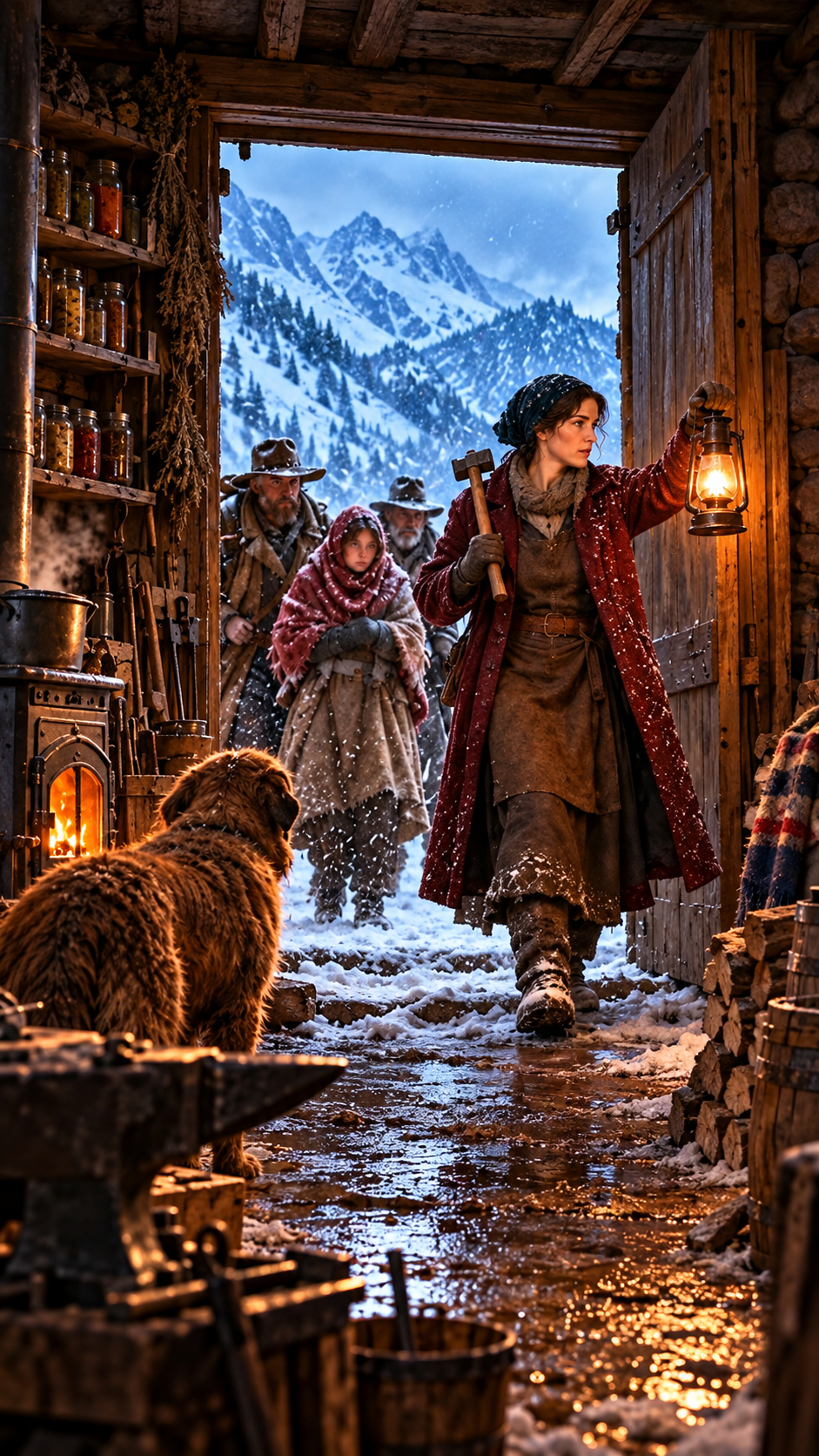
She stood outside the blacksmith shop that had belonged to her husband, one gloved hand gripping the wooden handle of his hammer while wind drove needles of ice against her cheeks.
“You can’t do this,” she said.
Silas Crowley pulled his coat tighter. “It’s already done.”
Behind him stood three members of the town council. None would meet her eyes.
Clara looked past them at the forge.
For nine years, she and her husband, Nathan, had worked there together. Nathan shaped horseshoes, wagon rims, hinges, axes. Clara kept the accounts at first.
Then one summer Nathan had crushed two fingers beneath a wagon axle.
Clara had picked up his hammer.
Within a year, half the town had learned that the quiet blacksmith’s wife could draw iron as straight as any man.
Then Nathan died of fever.
And suddenly the same people who had praised Clara’s work decided a widow had no business owning the forge.
Silas had produced a debt supposedly bearing Nathan’s signature.
Clara knew it was false.
But knowing and proving were different things.
“The shop belongs to me,” Silas said.
Clara stared at him. “You chose the first storm of winter to throw me out.”
“You were told to leave three days ago.”
“The pass was already closing.”
Silas shrugged.
That was when Clara understood.
This wasn’t eviction.
They expected the mountains to finish the argument.
She looked at the faces behind him.
“Remember this moment,” she said quietly.
Then she turned away.
Her dog Amos followed.
Clara carried one pack, Nathan’s hammer, a bedroll, two days of dried meat, and a lantern.
By sunset, the town had disappeared behind white darkness.
The wind screamed through the pines.
Amos struggled beside her, snow collecting in his thick brown coat.
“We stop soon,” Clara promised.
But there was nowhere to stop.
The abandoned trapping cabin she remembered stood another four miles north.
She never reached it.
Near midnight, Clara stumbled beside a frozen creek and saw Amos suddenly raise his head.
The dog barked.
“What?”
He ran toward the trees.
“Amos!”
Clara followed.
Twenty yards into the timber, the dog disappeared behind a wall of snow-covered rock.
Clara pushed through drifts and found him scratching at something.
Wood.
A door.
Almost completely hidden beneath an overhanging ledge.
Clara cleared the snow from an iron latch.
The door opened.
She raised her lantern.
A narrow passage stretched into darkness.
“Hello?”
No answer.
She stepped inside.
The passage opened into a cabin built partly against the mountain itself.
There was a stove.
A bunk.
Shelves.
Barrels.
Tools.
Firewood stacked nearly to the ceiling.
Clara simply stared.
Someone had prepared this place for winter.
Not one winter.
Years of winters.
She found matches in a tin beside the stove.
Twenty minutes later, flames crackled behind iron.
Amos collapsed beside them.
Clara laughed once, then unexpectedly began to cry.
“We’re alive,” she whispered.
She explored after warming her hands.
There were beans, flour, salt, coffee, dried apples, smoked meat, candles, lamp oil.
Enough supplies for months.
But the strangest thing was the workshop.
At the rear of the shelter stood a small forge.
An anvil sat beneath the stone chimney.
Tongs hung neatly from pegs.
Hammers rested according to weight.
Clara picked up one.
The balance was perfect.
“Who were you?” she murmured.
Then she saw the initials stamped into the anvil.
E.B.
Her breath stopped.
Nathan had spoken of an old mountain blacksmith named Elias Boone.
Everyone thought Boone had died decades earlier.
Nathan had once said, If half the stories about Boone are true, he could make iron sing.
Clara searched the shelter.
Inside a wooden chest she found a leather journal.
The first pages were ordinary records.
Weather.
Supplies.
Repairs.
Then the entries changed.
Boone wrote about landslides and snow depths. He recorded temperatures. He mapped springs that remained unfrozen.
Most importantly, he described the shelter.
It wasn’t merely a cabin.
It had been built as a refuge.
Behind the rear wall lay a natural stone chamber that stayed above freezing. A narrow shaft drew smoke from the forge. Meltwater from an underground seep fed a covered cistern.
Boone had engineered the entire place to survive a catastrophic winter.
His final entry was dated twenty-three years earlier.
Clara read it twice.
If the great storm comes after I’m gone, open the mountain door. This place was never meant for one man.
Clara frowned.
Mountain door?
For two days the storm intensified.
On the third morning, she heard something through the wind.
A shout.
Amos barked wildly.
Clara opened the outer door.
Three figures staggered through the snow.
A rancher named Gideon Hale supported an elderly man.
Between them stumbled a young woman wrapped in a red shawl.
“Clara?” Gideon gasped.
She stared.
“What are you doing here?”
“Trying not to die.”
Clara pulled them inside.
The young woman, Ruth Bell, was shaking uncontrollably. The older man had frostbite beginning in two fingers.
Clara fed the stove and heated water.
Gideon watched her work.
“We thought you were dead.”
“So did Silas Crowley.”
His expression changed.
“What does that mean?”
“Nothing useful tonight.”
By evening they had eaten stew.
Then came another pounding at the door.
Two more people.
Before dawn, there were nine.
By the following night, seventeen.
The storm had collapsed roofs in the lower valley. Families trying to reach town had been forced uphill when drifting snow buried the road.
Somehow word had spread.
There was shelter in the mountain.
Clara began rationing Boone’s supplies.
On the fifth day, Gideon approached her.
“Wood won’t last if more come.”
Clara nodded.
“I know.”
“And there are more coming.”
“I know that too.”
She opened Boone’s journal.
Open the mountain door.
She had searched every wall.
Nothing.
Then Amos solved it.
The dog kept sniffing near the forge.
Clara moved the coal bin.
Behind it was an iron ring set into the floor.
Gideon helped her pull.
A stone panel shifted.
Cold air rose from below.
They descended twelve steps.
Clara’s lantern illuminated a cavern.
Gideon whispered, “Good Lord.”
Boone had built another refuge beneath the first.
There were stacked bunks.
Barrels of charcoal.
Shelves.
Blankets sealed inside cedar chests.
And against the far wall stood bundles of split wood, perfectly dry after more than twenty years.
But that wasn’t the secret that made Clara stop.
It was the iron box.
Boone’s name was stamped across its lid.
Inside were deeds, survey maps, receipts—and letters.
Clara unfolded one.
Her hands began trembling.
“Gideon.”
“What?”
“This land.”
“What about it?”
“It doesn’t belong to the town.”
He stared at her.
She handed him the deed.
Elias Boone had owned the entire mountain parcel, including the creek valley below.
But the deed contained another name.
Nathan Whitmore.
Clara’s husband.
Boone had left the property to Nathan’s father, his former apprentice, with inheritance passing to his descendants.
Nathan had owned this mountain.
Which meant Clara now owned it.
And among Boone’s records was something even more damaging.
A ledger documented years of business with Silas Crowley’s father.
Payments.
Loans.
Land transfers.
Including the original deed to the blacksmith shop in town.
Clara read the final receipt.
Nathan’s supposed debt had been paid eighteen years earlier.
Silas’s claim was worthless.
Gideon looked at her.
“He knew.”
Clara said nothing.
“He must have known these records existed.”
“Maybe.”
“That’s why he wanted you gone.”
Clara slowly folded the paper.
Outside, the wind roared.
Then Amos barked.
Someone was pounding on the upper door.
Clara climbed the stairs.
She opened it.
Four figures stood outside.
The man in front was nearly frozen.
Silas Crowley.
For several seconds neither spoke.
His face changed when he recognized her.
“Clara.”
She held the lantern higher.
Behind him were his wife, his twelve-year-old son, and an elderly neighbor.
Silas looked past her toward the warmth.
“Our wagon overturned.”
Clara tightened her grip on Nathan’s hammer.
“You threw me into this storm.”
“I know.”
“You expected me to die.”
Silas lowered his eyes.
His son was shivering violently.
Clara looked at the boy.
Then she stepped aside.
“Get them inside.”
Silas stared at her.
“Clara—”
“Your boy first.”
They entered.
Clara gave them soup.
She gave Silas dry socks.
She put his son nearest the stove.
Only afterward did she place Boone’s papers on the table.
Silas went pale.
“You found them.”
“So you did know.”
His silence answered.
Gideon rose angrily.
Clara lifted a hand.
“No.”
She looked at Silas.
“You will sign a statement admitting what you did.”
He stared at the papers.
“And if I refuse?”
Clara glanced toward the door where snow hammered the mountain.
“I still won’t send you outside.”
Silas looked confused.
Clara continued.
“Because your cruelty doesn’t decide what kind of woman I become.”
His shoulders sank.
The storm lasted eight days.
Thirty-one people eventually sheltered inside Boone’s mountain refuge.
Not one froze.
Not one went hungry.
When they finally descended, the valley looked transformed.
Barns had collapsed.
Fences had vanished.
Several houses were buried to their windows.
The blacksmith shop still stood.
Silas returned its keys without argument.
But Clara surprised everyone.
She didn’t move back.
Instead, she repaired Boone’s mountain forge.
Gideon hauled iron uphill.
Ruth organized the food stores.
Families rebuilt the bunks.
By spring, the forgotten refuge had become something Boone had apparently intended all along.
A public shelter.
Above the entrance Clara hung a simple iron plate she forged herself:
BOONE HOUSE — NO ONE TURNED AWAY
Silas came one afternoon carrying lumber.
Clara watched him approach.
“I thought you might need help repairing the woodshed,” he said.
She considered him.
“You any good with a saw?”
“Better than I am with honesty, apparently.”
Clara almost smiled.
“Then start with the north wall.”
Years later, travelers still told the story of the winter when a widowed blacksmith was driven into the mountains and discovered the refuge of a dead man.
Most told it as a story about hidden deeds and stolen property.
Others told it as a story about survival.
But Gideon Hale always corrected them.
“You’ve got it wrong,” he would say.
“The greatest thing Clara found in that mountain wasn’t the shelter.”
Then he would point toward Boone House, where smoke rose from the chimney and the door remained unlocked.
“She found enough warmth to save the very people who’d left her in the cold.”