
The Town Laughed When She Lost Everything — Then She Found Her Mother’s Secret
By the time Eleanor Whitmore returned to the town of Ashcroft Hollow, people had already decided what she was.
A failure.
A woman who had once left for the city wearing polished boots, carrying scholarship letters and impossible dreams… only to come back at thirty-four with a broken suitcase, worn hands, and nothing left.
Nothing but debt.
Nothing but silence.
Nothing but the old farmhouse on Black Creek Road—the one nobody wanted.
The one everybody said was cursed.
As Eleanor’s pickup truck rattled over the gravel driveway, she stared through the cracked windshield at the house she hadn’t seen in nearly twenty years.
It looked smaller.
The white paint had peeled away, exposing gray wood beneath. The porch sagged like tired shoulders. Wild ivy climbed the stone chimney, and half the shutters hung crooked.
Her mother had lived here alone until the day she died.
And Eleanor hadn’t made it in time to say goodbye.
That guilt weighed heavier than the two suitcases in her backseat.
She shut off the engine.
Silence.
Then a bark.
A golden retriever came charging from behind the barn, tail whipping through the air.
Eleanor blinked.
“Scout?”
The dog was older now, his golden fur flecked with white, but he recognized her instantly. He launched himself against her legs with a joyful whine.
She dropped to her knees in the dirt.
“Well… at least someone’s happy I’m back.”
She buried her face in his fur and, for the first time in months, cried.
Ashcroft Hollow was the kind of town where news traveled faster than church bells.
By sunset, everyone knew Eleanor Whitmore had come home.
By morning, they had opinions.
She heard them in the diner.
She heard them at the feed store.
She heard them outside the post office.
“She lost her fancy city job.”
“Divorced.”
“Bankrupt.”
“Came crawling back.”
“Her mama warned her.”
Eleanor kept walking.
At Maggie’s Diner, conversations paused when she entered.
Forks froze.
Coffee cups hovered.
She walked to the counter.
“I’ll have black coffee.”
Maggie poured it without asking questions.
“Welcome home, Ellie.”
Eleanor gave a small smile.
At least one person remembered her before the town decided who she’d become.
At a booth near the window, Tom Becker, her old high-school classmate, smirked over his eggs.
“City life not all it’s cracked up to be?”
Laughter.
Eleanor met his eyes.
“No.”
She took her coffee and sat alone.
More laughter.
She let it happen.
Because what hurt wasn’t the mockery.
What hurt was knowing they weren’t entirely wrong.
She had lost everything.
Her architecture firm in Chicago.
Her apartment.
Her marriage.
Her savings.
Her confidence.
And now all she owned was a dying farm and memories she wasn’t sure she wanted.
The farmhouse smelled like cedar, dust, and old winters.
Her mother’s quilts still lay folded on chairs.
Her recipes still sat on the kitchen counter.
Her boots still waited by the back door.
As if she might come home any minute.
Scout followed Eleanor everywhere.
Room by room.
Memory by memory.
Until dusk.
That was when Eleanor noticed something strange.
A folded note pinned beneath an oil lantern.
Her name written in handwriting she’d recognize anywhere.
Ellie.
Her breath caught.
She opened it.
Inside, only one sentence.
When you lose everything, look beneath where life was preserved.
No signature.
No explanation.
But it was her mother’s handwriting.
Eleanor sat frozen.
“Preserved…”
Scout barked.
Then ran toward the cellar door.
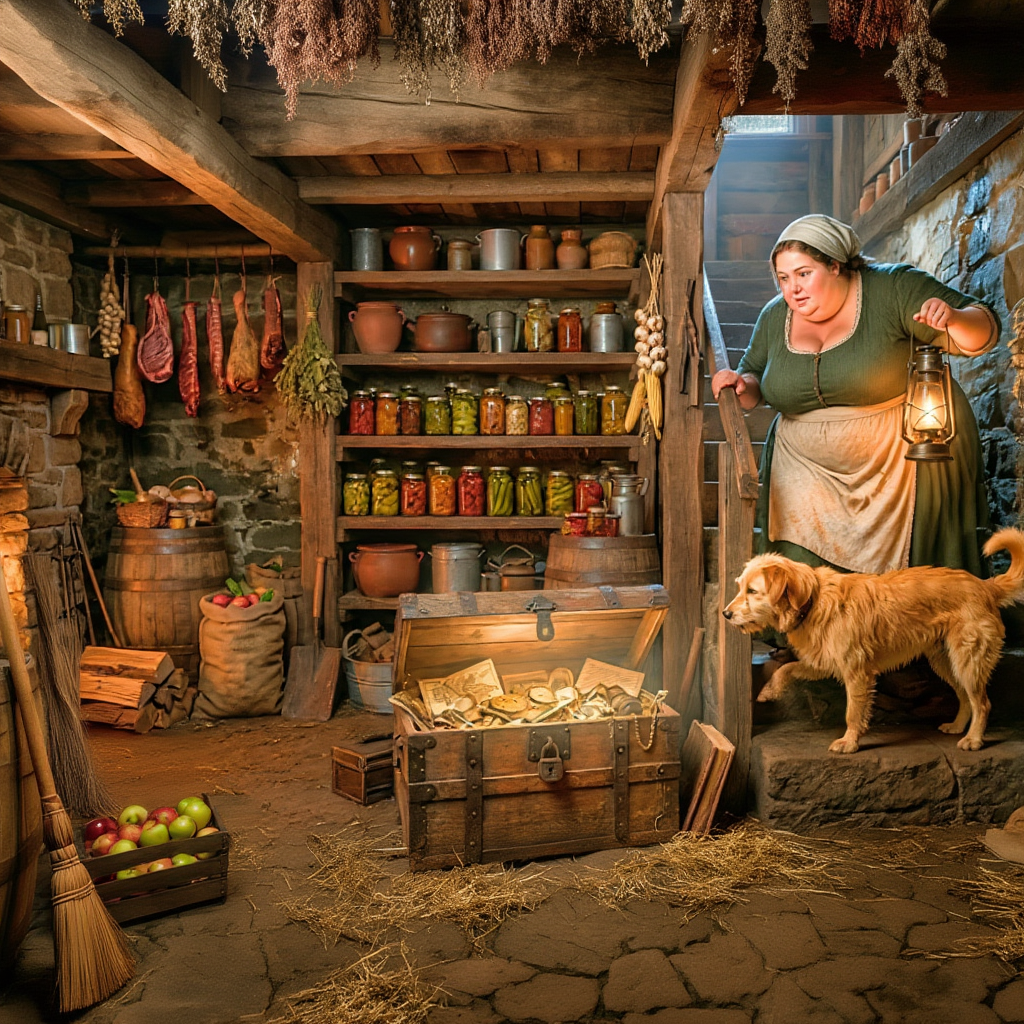
The cellar sat beneath the kitchen, hidden behind an old oak hatch.
Eleanor remembered it from childhood—cool stone walls, shelves lined with preserves, jars of peaches, beans, tomatoes.
Her mother had spent every summer canning food there.
She grabbed the old lantern.
Scout waited by the stairs.
When she opened the hatch, cold air rose like a breath from another century.
Wooden steps creaked under her weight.
Lantern light flickered across stone walls.
And suddenly she was ten years old again.
Only now…
She noticed things she hadn’t before.
Rows of preserved jars.
Dried herbs hanging from beams.
Garlic braided overhead.
Cured meats.
Wood crates filled with apples.
And in the corner…
A wooden chest.
Half buried beneath straw.
Scout barked again.
Eleanor’s heart pounded.
The chest looked ancient—oak wood, iron bands, brass lock.
Unlocked.
Her hands trembled as she lifted the lid.
Golden light spilled upward.
She gasped.
Inside—
Coins.
Stacks of old gold coins.
Leather-bound maps.
Letters.
Documents.
And on top…
Another note.
I always knew one day you’d need this.
Eleanor’s knees nearly gave out.
She sat hard on the stone floor.
“Mom…”
Scout pressed against her.
She opened the letters.
Most were addressed to Margaret Whitmore—her mother.
Some dated back to 1944.
Some older.
One from 1891.
And slowly…
The truth unfolded.
Her family had never been poor.
Not truly.
For generations, the Whitmores had owned hundreds of acres.
Rail contracts.
Mines.
Shipping routes.
Investments.
But Eleanor’s great-grandfather had disappeared during the Depression, and much of the family fortune vanished.
Or so everyone believed.
But Margaret had discovered the truth years earlier.
The wealth hadn’t disappeared.
It had been hidden.
Protected.
Passed secretly from mother to daughter.
Waiting.
For the one who needed it most.
Eleanor’s hands shook as she opened the final letter.
Her mother’s voice seemed alive in every word.
Ellie,
If you are reading this, life has broken you the way it broke me once.
Good.
Because broken things no longer pretend.
I never told you about this because you needed to build your own life first.
I needed you to know your worth before you knew your inheritance.
If you’ve come home with empty hands, then perhaps your hands are finally ready to hold something real.
The town will laugh.
Let them.
People who have never lost everything can never understand what treasure really is.
Love,
Mom
Eleanor cried until the lantern burned low.
Not for the gold.
Not for the fortune.
But because for the first time…
She understood her mother.
Word spread quickly.
Not because Eleanor told anyone.
But because small towns notice things.
Contractors arriving.
Surveyors measuring land.
Lawyers visiting.
Bankers from Louisville.
And within weeks…
The whispers changed.
“She found oil.”
“She won a lawsuit.”
“She married rich.”
“Lottery.”
But no one knew.
Except Maggie.
And Scout.
And Eleanor.
She could have sold everything.
Moved back to Chicago.
Started over.
Bought penthouses.
Cars.
Luxury.
Instead…
She rebuilt Ashcroft Hollow.
She restored the school.
Paid off medical debts for families.
Funded scholarships.
Repaired roads.
Reopened the mill.
Created jobs.
Restored abandoned farms.
Quietly.
Without speeches.
Without headlines.
Without revenge.
Six months later, Eleanor walked into Maggie’s Diner.
Every voice fell silent.
Tom Becker looked up.
Awkward.
Ashamed.
He stood.
“Ellie… I owe you an apology.”
She smiled gently.
“No, Tom.”
She placed money on the counter for coffee.
“You owed me kindness.”
Silence.
No laughter.
Only respect.
That evening she returned home.
Scout beside her.
The farmhouse glowed with warm lantern light.
She walked down into the cellar once more.
Past the jars.
Past the herbs.
Past the apples.
To the chest.
Still open.
Still glowing.
But now she understood.
The treasure had never been the gold.
It had been the lesson.
Sometimes life takes everything…
So you finally look where your mother told you to.
And in the deepest, darkest cellar—
You discover…
You were never poor at all.