
Elderly Couple Lost Everything, Moved Into A Rusted Quonset — What It Became Changed Everything
The wind rolled low across the Kansas plains, bending the brittle weeds that lined the dirt road like tired old men bowing to something greater than themselves.
Walter Bennett stood still beside his wife, his weathered hands shoved deep into the pockets of a faded brown jacket. At seventy-four, his shoulders had begun to curve, but there was still something solid about him—something built from forty years of welding steel, fixing engines, and lifting things other men said couldn’t be moved.
Beside him stood June.
Seventy-one.
Quiet.
Sharp-eyed.
The kind of woman who could spot a lie before the liar opened their mouth.
And today, both of them were staring at what would become their new home.
A rusted Quonset hut.
Half buried in prairie grass.
Its corrugated steel shell was stained orange with decades of rain, wind, and neglect. One small window sat crooked on one side. The doorway yawned black and empty.
Beside them, their dog—an aging mutt named Rusty—pulled lightly on his leash, sniffing the air as though he had more faith in this place than either of them did.
Walter swallowed hard.
“Well…”
June folded her arms.
“I’ve seen worse.”
Walter looked at her.
“No, you haven’t.”
She smirked.
“No,” she admitted. “I really haven’t.”
For a moment, they just stood there in silence.
Three months earlier, they’d had everything.
A small paid-off house in Wichita.
A vegetable garden.
Two rocking chairs on a porch.
Family photos.
Savings.
Routine.
Security.
Then the hospital bills came.
Walter’s emergency heart surgery.
Complications.
Insurance loopholes.
Debt collectors.
Refinancing.
Missed payments.
And then one letter.
FORECLOSURE.
Thirty-seven years of life packed into cardboard boxes in less than a week.
Their son lived in Seattle.
Their daughter in Atlanta.
Both offered spare bedrooms.
Both offered comfort.
Both offered pity.
Walter refused.
June refused faster.
They sold what little remained.
Bought an old pickup.
And through a county auction, for twelve hundred dollars…
They bought a forgotten patch of land.
And this.
Walter looked at the hut again.
“You sure about this?”
June tightened her jacket against the wind.
“No.”
She took his hand.
“But I’m sure about you.”
Walter looked away before his eyes could betray him.
“Damn woman,” he muttered.
She smiled.
“Come on.”
And together, they walked toward the hut.
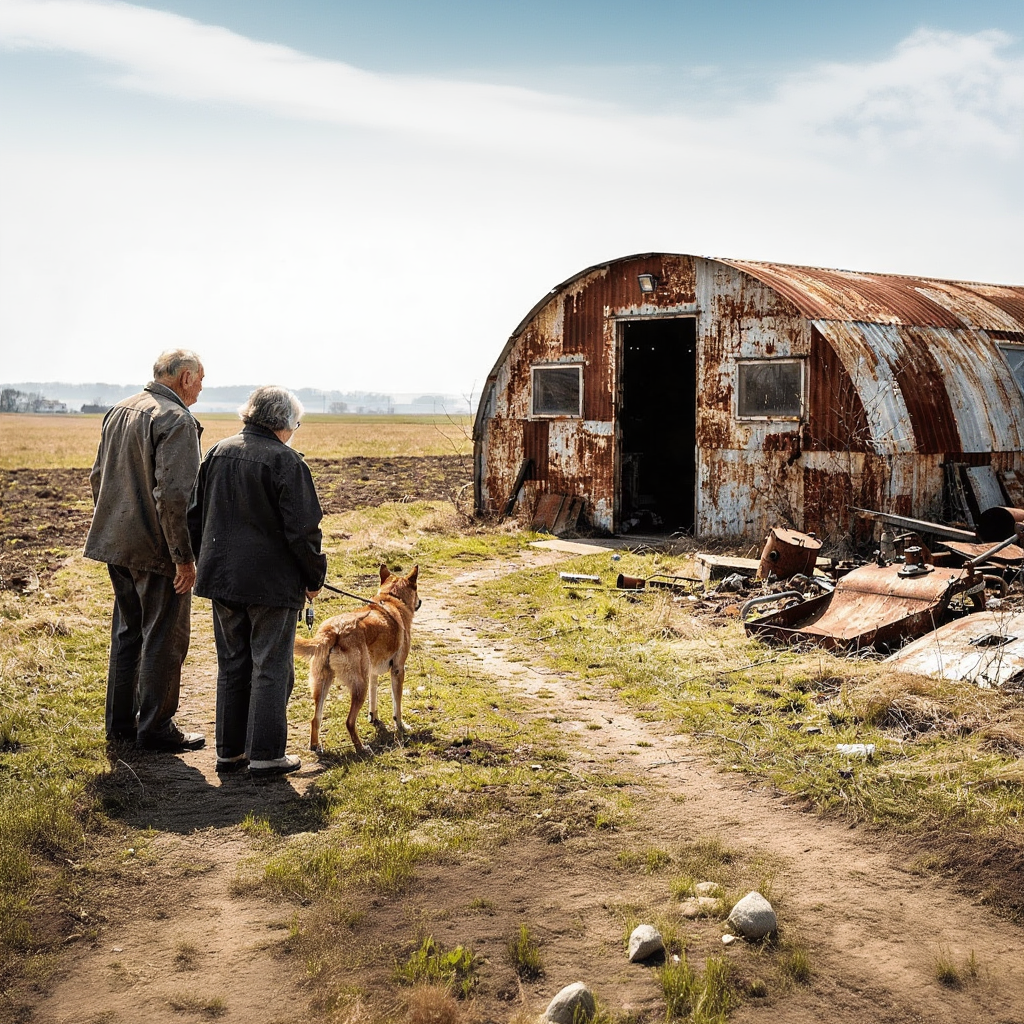
The smell hit them first.
Dust.
Oil.
Mouse droppings.
Old steel.
Walter opened the rusted door wider with a groan of protesting hinges.
Sunlight spilled across a dirt floor.
The inside was bigger than it looked—nearly forty feet long.
Curved steel walls.
Exposed ribs.
A cracked concrete slab in one corner.
Broken shelving.
Spiderwebs thick enough to catch birds.
June walked in slowly.
Her boots echoed.
Walter watched her face.
He expected fear.
Disappointment.
Regret.
Instead…
She smiled.
Walter frowned.
“What?”
She turned.
“It’s perfect.”
Walter stared at her.
“You finally lost your mind.”
She pointed.
“Kitchen there.”
Then another corner.
“Bed there.”
Another.
“Wood stove.”
Walter crossed his arms.
“With what money?”
June reached into her coat pocket.
Pulled out a folded envelope.
Walter blinked.
“What’s that?”
She grinned.
“Remember my quilting club?”
Walter nodded.
“The ladies who drink tea and gossip?”
June opened the envelope.
Inside—
Thirty-two hundred dollars.
Walter’s jaw dropped.
“You’ve been hiding money?”
June shrugged.
“I prefer ‘planning ahead.’”
Walter laughed so hard his chest hurt.
For the first time in months…
He laughed.
Really laughed.
And that’s when something changed.
The first winter nearly killed them.
The Kansas wind found every crack.
Every seam.
Every weakness.
Walter insulated walls with salvaged foam panels.
June stitched heavy curtains from old blankets.
They built a wood stove from a discarded oil drum.
Collected pallets.
Scavenged windows.
Bought secondhand furniture.
Every dollar mattered.
Every nail mattered.
Every day mattered.
By December, the hut looked different.
By January…
It felt like home.
And by February…
Something unexpected happened.
A truck pulled into their driveway.
Walter stepped outside cautiously.
A young woman climbed out.
Late twenties.
Camera in hand.
Big city clothes.
Big city smile.
“Excuse me,” she said.
“I heard about you two.”
Walter frowned.
“From who?”
She smiled.
“The internet.”
Walter looked confused.
June stepped outside.
“What internet?”
The woman laughed.
“Your granddaughter posted photos.”
June froze.
“She did what?”
The woman showed them her phone.
A photo.
Walter and June.
Standing in front of the Quonset.
Rusty between them.
Caption:
My grandparents lost everything… and started over at seventy.
Below it—
Three million views.
Walter blinked.
“What in God’s name…”
The woman extended her hand.
“I’m Hannah Pierce. I write for American Home Revival.”
Walter stared.
“You’re kidding.”
She smiled.
“No sir.”
She looked at the hut.
“Can I tell your story?”
Walter looked at June.
June looked at him.
And smiled.
“Why not?”
The article exploded.
Then came podcasts.
YouTube channels.
Tiny-home magazines.
Rural living blogs.
Television calls.
Interview requests.
Walter hated every minute.
June loved all of it.
Within weeks, letters started arriving.
Handwritten.
From widows.
Veterans.
Retirees.
Families losing homes.
People who thought starting over was impossible.
People who saw themselves…
In a rusted hut.
June read every single one.
Sometimes crying.
Sometimes laughing.
Sometimes sitting in silence.
One night, Walter found her at the kitchen table.
Letter in hand.
Tears in her eyes.
He sat beside her.
“What is it?”
She handed him the letter.
From a man in Ohio.
Age seventy-eight.
Widower.
Living in his truck.
One sentence underlined.
If you two can begin again, maybe I can too.
Walter sat quietly.
Then folded the letter carefully.
And something changed again.
Spring came.
And with it…
An idea.
Walter drew it on scrap plywood.
June looked over his shoulder.
“What’s that?”
Walter smiled.
“Rows.”
“Rows of what?”
He looked at the hut.
Then the empty land around it.
“More huts.”
June blinked.
“What?”
Walter leaned back.
“For people like us.”
She stared.
“Walter…”
He nodded.
“Veterans.”
“Widows.”
“Folks who lost everything.”
June’s eyes filled.
“You’re serious.”
Walter smiled.
“For the first time in my life.”
She smacked his arm.
“You old liar.”
The first donation arrived anonymously.
Five hundred dollars.
Then two thousand.
Then ten thousand.
Then companies offered materials.
Local welders volunteered.
Farmers brought tools.
Carpenters showed up on weekends.
Students painted walls.
Retirees planted gardens.
And on the same patch of forgotten Kansas dirt…
A village began to rise.
Small Quonset homes.
Simple.
Warm.
Affordable.
Dignified.
Not shelters.
Homes.
People started calling it—
Bennett Ridge.
Walter hated the name.
June loved it.
So naturally…
June won.
Two years later…
Walter stood where he had first arrived.
Same dirt road.
Same prairie wind.
Same sky.
But everything else…
Had changed.
Where there had once been one rusted hut…
There were now twenty-four.
Solar panels gleamed.
Gardens bloomed.
Dogs barked.
Children visited grandparents.
Smoke curled from chimneys.
Laughter carried across the fields.
And beside him…
June held his hand.
Rusty, now nearly blind, lay at their feet.
A black SUV pulled into the drive.
Another reporter.
Another interview.
Walter groaned.
June smiled.
“Be nice.”
Walter muttered.
“I was nice in 1973.”
She laughed.
The reporter approached.
“Mr. Bennett?”
Walter nodded.
She smiled.
“One question.”
Walter sighed.
“Fine.”
She looked around.
At the homes.
The people.
The life.
Then back at him.
“When you first saw this rusted Quonset…”
She paused.
“…did you ever imagine this?”
Walter looked across the village.
At the gardens.
At the old men drinking coffee.
At widows laughing.
At people who’d once believed life was over.
And then he looked at June.
She smiled at him the same way she had fifty-one years ago.
Walter’s voice cracked.
“Not even close.”
He squeezed her hand.
Then smiled.
“We thought we’d lost everything.”
He looked back at the village.
“Turns out…”
He paused.
“…we were finally standing where everything was supposed to begin.”
And under the endless Kansas sky…
The rusted hut that once looked like the end…
Became the beginning of hundreds of second chances.