
Stepmother Kicked Me Out — She Said My Blacksmith Shop Was Worthless, What I Found Saved Me
The first time my stepmother called my life’s work worthless, I was thirteen years old, standing barefoot in a barn full of coal dust.
“Look at you, Caleb,” she had said, folding her arms as sparks flew from my father’s old forge. “Playing with fire while other boys learn how to make real money.”
I still remembered the way my father had looked at me then.
Not angry.
Not embarrassed.
Proud.
“Steel remembers the hands that shape it,” he had told me.
I held onto those words long after he died.
And long after Ruth Whitmore—my father’s second wife—took everything that belonged to him.
Including me.
By the time I turned twenty-seven, the town of Red Creek, Colorado, knew me as the blacksmith who could repair anything.
Broken wagon axle?
Bring it to Caleb.
Snapped plow blade?
Caleb.
Mining picks?
Horse shoes?
Door hinges?
Wedding rings?
If metal was involved, I could make it sing.
But none of that mattered to Ruth.
She cared about banks.
Land deeds.
Coal contracts.
And appearances.
She wore expensive dresses even in mountain mud and spoke as though every conversation were a courtroom.
After Father passed from pneumonia, she inherited the Whitmore ranch, the house, the barns, and the surrounding land.
And because Father had died without updating his will…
I inherited nothing.
Except my forge.
A small stone workshop on the edge of our property.
And apparently, that was too much for her.
The morning everything changed started with snow.
Late October.
The mountains glittered white under a sharp blue sky.
I was hammering red-hot steel into horseshoes when Ruth walked into my shop without knocking.
Her perfume clashed with coal smoke.
She glanced around as though she’d stepped into a pigpen.
“You’re still doing this?”
I kept hammering.
CLANG.
CLANG.
CLANG.
She raised her voice.
“I asked you a question.”
I plunged the steel into water.
Steam rose between us.
“Yes,” I said.
Her lips curled.
“This toy shop.”
I looked up.
Her eyes were cold.
“Your father spoiled you.”
I said nothing.
She stepped closer.
“You’re twenty-seven.”
Still nothing.
She leaned over my anvil.
“You should be running numbers.”
“Negotiating land.”
“Managing assets.”
“Not pretending you’re some frontier hero.”
I wiped sweat from my forehead.
“This forge feeds me.”
She laughed.
“No.”
Her voice sharpened.
“The ranch feeds you.”
Then she pulled a folded paper from her coat.
And placed it on my anvil.
I unfolded it.
Eviction notice.
Thirty days.
At first, I thought it was a joke.
Then I saw the lawyer’s seal.
And Ruth smiled.
“Your little blacksmith shop sits on my land.”
I stared at her.
She tilted her head.
“And I’ve decided I want it demolished.”
I felt my chest tighten.
“You can’t.”
She smiled wider.
“Oh…”
She turned toward the door.
“I already did.”
For thirty days, I worked like a man possessed.
Every customer who came by heard the story.
Most shook their heads.
Some cursed Ruth’s name.
A few offered money.
I refused.
This wasn’t about charity.
This was about survival.
I sold every extra tool.
Packed every nail.
Every tong.
Every hammer.
Every scrap of steel.
And on the morning of the thirtieth day…
I stood outside the shop my father built.
Snow fell softly.
I touched the stone chimney.
Ran my fingers across the old oak door.
And walked away.
With one backpack.
And nowhere to go.
I followed the mountain road west.
Past old mining camps.
Past frozen streams.
Past pine forests that smelled of resin and ice.
By noon, clouds rolled in.
By evening, I was lost.
The trail vanished beneath fresh snow.
Wind screamed through the canyon.
And for the first time in my life…
I wondered if Ruth had killed me without ever lifting a hand.
My boots slipped on ice.
I fell hard.
My backpack slid down a slope.
And when I scrambled after it…
I saw something impossible.
Across the gorge.
Built into solid stone.
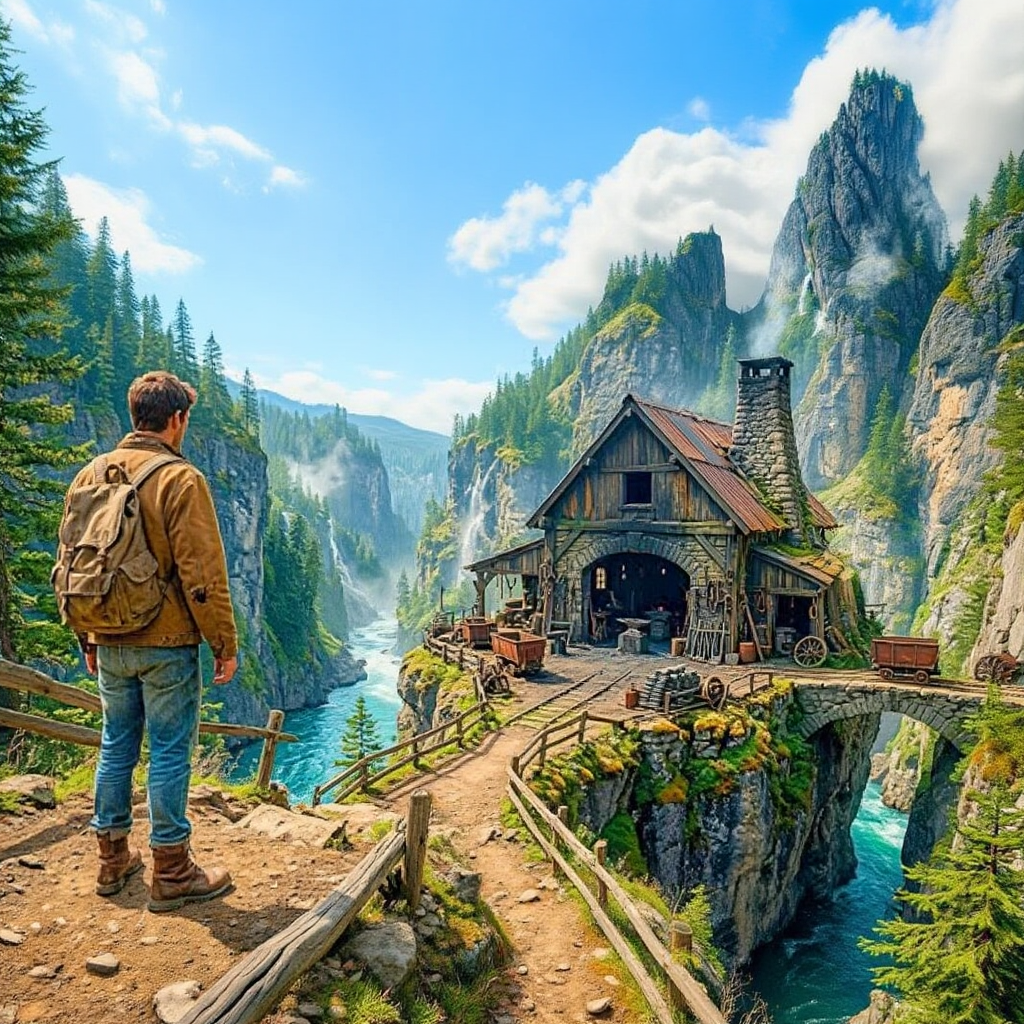
A workshop.
At first, I thought I was hallucinating.
The building clung to a cliffside above a turquoise river.
Wood.
Stone.
Smoke rising from a chimney.
Mining carts.
Rails.
A bridge.
And inside the wide archway…
Fire.
Real fire.
I stood frozen.
My father had told me stories as a boy.
About old mountain smiths.
Men who disappeared into the Rockies.
Building secret forges where no banker, no sheriff, and no widow could touch them.
I had laughed.
Now…
I was staring at one.
The bridge groaned under my weight.
Wind whipped snow across the planks.
One wrong step—
And I’d be dead.
But something deeper than fear pulled me forward.
Maybe desperation.
Maybe destiny.
Maybe my father.
When I reached the far side…
The workshop door creaked open by itself.
Heat spilled into the cold.
And I stepped inside.
I stopped breathing.
The place was enormous.
Stone walls.
Iron beams.
Bellows.
Coal bins.
Anvils.
Water troughs.
Racks of tools older than the Civil War.
And in the center…
A forge.
Still burning.
But no one was there.
“Hello?”
Only echoes.
I walked deeper.
Then I saw the note.
Pinned to the anvil.
In faded ink.
If you found this… you were meant to.
My hands trembled.
Below that:
A forge is never worthless.
My throat tightened.
I knew that handwriting.
I knew every curve.
Every stroke.
My father.
I sank onto a wooden stool.
Unable to breathe.
Unable to think.
How?
Why?
Then I noticed a leather journal beside the note.
I opened it.
And everything changed.
My father hadn’t been poor.
He hadn’t been careless.
And he certainly hadn’t been naïve.
For twenty years…
He had secretly invested in abandoned silver claims throughout the mountains.
Claims everyone else believed were empty.
But according to his journals…
They weren’t.
They were rich.
In cobalt.
Nickel.
And rare earth metals.
Minerals worth fortunes.
He had built this forge as a hidden base.
A sanctuary.
And he had hidden it from everyone.
Including Ruth.
Especially Ruth.
Because in the journal…
I found her name.
Repeated.
Over.
And over.
And over.
Ruth is asking too many questions.
She wants access to the accounts.
If anything happens to me, Caleb must find the forge.
He’ll know what to do.
My vision blurred.
My father had known.
He’d known something might happen.
And he’d left this…
For me.
Not the ranch.
Not the land.
Not the house.
Something far greater.
Freedom.
For the next six months…
I disappeared.
Red Creek assumed I’d died.
Some thought wolves got me.
Some thought snow.
Some thought whiskey.
Ruth told everyone she’d “done her best.”
And the town believed her.
Meanwhile…
I worked.
Morning.
Noon.
Night.
I repaired ancient mining machinery.
Reopened tunnels.
Surveyed claims.
Smelted ore.
Rebuilt rails.
Sharpened tools.
And for the first time in my life…
Everything I made belonged to me.
By spring…
The first buyers arrived.
Engineers from Denver.
Rail men from Utah.
Investors from Chicago.
They crossed that stone bridge.
Looked around.
And stared in disbelief.
“Who owns this place?”
I smiled.
And placed the deed on the table.
Caleb Whitmore.
Sole proprietor.
Word spread faster than wildfire.
Within months…
My forge employed thirty men.
Then fifty.
Then a hundred.
Families moved into the valley.
Cabins rose beside streams.
Schools opened.
Roads expanded.
Red Creek stopped being a dying mountain town.
And became a boomtown.
Because of steel.
Because of stone.
Because one “worthless” blacksmith refused to quit.
Then one afternoon…
A carriage arrived.
Black lacquer.
Silver trim.
I knew who it was before the wheels stopped.
Ruth stepped out.
Her dress looked smaller somehow.
Her confidence thinner.
She walked into my forge.
Looked around.
And for the first time in her life…
She was speechless.
Finally, she whispered:
“Caleb…”
I kept hammering.
CLANG.
CLANG.
CLANG.
She swallowed.
“I didn’t know.”
I plunged the steel into water.
Steam rose.
I turned toward her.
“No.”
I said calmly.
“You never cared enough to ask.”
Her eyes glistened.
“The ranch…”
She hesitated.
“It’s bankrupt.”
I waited.
She looked at the floor.
“They’re taking everything.”
I studied her face.
The woman who had thrown me into winter.
Who had called my father’s craft worthless.
Who had tried to erase me.
Now standing in my firelight…
Looking small.
Human.
Afraid.
She whispered:
“I need help.”
Silence filled the forge.
Men stopped working.
Even the fire seemed to listen.
Finally…
I smiled.
And pointed to the broom in the corner.
Ruth blinked.
“What?”
I handed her leather gloves.
“In this shop…”
I said.
“Everyone earns their place.”
She stared at me.
Then at the gloves.
Then slowly…
For the first time in her life…
She took them.
And somewhere beyond the mountains…
My father, I hoped…
Was smiling.
Because steel remembered.
And so did I.