
STORY
By the time Silas Mercer laid the first stone across the roof, nearly everyone who passed his property had an opinion.
By the time the roof was five feet thick, they had decided he had lost his mind.
Silas didn’t argue.
He simply climbed down from the ladder, brushed the stone dust from his beard, and looked at the low cabin disappearing into the earth.
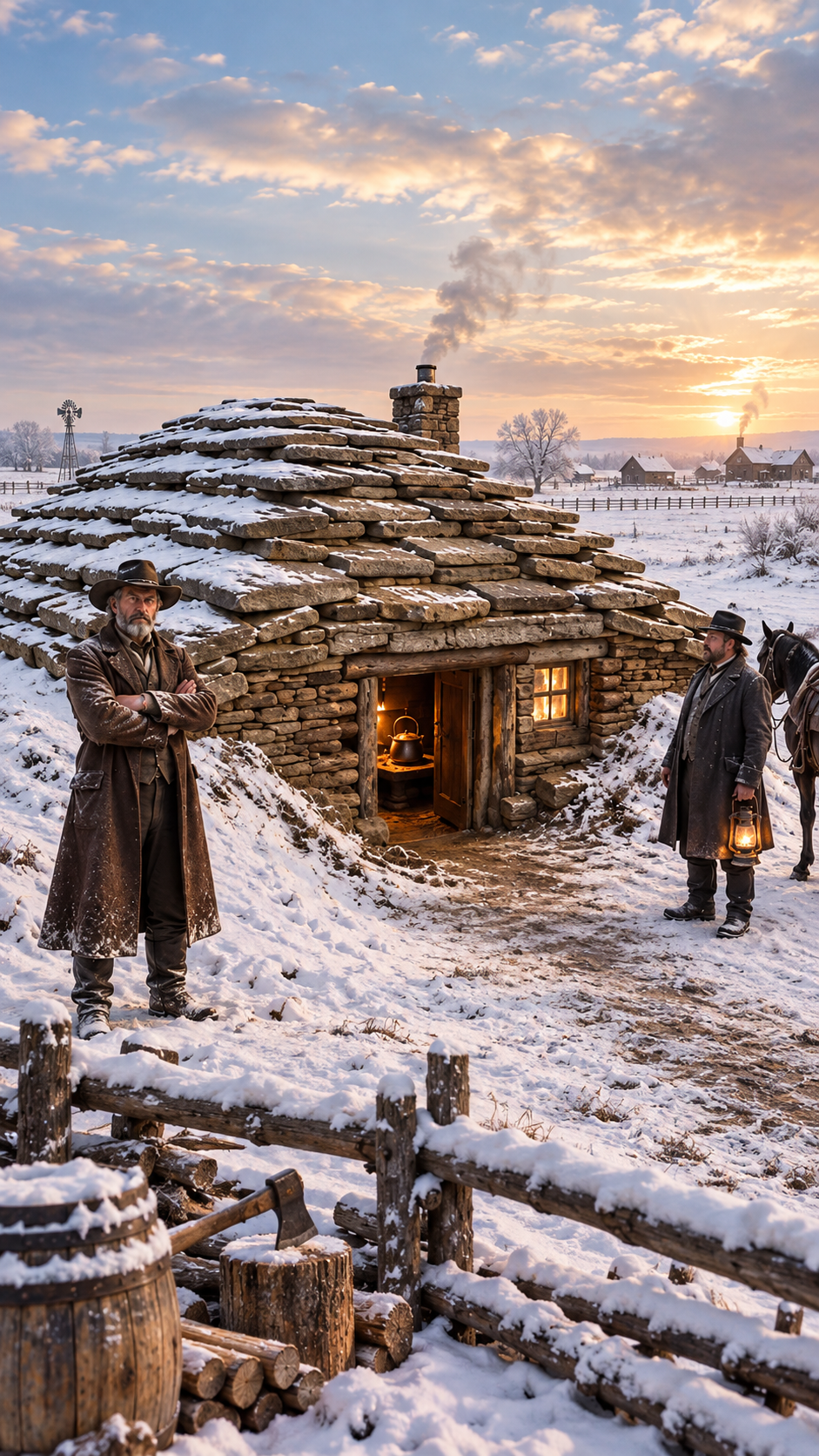
Only the front wall stood fully exposed. The back and sides had been dug into a gentle rise, then packed with soil. Above them sat layer after layer of flat fieldstone, fitted so tightly that snow could scarcely find a crack.
His younger brother, Nathan, stared at it from beside his horse.
“That’s not a roof,” Nathan said. “That’s a mountain.”
“Close enough.”
“You know what five feet of stone weighs?”
Silas glanced upward. “Enough that the wind won’t take it.”
Nathan laughed.
Silas didn’t.
It was late autumn, and something about the season had troubled him for weeks.
The geese had left early.
The rabbits had grown unusually thick coats.
And three mornings in a row, Silas had found ice along the creek before anyone in town thought seriously about winter.
His father had taught him to notice such things.
“Weather gives warnings,” the old man used to say. “Most folks just don’t like what the warnings cost them.”
So Silas had spent nearly everything he had.
He dug the cabin three feet into the hillside. He reinforced the ceiling with thick oak beams. Above those came timber, packed clay, another timber layer, and finally tons of flat stone.
Nathan watched all of it.
“Soil would be cheaper,” he said.
“Stone holds heat.”
“Stone also crushes men.”
“That’s why I used oak underneath.”
Nathan shook his head. “Clara must be thrilled.”
From the doorway, Silas’s wife appeared with flour on her hands.
“I’ve stopped asking questions,” Clara said.
Silas almost smiled.
Behind her, their nine-year-old daughter, Elsie, peeked outside.
“Papa says we’ll be warm.”
Nathan winked at her.
“Your papa also thinks he’s a badger.”
That made Elsie giggle.
Silas went back to work.
By December, people had begun calling the place Mercer’s Burrow.
The name reached Silas through Amos Bell, who owned the largest farmhouse nearby.
Amos arrived one afternoon wearing a long brown coat and an amused expression.
“Mercer!”
Silas was splitting wood.
Amos pointed toward the cabin.
“How much stone did you put up there?”
“About five feet at the thickest part.”
Amos whistled.
“Building a house or your own tomb?”
Silas drove the axe into another log.
“Depends on the winter.”
Amos laughed loudly.
“You know I built my place with ordinary timber? Been standing seventeen years.”
“I know.”
“Two fireplaces.”
“I know.”
“Proper windows.”
Silas looked toward his tiny glass panes.
“I’ve got windows.”
“You’ve got gun ports.”
Even Silas laughed at that.
But Amos wasn’t finished.
“You ought to bring Clara and Elsie to my place if the weather gets rough. No shame in admitting an experiment didn’t work.”
Silas rested both hands on the axe handle.
“And if your place gets cold?”
Amos grinned.
“Then I’ll come sleep under your mountain.”
Neither man knew how soon that joke would become a promise.
The first real storm arrived three days before Christmas.
At first, it seemed ordinary.
Snow began before dawn.
By noon, the road vanished.
By evening, the wind had strengthened enough to shake the barn doors.
Silas stood outside watching clouds swallow the western horizon.
Clara came beside him.
“You were expecting this.”
“Not this early.”
“How bad?”
Silas watched the horses turn their backs to the wind.
“Bad.”
That night the temperature fell below zero.
The next morning it dropped further.
The morning after that, Nathan arrived on horseback with frost crusted across his beard.
Silas opened the door.
“What are you doing out in this?”
“Checking on you.”
Nathan stepped inside—
and stopped.
The cabin was warm.
Not merely tolerable.
Warm.
Elsie sat barefoot near the table drawing pictures on scraps of paper.
Clara was kneading bread with her sleeves rolled above her elbows.
A modest fire burned in the small iron stove.
Nathan slowly removed his gloves.
“How much wood are you burning?”
Silas nodded toward the stove.
“That.”
“Since morning?”
“Since last night.”
Nathan looked around.
“That’s impossible.”
“Touch the wall.”
Nathan placed his palm against the interior stone.
It was faintly warm.
Silas explained.
“The earth keeps the sides from losing heat. The roof stores what rises. Once all that stone warms, it gives the heat back slowly.”
Nathan stared upward.
“So your ridiculous roof works.”
“Looks that way.”
A sudden gust roared outside.
Nathan’s smile disappeared.
“I came for another reason.”
Silas waited.
“Amos Bell’s north wall is freezing through.”
By evening, the temperature had fallen to twenty-eight below.
The wind made it worse.
Silas brought extra wood inside.
Then came the pounding.
Three heavy blows against the door.
Silas opened it.
Amos nearly fell across the threshold.
His eyebrows were white with frost.
“Fireplace won’t heat the bedrooms,” he gasped. “My wife’s keeping the children in the kitchen.”
Silas grabbed his coat.
“How many?”
“Five of us.”
“We’ll bring them here.”
Amos stared at him.
“Here?”
“Unless you’d rather discuss architecture.”
Amos said nothing.
Within an hour, Silas and Nathan had brought Amos’s family through the storm.
The cabin became crowded.
Children slept beneath tables and along walls. Clara spread blankets everywhere she could.
But the temperature inside remained steady.
Then another neighbor arrived.
Then another.
A chimney had cracked.
A stove had failed.
A farmhouse window had blown inward.
By midnight, fourteen people were packed inside Mercer’s Burrow.
Outside, the temperature reached thirty-six below.
The wind screamed across the prairie.
Yet the little stove glowed quietly.
Amos stood beneath the massive roof and stared at it.
“I laughed at this thing.”
Silas handed him coffee.
“I remember.”
“You going to make me apologize?”
“No.”
“Why not?”
“Because you’ll be helping me bring firewood in the morning.”
Amos gave a tired laugh.
Then something struck the roof.
BOOM.
Everyone froze.
Elsie ran to her father.
“What was that?”
Silas listened.
Another tremendous impact followed.
BOOM.
Nathan stood.
“Tree?”
“No trees close enough.”
Silas opened the door a crack.
Wind hurled snow inside.
He forced it shut.
“Drift collapsing off the ridge.”
Amos looked upward.
“Can the roof hold it?”
Silas didn’t answer immediately.
That frightened everyone more than if he had said no.
Finally he replied.
“That’s what we’re about to find out.”
They waited through the longest night any of them could remember.
The temperature eventually reached forty below.
The wind buried the cabin so completely that by dawn only part of the chimney remained visible above the drift.
But something unexpected happened.
The deeper the snow became, the warmer the cabin seemed.
Nathan noticed first.
“Silas.”
“What?”
“The stove’s almost out.”
Everyone looked.
Only a handful of coals remained.
Yet nobody was shivering.
Silas touched the wall.
Warm.
Then the ceiling beam.
Dry.
Stable.
The earth, stone, and now several feet of snow had wrapped the cabin in layers of insulation.
Amos stared at Silas.
“You planned the snow too?”
“No.”
For the first time in two days, Silas grinned.
“But I’ll take it.”
They laughed.
Not because anything was funny.
Because they were alive.
The storm lasted three more days.
They rationed food.
Clara stretched one pot of stew with beans, potatoes, and barley until it fed everyone.
Children told stories.
Men took turns clearing the chimney.
At night, people slept shoulder to shoulder.
And each morning, Silas checked the roof supports.
Not one had shifted.
On the fourth morning, silence woke him.
No wind.
Silas climbed through a tunnel they had dug toward the doorway and pushed through the snow.
Sunlight blinded him.
The prairie was transformed.
Fences had vanished.
Barns looked like small islands.
Several distant chimneys were gone entirely.
Then someone emerged behind him.
Amos.
For a long moment, the two men said nothing.
Finally Amos looked back at the squat stone roof protruding from the snow.
“Five feet.”
Silas nodded.
“Five feet.”
“I called you crazy.”
“You did.”
“I believe I called it a tomb.”
“Twice.”
Amos rubbed his beard.
“Turns out you built the opposite.”
Silas looked toward the doorway where Clara and Elsie were emerging.
“A house?”
Amos shook his head.
“A refuge.”
Spring revealed how much the winter had taken.
Three barns collapsed.
Two houses required major rebuilding.
Livestock losses were worse.
But every person who had sheltered inside Mercer’s Burrow survived.
And something changed afterward.
People stopped laughing.
Instead, they started measuring.
Silas would wake to find neighbors studying the angle of his roof.
They asked about the depth of the foundation.
The thickness of the beams.
The packed clay.
The stone.
Even Amos came carrying a notebook.
Silas raised an eyebrow.
“Building yourself a tomb?”
Amos sighed.
“I’m never going to hear the end of that, am I?”
“No.”
Amos opened the notebook.
“Good. Now tell me about the roof.”
By autumn, three new houses had been partially dug into hillsides.
The next year there were seven.
Nobody copied Silas exactly. Some used sod instead of stone. Others built thicker earth banks around conventional cabins.
But everyone had learned the same lesson.
Sometimes the strangest-looking house in summer was the house you wanted when winter came.
Years later, travelers occasionally stopped beside Silas’s property.
They would stare at the low stone structure and ask why anyone would put five feet of rock over a perfectly good cabin.
By then Elsie was old enough to answer.
She would smile and point toward an old mark carved beside the doorway.
−40°
“Because one winter,” she would say, “everyone else thought my father had built his family a stone tomb.”
Then she would open the heavy wooden door, revealing the warm room beyond.
“But when the cold came, it turned out he’d built the place that kept everybody alive.”
And Silas, usually sitting beside the stove, would hear her tell it.
He never corrected the story.
He only smiled.
Because the roof had never really been about proving anyone wrong.
It was about understanding something his father had taught him long before:
Winter didn’t care whether a man looked foolish while preparing for it.
It only cared whether he was ready.