
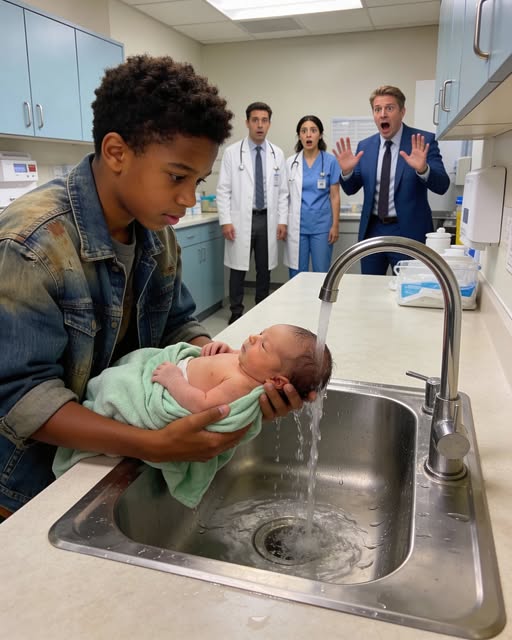
18 doctors couldn’t save the billionaire’s son, until the poor boy did the impossible.”
The Santillán Residence had never seen such chaos.
Eighteen of the world’s most decorated pediatricians crowded a room they called “the nursery.” Their white coats blended into a desperate whirlwind under the glow of the chandeliers. Heart monitors shrieked. Ventilators hissed. A team from the National Institute of Pediatrics argued with specialists flown in from Barcelona, Geneva, and Houston. An international award-winner in pediatric immunology wiped sweat from his brow and whispered what no one wanted to hear:
—“We’re losing him.”
Baby Julián Santillán, heir to a forty-billion-dollar empire, was dying. Not even fifty thousand dollars an hour in medical genius could explain why his tiny body had turned the color of twilight: blue lips, bluish fingers, and a mottled rash growing over his chest like an accusation.
Every test came back “inconclusive.” Every treatment failed.
And behind the side window, pressing his forehead against the glass that was never cleaned for someone like him, was León García, fourteen years old—the son of the woman who did the night cleaning. He wore a coat that was too thin, the kind that leaves you cold on the inside no matter how tight you pull the fabric, and sneakers held together by faith and duct tape.
In that house, he was a shadow. A boy who walked pressed against the walls, who learned not to make a sound before he learned equations. A boy who noticed everything because no one noticed him.
That night, León wasn’t looking at the doctors or the machines.
He was looking at a flowerpot on the windowsill.
It had arrived three days ago, wrapped in a golden ribbon with a card in elegant handwriting. A beautiful plant with dark green, shiny leaves, as if varnished by an oily substance. It had bell-shaped flowers—pale, almost white with purple veins, like bruises on porcelain.
León swallowed hard. Because he knew exactly what it was.
His grandmother, Doña Micaela—a neighborhood healer in Ecatepec who had helped half the community with herbs, poultices, and a gaze that saw beyond the pain—had taught him to recognize that leaf pattern before he even knew how to read. She repeated it to him like a prayer:
—“Beauty bites too, my boy. Learn to distinguish what heals from what kills.”
That plant had a pretty name for those who didn’t know: Foxglove. To medicine: Digitalis. To Doña Micaela: “the one that lowers the heart until it turns off.”
León remembered something else: the yellowish, sticky residue it left on the fingers. The same one he had seen on the gloves of the gardener, Don Rogelio, when he placed the pot by the window… and then, without washing properly, wiped the bars of the crib “so it would look pretty in the photos.”
The geniuses in that room had walked past that pot seventeen times without seeing it.
León felt his hands tremble. He looked at the hallway. He looked at the guard making rounds. He looked, through another door, at the profile of his mother, Graciela, in the service kitchen—her face tight with fear and years of telling herself the same thing:
—“Stay invisible, León. Stay safe. Don’t give them a reason to throw us out.”
León thought about what would happen if he was wrong. And then he thought about what would happen if he was right… and did nothing.
He clutched his coat against his chest. And he ran.
He burst into the nursery. Eighteen heads turned. Eighteen faces shifted from surprise to confusion and then to fury.
—“Who is this kid?” —“Security!” —“Get him out of here!”
The room smelled of antiseptic, fear… and something sweet and strange, like a rotting flower. León felt his throat burn. His eyes went straight to the crib: Julián, so small, so pale, with blue-gray skin.
—“THE PLANT!” León shouted, his voice breaking. “It’s the plant in the window! It’s digitalis, it’s poison!”
Guards grabbed his shoulders. They lifted him off the ground. Arturo Santillán, the owner of it all, approached in a rage.
—“Who are you?” he spat. “Get him out right now!”
León kicked desperately.
—“My grandmother taught me! That plant releases toxic oil! It sticks to hands, to everything! The baby is breathing it!”
One of the doctors looked at him with contempt. “This is absurd. He’s delusional.”
And then León felt something snap inside. He had spent fourteen years swallowing his voice. Being invisible. And now they were dragging him out while a baby died because no one would listen to the cleaning lady’s son.
In a move of pure survival, he slipped away from the guard’s grip. He lunged for the crib, scooped up the tiny baby, and ran into the adjoining bathroom, locking the door behind him.
Inside, he saw a small jar on the marble vanity: Activated charcoal.
—“Charcoal binds the poison, my boy. It grabs it and takes it out,”—his grandmother’s voice echoed in his mind.
He mixed a bit with water and gave it to the baby just as the door exploded open. Guards tackled him to the floor, pinning him down. Arturo snatched his son, looking at the black residue on the baby’s lips.
—“What did you give him?!” a doctor roared, grabbing León by the collar.
—“Activated charcoal,” León gasped, his face pressed against the marble. “It absorbs toxins. But you have to remove the plant! Test the plant!”
There was a strange silence. Dr. Nakamura, a specialist standing by the monitors, looked up, her face tightening.
—“His color… it’s changing.”
Arturo looked at his son. Elena let out a moan.
—“Oxygen levels rising. Heart rate stabilizing…” the doctor said, incredulous. “He’s responding.”
The doctors stood still as if the world had been turned off.
For three seconds, no one moved.
Then the room exploded—not with shouting this time, but with motion. Doctors rushed back to the monitors. A nurse ripped off her gloves and reached for new ones. Someone shouted orders in Spanish, another in English, another in Japanese.
—“Get toxicology on the line. Now.”
—“Remove the plant. Seal it. Gloves, masks—no one touch it barehanded.”
—“Prepare digoxin antibody fragments. If this is digitalis poisoning, we’re already late.”
The foxglove pot was yanked from the windowsill with surgical care, sealed inside a biohazard bag like a crime scene exhibit. A young resident stared at it, horrified.
—“We walked past that thing all night…”
León lay on the cold marble floor, wrists pinned, chest heaving. He didn’t resist anymore. His job was done. Or so he thought.
—“Wait.”
The voice wasn’t loud, but it carried absolute authority.
Dr. Nakamura stood by the monitor, her eyes locked on the rising numbers as if afraid they might disappear if she blinked.
—“Don’t take him away yet.”
The guards hesitated.
—“What?” Arturo Santillán snapped. His suit was rumpled now, billionaire composure stripped bare by terror. “He kidnapped my son!”
—“He may have saved him,” Dr. Nakamura replied, without looking up.
A nurse leaned over the crib, disbelief etched across her face. —“Capillary refill is improving. Cyanosis is fading.”
—“Blood pressure is coming up,” another doctor whispered. “This shouldn’t be happening.”
Arturo staggered backward, gripping the edge of the crib as if it were the only solid thing left in the universe. His wife, Elena, clutched his arm, tears streaking her face.
—“Julián…” she sobbed. “My baby…”
León slowly pushed himself up onto his elbows. No one stopped him now.
—“The oil,” he said hoarsely. “It sticks to skin. To metal. To fabric. If the gardener touched the crib bars after handling the plant… the baby absorbed it. Babies don’t need much.”
Eighteen doctors turned to stare at him.
A senior toxicologist cleared his throat. —“Digitalis poisoning in neonates presents with bradycardia, cyanosis, rash… inconclusive labs early on.” He looked around the room, pale. “It fits.”
Silence fell again—but this time it was different. Heavy. Ashamed.
Arturo turned toward León, his voice breaking in a way that money could not repair. —“Who taught you this?”
León wiped his nose with his sleeve. —“My grandmother. She helps people in our neighborhood. With plants. With… paying attention.”
Elena dropped to her knees in front of León, heedless of the marble floor or the watching staff. She grabbed his hands—hands that had been scrubbing toilets an hour earlier.
—“You saved my son,” she whispered. “You saved my son.”
León froze. No one had ever said that to him before.
The antidote arrived within minutes. Julián was transferred to intensive care, pink creeping back into his cheeks like dawn returning to the sky. The monitors stabilized. The room, once frantic, felt like it had survived a storm.
Only then did the weight of what had almost happened truly sink in.
Security released León. No one ordered them to. They just… did.
Dr. Nakamura knelt in front of him. —“You acted faster than eighteen specialists,” she said quietly. “Do you understand how extraordinary that is?”
León shook his head. —“I just didn’t want the baby to die.”
Arturo stood there, staring at the boy as if seeing him for the first time—not as a shadow, not as staff, not as an inconvenience, but as a human being who had walked into hell and come back carrying his child.
—“What is your name?” he asked.
—“León García, sir.”
Arturo nodded slowly. —“León,” he repeated, tasting the word. “Lion.”
The investigation was swift. The plant had been a gift from a foreign associate—beautiful, expensive, and deadly. No one had thought to question it. Don Rogelio, devastated, confessed immediately. He had never known.
The headlines the next morning were brutal:
“Billionaire Heir Poisoned by Decorative Plant — Saved by Cleaner’s Son.”
But León never read them.
That afternoon, Arturo Santillán visited the service quarters where León and his mother lived—two small rooms behind the estate, walls thin as apologies. Graciela trembled when she opened the door, ready to be fired, evicted, erased.
Instead, Arturo bowed his head.
—“Your son saved my family,” he said. “I can never repay that.”
He offered to pay. To relocate them. To give León anything he wanted.
León listened politely, then shook his head.
—“My grandma,” he said. “She needs medicine. And… I want to study. Medicine. So I don’t have to guess next time.”
Arturo’s eyes filled.
Years later, Dr. León García would stand in a children’s hospital, his white coat worn thin at the elbows. On his desk would sit a single photograph: a baby with bright eyes, laughing, and beside him, a potted plant—plastic, harmless.
When asked why he became a doctor, León would smile and say:
—“Because sometimes the impossible isn’t a miracle. It’s just someone poor enough to notice what everyone else walks past.”